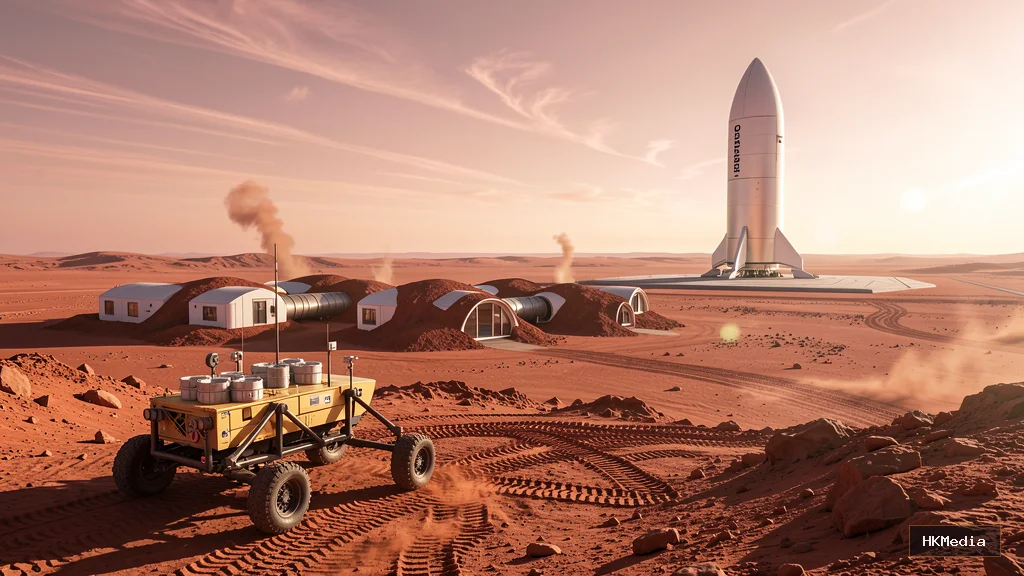
THE VISION — INTERPLANETARY FUTURES
The question is no longer if humans will reach Mars, but when they will stay. Every launch window—roughly every 26 months—brings new hardware, new data, and a sharper picture of what a permanent presence requires. NASA's Perseverance rover is sealing rock cores for a future sample-return mission. SpaceX is iterating Starship toward orbital refueling, the key that unlocks the Earth-Mars transfer. China, the UAE, Europe, and a growing commercial sector are all writing their own chapters.
Yet the distance between "flags and footprints" and "families and factories" is measured not in kilometers but in solved engineering problems: radiation shielding that doesn't cost a fortune, life-support loops that recycle 98% of water and air indefinitely, in-situ resource utilization (ISRU) that turns carbon dioxide and ice into methane, oxygen, steel, and food. This article surveys where each piece stands in early 2025, what the next launch windows hold, and why the first Martians will be engineers, not tourists.
The Robotic Vanguard: What We're Learning Right Now

NASA's February 2025 Mars Report underscores a quiet revolution: Perseverance has now cached multiple sample tubes containing material from Jezero Crater's ancient river delta—rocks that may hold biosignatures from a time when Mars was warm and wet [1]. The rover's autonomous driving software, AutoNav, lets it cover hundreds of meters per sol without hand-holding from Earth, a capability any future human base will depend on for scouting and logistics.
Meanwhile, Curiosity continues its climb up Mount Sharp, documenting the transition from habitable lakes to the arid world we see today. The Ingenuity helicopter—originally a 30-day tech demo—has flown over 70 times, proving aerial reconnaissance works in Mars' thin atmosphere. Its successors, larger and more capable, are already on the drawing board for the Mars Sample Return campaign.
That campaign, a joint NASA-ESA effort, remains the most complex robotic mission ever attempted: a Sample Retrieval Lander, a Mars Ascent Vehicle (the first rocket to launch from another planet), two Ingenuity-class fetch helicopters, and an Earth Return Orbiter. The architecture has been redesigned to reduce cost and risk, but the fundamental challenge—getting 30-odd sealed tubes off Mars and into terrestrial labs—remains a pacing item for the 2030s.
Starship: The Heavy-Lift Key That Changes the Math

Every Mars architecture since von Braun has foundered on the same equation: the mass you need on the surface divided by the mass you can throw out of Earth's gravity well. SpaceX's Starship, now in integrated flight testing, aims to break that ratio. A fully reusable Starship-Super Heavy stack could deliver 100–150 metric tons to low Earth orbit; with orbital refueling, the same ship can carry that payload all the way to Mars' surface.
Elon Musk's May 2025 update reaffirmed a target: uncrewed Starships to Mars in the late-2026 launch window, carrying cargo, ISRU demonstrators, and perhaps Tesla Optimus robots to begin site preparation. The timeline is aggressive—SpaceX has a history of moving dates right—but the hardware progress is tangible. Flight 4 achieved a controlled splashdown of both stages; Flight 5 aims for tower catch of the Super Heavy booster. Orbital propellant transfer, the critical enabler, is slated for demonstration in 2025 under a NASA Tipping Point contract.
If Starship reaches even half its design payload, the cost per kilogram to Mars surface drops by two orders of magnitude compared to the Sky Crane that delivered Curiosity and Perseverance. That economic shift is what makes a base, not just a visit, conceivable.
"The first person to live on Mars has already been born. The first person to die on Mars will be an engineer who stayed too long fixing the oxygen scrubber."
Hesham Kholef
The Hard Problems That Robots Don't Solve
Landing mass is necessary but not sufficient. A permanent settlement demands solutions to problems that no rover faces:
Radiation
Mars lacks a magnetosphere and has only 1% of Earth's atmospheric column. Galactic cosmic rays (GCRs) and solar particle events (SPEs) deliver ~0.67 sieverts per year on the surface—roughly 150× Earth's background. A 500-day surface stay approaches NASA's career radiation limits for astronauts. Shielding options—regolith berms, water tanks, lava tubes, or active magnetic fields—all add mass and complexity. The first habitats will likely be buried or built inside natural cavities.
Closed-Loop Life Support
The ISS recycles ~90% of water and ~50% of oxygen. A Mars base needs >98% for both, with zero resupply for years. CO2 reduction to methane and oxygen (Sabatier/RWGS) works in the lab but must run continuously, autonomously, with dust-fouled intakes and no spare parts from Earth. Food production adds biological instability: crop failures, pathogen outbreaks, nutrient cycling. The Biosphere 2 experiment showed how hard this is even with Earth's gravity and atmosphere.
In-Situ Resource Utilization (ISRU)
Making propellant from Martian CO2 and water ice is the linchpin of return-trip economics. NASA's MOXIE experiment on Perseverance produced oxygen at ~6 g/hr—a proof of concept. A human mission needs ~30 metric tons of oxygen per launch window, requiring a system 100,000× larger that survives dust storms, thermal cycling, and years of unattended operation. Water extraction from regolith or subsurface ice is equally unproven at scale.
Gravity and Health
Mars' 0.38 g may mitigate some microgravity effects (bone loss, muscle atrophy, fluid shift), but no long-term data exist. The only way to know is to go—and the first crews are the experiment.
The gap between "landing on Mars" and "living on Mars" is not a difference of degree—it is a difference of kind. One is a transportation problem; the other is a civilization problem.
Competing Timelines: NASA, SpaceX, China, and the Rest
| Actor | Near-Term Milestone | Crewed Target | Architecture |
|---|---|---|---|
| NASA (Moon-to-Mars) | Artemis III lunar landing (2026–2027) | Late 2030s / early 2040s | Gateway → Deep Space Transport → Mars Base Camp |
| SpaceX | Uncrewed Starship Mars landing (2026 window) | 2029–2031 (aspirational) | Direct Earth-Mars with orbital refueling |
| China (CNSA) | Tianwen-3 sample return (~2028–2030) | 2033–2040 (stated goal) | Long March 9 heavy lift, nuclear thermal propulsion study |
| Blue Origin | New Glenn orbital debut (2024–2025) | 2030s (via NASA HLS / Artemis) | Blue Moon lander, lunar ISRU pathfinder |
NASA's "Moon to Mars" architecture treats the Moon as a proving ground for life support, ISRU, and deep-space operations. SpaceX bypasses the Moon, betting that Starship's payload margin makes direct Mars operations faster. China's timeline is state-directed, opaque, but increasingly credible after Tianwen-1's orbiter/rover success. The UAE's Hope orbiter and Japan's MMX mission (Phobos sample return) round out a multipolar exploration landscape.
Crucially, these are not mutually exclusive. NASA has already contracted Starship as the Human Landing System for Artemis III. A future where NASA astronauts ride Starship to Mars, supported by Blue Origin lunar infrastructure and Chinese relay satellites, is more plausible than any single-agency monopoly.
The Economics of a Self-Sustaining City
Elon Musk has described the threshold for a self-sustaining Mars city as roughly one million tons of cargo delivered—a figure that implies thousands of Starship flights over decades. The early economy will be entirely import-dependent: every microchip, medical supply, and specialized alloy comes from Earth. Export value—scientific data, intellectual property, perhaps rare isotopes—will not balance the books for generations.
This raises a question rarely addressed in roadmaps: who pays? Apollo was a Cold War prestige project. Artemis is framed as sustained exploration with commercial partnerships. SpaceX's Mars ambition is funded by Starlink revenue and investor capital. A permanent settlement eventually needs a legal framework for property rights, resource extraction, and governance—none of which exist under the 1967 Outer Space Treaty.
The first Martians will be employees: of NASA, of SpaceX, of a future international consortium. Their labor builds the infrastructure that later enables settlers. The transition from "outpost" to "town" happens when the cost of importing a kilogram of food exceeds the cost of growing it locally—and that crossover point is decades away.
Where We Go Next: The Next Three Launch Windows
- 2026 window (Nov 2026 – Jan 2027): SpaceX attempts first uncrewed Starship landings. NASA/ESA Mars Sample Return design finalization. China launches Tianwen-3 elements.
- 2028/2029 window: Multiple Starships deliver ISRU pilot plants, habitat modules, power systems (solar arrays + small fission). NASA Artemis crewed lunar ops provide deep-space ops data. First crewed Starship Mars flyby or orbit possible if SpaceX timeline holds.
- 2031 window: Best-case first crewed landing (SpaceX) or orbital mission (NASA). Initial surface stay: 30–500 days depending on architecture. Focus: validate ISRU, life support, radiation mitigation, human factors in partial gravity.
Each window is a ratchet. Failure in 2026 pushes cargo to 2028; failure of life-support validation in 2031 pushes crewed stays to 2033. The timeline is not a schedule—it is a dependency graph.
Conclusion: The Longest Expedition
Will mankind live on Mars? Yes—if we choose to. No physical law forbids it. The chemistry of the atmosphere and soil provides carbon, oxygen, water, and metals. The sunlight, though half Earth's intensity, is sufficient for power and agriculture. The gravity is likely enough to sustain human biology long-term.
But "choosing to" means sustaining a multi-decadal, multi-trillion-dollar effort across political cycles, economic crises, and inevitable tragedies. It means solving closed-loop ecology better than we've managed on Earth. It means building a legal and ethical framework for a second human world before the first child is born there.
The rovers are already there. The rockets are bending metal in Boca Chica and New Orleans. The next launch window is always the most important one. The first Martians are not astronauts in the old sense—they are infrastructure builders, and their work has already begun.
Comments (0)