Ancient History · Historical Narrative
A civilization's greatest treasure was not gold or power, but the accumulated wisdom of humanity. For centuries, the Library of Alexandria pursued a dream that may never be realized again: to gather the world's knowledge in one place.

There are places whose destruction can be measured in broken walls, fallen columns, and ashes scattered by the wind. And then there are places whose loss reaches far beyond their physical remains.
The Library of Alexandria belongs to the second kind. Its story is not simply about a building that disappeared. It is about the countless ideas, discoveries, arguments, poems, and histories that may once have existed within its walls—and about the terrible uncertainty surrounding the fate of so much ancient knowledge.
Founded in the early Hellenistic period, after Alexander the Great's conquests reshaped the eastern Mediterranean, Alexandria became one of the ancient world's most extraordinary intellectual centers. Under the Ptolemaic dynasty, the city attracted scholars, poets, physicians, mathematicians, and philosophers from across the Mediterranean and beyond.
Their ambition was astonishing: to collect, study, preserve, and compare the writings of the known world. What began as a royal pursuit became a lasting symbol of humanity's desire to understand itself.
Yet the library's history remains partly hidden. Ancient accounts disagree, surviving evidence is fragmentary, and no single, universally accepted catastrophe explains the disappearance of its collections.
To understand what was lost, we must first imagine what Alexandria once dared to build.
I. The City Built to Gather the World
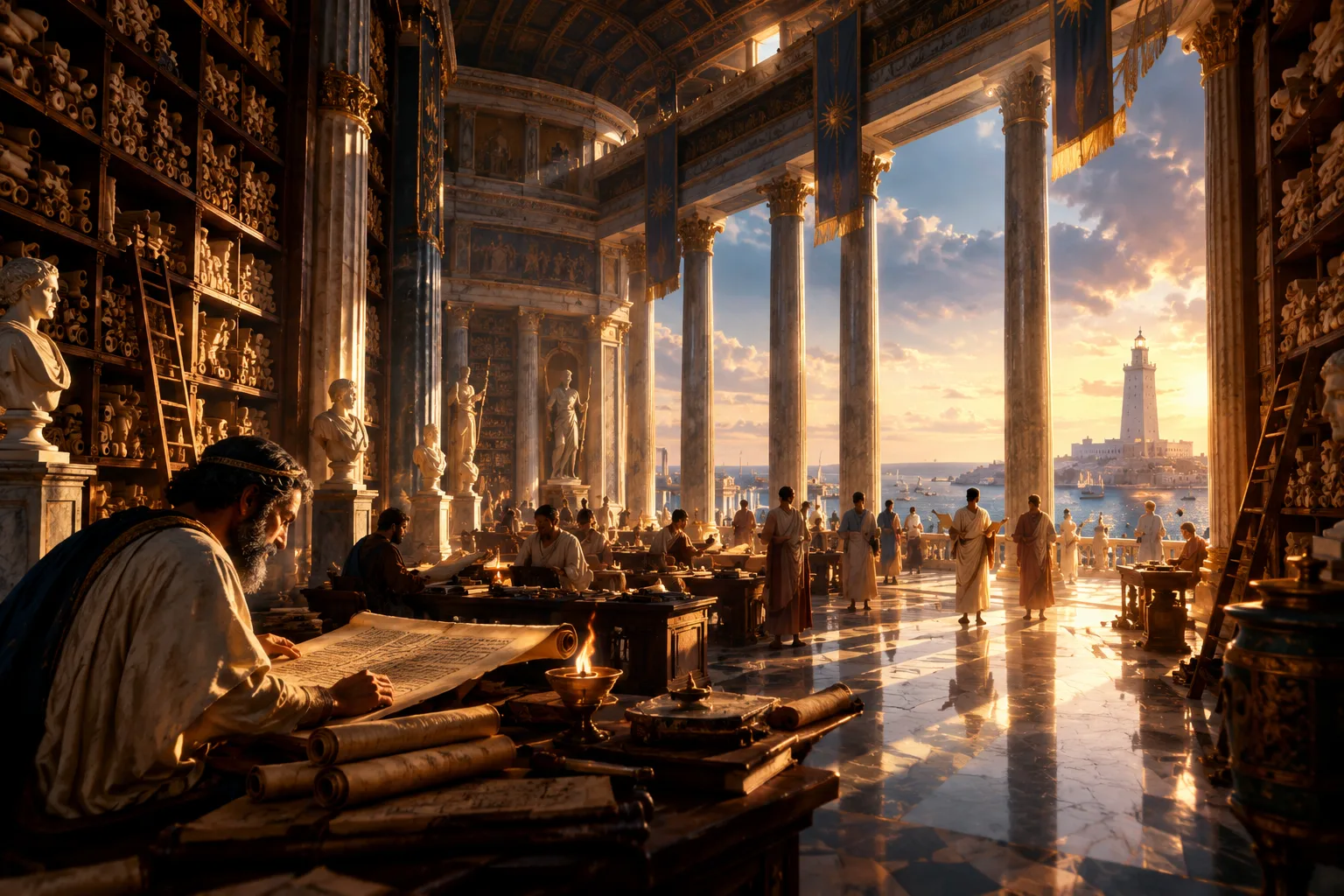
Imagine Alexandria during the reign of the early Ptolemies. The Mediterranean glitters beyond its harbors. Merchant ships arrive bearing timber, metals, spices, textiles, and stories from distant shores. Greek is heard in public spaces, while Egyptian traditions continue to shape the rhythms of the city.
Founded by Alexander the Great in 331 BCE, Alexandria grew into a powerful center of commerce and royal ambition. After Alexander's death, his general Ptolemy established a dynasty in Egypt and transformed the city into a seat of political and cultural influence.
The Ptolemies understood that knowledge could be a source of prestige as powerful as armies or monuments. Scholars could strengthen a ruler's reputation, improve practical learning, and place a royal court at the center of intellectual life.
Within the royal quarter stood the Mouseion, an institution devoted to the Muses and the pursuit of learning. Associated with it was the great library, whose collections were assembled and expanded under royal patronage. The exact dates of its foundation and early development remain debated, but its importance in the Hellenistic world is unmistakable.
This was not merely a room filled with scrolls. The Mouseion brought scholars together, supported study, and encouraged the comparison of texts. It belonged to a broader intellectual ecosystem in which literature, mathematics, astronomy, medicine, and philosophy could develop through sustained investigation.
The library's ambition was almost impossible to satisfy. Every new voyage opened the possibility of another text. Every visiting scholar carried memories of another school, another tradition, another way of describing the world.
Alexandria sought to make these scattered fragments part of a shared intellectual inheritance.
A scroll could preserve the thought of a person who had died centuries earlier. A library could allow that thought to speak again.
Yet every collection, no matter how magnificent, depends on something deceptively ordinary: the continued survival of its materials and the people who care for them.

II. Inside the Kingdom of Scrolls
The image of the Library of Alexandria has grown more magnificent with every passing century. Popular imagination often pictures endless halls of towering shelves, guarded chambers, and countless scrolls containing every secret of the ancient world.
The reality was less theatrical, but perhaps even more remarkable.
Ancient Greek and Egyptian knowledge existed in different languages, formats, and intellectual traditions. Texts had to be copied by hand. Their wording could change through repeated transcription, and different versions of the same work might circulate at the same time.
Scholars in Alexandria helped develop methods for comparing manuscripts, examining language, organizing literature, and establishing more reliable texts. The poet and scholar Callimachus is associated with the Pinakes, an influential bibliographic catalog that organized literary works and their authors.
It was an early expression of a challenge that remains familiar today: before knowledge can be used, it must be found, identified, evaluated, and understood.
Imagine a scholar unrolling a papyrus manuscript. The material is delicate. The ink has darkened. A line is incomplete, and another passage differs from a copy preserved elsewhere.
The scholar studies the wording, compares the evidence, and attempts to recover what the author intended. Across generations, such work allowed ancient literature to be copied, interpreted, and passed onward.
The library's influence reached into the intellectual life of the Hellenistic world. Associated with Alexandria were figures such as the poet and scholar Callimachus, the mathematician Euclid, and the astronomer Aristarchus of Samos, although the precise institutional connections of individual thinkers vary.
Their world was not one of uninterrupted progress. Scholars argued. Ideas competed. Royal patronage could support inquiry, but it could also make intellectual life dependent on political favor.
Still, the principle was extraordinary: knowledge did not have to remain isolated in the city or culture where it first emerged. It could travel, be compared, challenged, and transformed.
A poem from one land could be read beside a history from another. Mathematical observations could be examined alongside earlier calculations. A medical text could become the starting point for further study.
The library was not the sole keeper of ancient wisdom, nor did it contain every work ever written. But it became a powerful symbol of what organized scholarship could accomplish when knowledge was treated as something worth collecting and protecting.
III. The First Shadows
No great institution exists outside history.
The Library of Alexandria flourished in a world shaped by dynastic struggles, changing alliances, military campaigns, and the shifting fortunes of the Mediterranean. Its survival depended on more than the durability of papyrus. It depended on institutions, resources, political stability, and the continued work of scholars and copyists.
One of the most famous episodes in its story occurred during the Alexandrian War in 48 BCE, when Julius Caesar became involved in the conflict surrounding Cleopatra VII and her brother Ptolemy XIII.
Ancient sources describe a fire connected with Caesar's operations in Alexandria that damaged ships and spread into parts of the city. Some accounts associate the blaze with the destruction of books or book-storage facilities.
But a crucial distinction must be made: the surviving evidence does not establish beyond doubt that the entire Great Library was destroyed in this incident. The extent of the damage, the precise locations affected, and the relationship between the fire and the library's main collection remain disputed.
Whatever was lost, the intellectual life of Alexandria did not immediately disappear. The city continued to be a center of scholarship for centuries, and its collections and institutions changed over time.
Perhaps this is the first tragedy hidden within the library's story. Even while the city endured, individual works could vanish without leaving any record of their disappearance.
A scroll might decay before it could be copied. A private collection might be scattered after its owner died. A text might survive in only one version, then disappear when that copy was damaged or discarded.
No dramatic blaze was necessary. Sometimes the loss of knowledge required nothing more than the passing of generations.
History remembers great fires because flames are visible. The quieter disappearance of a manuscript may leave nothing behind to tell us that it ever existed.

IV. A Library Without a Single Ending
The most persistent version of the story tells of one catastrophic night when the Library of Alexandria burned, its scrolls turning to ash as the world's knowledge vanished in a single act of destruction.
It is a powerful image. It is also too simple to explain the evidence we possess.
The history of Alexandria's libraries and scholarly institutions unfolded over centuries. The Great Library, associated with the royal Mouseion, was not necessarily identical to every other collection in the city. Ancient sources also refer to a collection associated with the Serapeum, a temple complex that became an important center of religious and cultural life.
These distinctions matter. Damage to one collection does not automatically establish the fate of every other collection, and the destruction of a building cannot tell us exactly which texts survived elsewhere.
Later episodes of political and religious violence further complicated the city's history. In 391 CE, amid the religious conflicts of the late Roman Empire, the Serapeum was destroyed following an imperial decree against pagan temples and a confrontation involving Christian authorities and local pagans.
The event is often described as the final burning of the Great Library. Yet the identification of the Serapeum's collection with the original royal library, and the precise fate of any books associated with the site, remain uncertain.
Another popular account blames the Arab conquest of Alexandria in the seventh century and attributes the destruction of the books to orders supposedly given by Caliph Umar. This story appears in much later sources and is widely regarded by historians as unreliable, rather than as a firmly established account of the library's end.
There may never have been one final moment that deserves to be called the destruction of the Library of Alexandria.
Its collections may have suffered different losses at different times. Institutions may have declined, been reorganized, or disappeared. Manuscripts could have been damaged, dispersed, copied elsewhere, or simply lost through the ordinary fragility of the ancient written world.
The exact sequence remains beyond complete recovery. That uncertainty is not a weakness in the history. It is part of the history itself.
V. The Books We Can Never Read
To understand the scale of the loss, it helps to consider what has survived from antiquity.
Many ancient works are known only through quotations preserved by later writers. Others survive in fragments copied onto scraps of papyrus or recovered from places where dry conditions helped preserve them. Some texts are known by title alone, their contents reduced to a brief reference in another author's work.
These fragments are like voices heard through a wall. We recognize the existence of a speaker, perhaps a few words, but not the full conversation.
Ancient Greek drama offers a striking example. Playwrights whose works once entertained audiences across the Greek-speaking world produced far more plays than have survived intact. The fragments of lost tragedies and comedies reveal the outlines of a much larger literary culture.
Similar gaps exist in philosophy, history, science, and technical writing. The writings of ancient mathematicians and natural philosophers were copied, revised, and transmitted unevenly. Some ideas survived through later authors; others are difficult or impossible to reconstruct.
It would be misleading to imagine that every missing work once sat on a shelf in Alexandria. Ancient knowledge was distributed among many libraries, archives, private collections, schools, and religious institutions. Some texts may have existed only in a handful of copies, while others circulated widely.
Yet the library's symbolic importance remains. It represents the possibility that works now lost might once have been brought together, studied beside one another, and preserved for future generations.
Imagine discovering a complete account of a forgotten voyage, written by a sailor whose observations never reached another historian. Imagine reading the unabridged arguments of a philosopher known today through a few surviving quotations. Imagine a medical treatise describing experiments that no later writer recorded.
These are possibilities, not claims about specific books that the library certainly possessed. Their power lies in reminding us how much of the ancient world remains inaccessible.
The most painful loss may not be the disappearance of a famous masterpiece. It may be the disappearance of an ordinary observation that would have changed how we understood something else.
Knowledge grows through connections. One discovery clarifies another. One argument challenges an older belief. One surviving record helps historians recognize a pattern across centuries.
When a text disappears, we lose not only its words, but also the questions it might have answered and the new questions it might have inspired.

VI. The Knowledge That Escaped
The story of ancient knowledge is not solely a story of destruction.
Ideas traveled along trade routes, through schools, across political borders, and between languages. Scholars copied works they considered valuable. Readers preserved texts for practical use, religious study, literary appreciation, or intellectual debate.
Greek literature and scholarship continued to circulate in the Byzantine world. Other works were translated into Syriac, Arabic, Latin, and additional languages, entering new intellectual settings in which translators and scholars interpreted and expanded upon earlier learning.
During the medieval period, translation movements helped transmit and develop important bodies of Greek philosophy, mathematics, astronomy, and medicine. These traditions were not simply copied without change. Scholars examined them, criticized them, combined them with other knowledge, and produced new work.
The survival of ancient knowledge was therefore not a direct, uninterrupted line from Alexandria to the modern world. It was a complicated process involving many communities, languages, institutions, and historical circumstances.
Some works survived in multiple copies. Others were recovered from quotations, fragments, or later manuscripts. Still others disappeared beyond recovery.
This is why the history of the library cannot be separated from the history of transmission. A text survives because someone, somewhere, finds a reason to preserve it—and because circumstances allow that preservation to continue.
A scholar who copies a difficult manuscript may never meet the reader who benefits from it a thousand years later. A translator may not realize that a single decision about a word will influence generations of future thought.
Yet these small acts can outlast kingdoms.
The legacy of Alexandria lives partly in the questions it inspires, partly in the scholarship associated with its intellectual world, and partly in the wider history of libraries and institutions that seek to make knowledge accessible.
What survived was never everything. But what survived was enough to remind us what preservation makes possible.
VII. The Library in Our Imagination
Why does the Library of Alexandria continue to fascinate us more than two thousand years after its founding?
Perhaps it is because the library represents an ambition that feels both ancient and modern. We want to gather the scattered achievements of humanity, make them understandable, and pass them to people who have not yet been born.
Today, libraries preserve printed books, manuscripts, photographs, maps, recordings, and digital collections. Archives protect letters and records that may seem insignificant until a future researcher discovers their meaning. Museums safeguard objects whose histories might otherwise become impossible to tell.
Digital technology has made it possible to copy and distribute information on a scale unimaginable to an ancient scribe. Yet digital preservation introduces its own challenges: obsolete formats, damaged storage, incomplete metadata, restricted access, and the difficulty of ensuring that files remain readable over time.
Our world possesses tools the scholars of Alexandria could scarcely have imagined. But we remain vulnerable to the same fundamental problem.
Information is not preserved merely because it exists. Someone must maintain it, organize it, protect it, and make it available to others.
The lesson is not that one fire could erase all human knowledge. No single institution ever contained the entirety of human understanding, and the history of Alexandria does not support such a simple conclusion.
The lesson is that knowledge can be lost in many ways: through violence, neglect, decay, censorship, changing priorities, and the quiet disappearance of materials no one thought to preserve.
The library has become a symbol of both our highest intellectual aspirations and our inability to guarantee that everything valuable will survive.
VIII. The Silence That Remains
Imagine standing beside the ancient harbor of Alexandria at dusk. The day's heat has begun to fade. Ships move across the water, their sails dark against the horizon. Beyond the harbor, the city settles into evening.
Somewhere in the city's long history, a scholar once bent over a scroll, struggling with a damaged passage. Another reader searched for a title in a catalog. A copyist carefully reproduced a text so that it might be read again.
None of them could know which words would survive. None could predict which works would become famous, which would be quoted by later generations, or which would disappear so completely that only their titles would remain.
Their work was ordinary in one sense. They read, wrote, copied, compared, and argued. But together, such acts formed a chain connecting the living with people they would never meet.
The Great Library is no longer there for us to enter. We cannot walk its halls, examine its original shelves, or reconstruct every text that passed through its collections.
Even the physical form of the library, its precise arrangements, and the full scale of its collections remain uncertain. The grandest images of its interior belong partly to imagination.
But the idea it embodied has endured.
It endures whenever a fragile manuscript is conserved, whenever a forgotten letter is cataloged, whenever a translator makes an old argument available to a new audience, and whenever a library opens its doors to someone searching for an answer.
Perhaps the most meaningful memorial to Alexandria is not a monument built in stone. It is the continued effort to protect the words, records, discoveries, and stories that allow one generation to speak to another.
The ancient library's final fate may never be known in full. Its losses cannot be counted with certainty. Its missing books cannot be listed in their entirety.
And yet its story still asks us to choose what kind of world we want to leave behind.
One in which knowledge is treated as a possession to be forgotten when it is no longer useful—or one in which we recognize that even a single surviving page may hold something the future has not yet learned how to understand.
The Library of Alexandria is lost to us as a place. Its deeper purpose remains unfinished.
Comments (0)