The Journey · American History
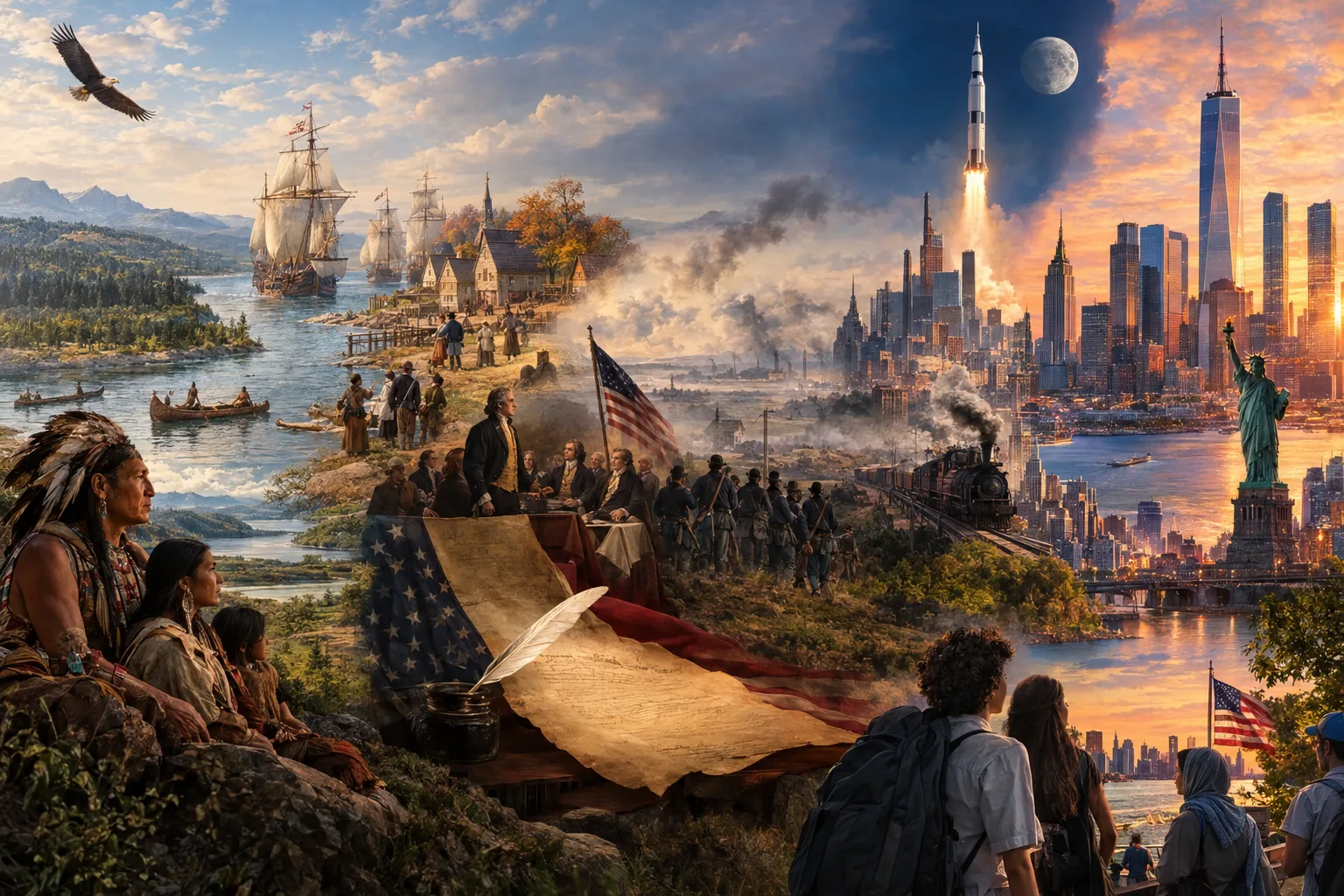
The American Saga: A Journey Through Time
From Indigenous civilizations and colonial settlements to a modern nation still debating the meaning of freedom, identity, and democracy.
A visual historical overview · Updated October 2026

The story in brief
The United States emerged from thirteen British colonies that declared independence in 1776. Its history includes constitutional experiments, territorial expansion, slavery, civil war, industrialization, immigration, social movements, global conflict, technological innovation, and continuing arguments about democracy.
This story is not a simple march toward progress. The nation's founding ideals existed alongside dispossession and exclusion, while generations of people worked to expand rights and participation. Understanding both achievement and injustice makes the American story more complete.
Indigenous North America
Long before European colonization, North America was home to diverse Indigenous nations with distinct languages, political systems, spiritual traditions, trade networks, and knowledge of the land. The Ancestral Puebloans built sophisticated communities; Mississippian societies developed major centers such as Cahokia; and the Haudenosaunee Confederacy connected nations through diplomacy and shared institutions.
Colonization brought new trade relationships but also epidemic disease, warfare, forced removal, and competition for territory. Indigenous history did not end with colonization: Native nations and communities continue to shape the country's culture, law, politics, and public life.

European Exploration and Colonial America
Spain, France, the Netherlands, and England established settlements and trading networks across North America. Jamestown was founded in 1607, and Plymouth followed in 1620. Over time, thirteen British colonies developed distinct economies and political cultures.
New England's maritime trade, the Middle Colonies' agriculture and commerce, and plantation economies in the South were connected to Atlantic trade. Enslaved Africans were forced into labor, and slavery became central to many colonial economies. Britain's victory in the French and Indian War in 1763 brought new taxes and imperial policies that intensified colonial resistance.
Revolution and Independence
Colonial opposition to British taxation and authority grew through protests, boycotts, and political organizing. The Boston Tea Party took place in 1773, and fighting began at Lexington and Concord in April 1775. On July 4, 1776, the Continental Congress adopted the Declaration of Independence, asserting that legitimate government depends on the consent of the governed.
With George Washington leading the Continental Army and France providing crucial assistance, the revolutionaries secured victory. The Treaty of Paris formally recognized American independence in 1783.

Building a Republic
The Articles of Confederation created a limited central government. Delegates drafted the Constitution in 1787, establishing a federal system with separate legislative, executive, and judicial branches. The Bill of Rights was ratified in 1791.
George Washington became the first president in 1789. The Louisiana Purchase of 1803 greatly expanded the country's territorial claims, while the War of 1812 strengthened national identity. Expansion also intensified pressure on Indigenous nations and raised continuing questions about slavery and the balance of power between states and the federal government.
Expansion and the Conflict over Slavery
During the nineteenth century, the country expanded westward. The Indian Removal Act of 1830 facilitated the forced displacement of Indigenous nations, including the Cherokee. Texas was annexed in 1845, and the Mexican-American War transferred vast territories to the United States. The California Gold Rush began in 1848.
Every new territory raised a difficult question: would slavery be permitted there? Political compromises repeatedly postponed a deeper crisis, while the Kansas-Nebraska Act and the Dred Scott decision sharpened divisions. By 1860, conflict over slavery and the future of the Union had become impossible to contain.
The Civil War and the End of Slavery
After Abraham Lincoln's election, eleven Southern states seceded and formed the Confederacy. The war began in 1861. Slavery was central to the Confederate political and economic system; the Union initially fought to preserve the nation, and the war increasingly became a struggle over emancipation as well.
The Emancipation Proclamation took effect in 1863. Union victories at Gettysburg and Vicksburg marked major turning points, and Robert E. Lee surrendered to Ulysses S. Grant in April 1865. The Thirteenth Amendment abolished slavery later that year, although freedom did not immediately bring equal rights or protection from racial violence.

Reconstruction and the Struggle for Equality
Reconstruction attempted to rebuild the South and establish rights for formerly enslaved people. Black Americans voted, held public office, founded institutions, and participated in political life. The Fourteenth Amendment established birthright citizenship and equal protection; the Fifteenth prohibited racial discrimination in voting.
White supremacist violence and political resistance undermined these gains. After Reconstruction ended, Southern states imposed segregation and voting restrictions. The struggle for equal citizenship continued through later generations of activists, organizers, and legal challenges.
Industrialization, Immigration, and Global Power
Railroads, steel, oil, electricity, and mass production transformed the United States into a leading industrial economy. Cities grew as millions of immigrants arrived. Industrial expansion generated wealth and new technologies, but many workers faced dangerous conditions, low wages, and long hours.
Progressive reformers demanded workplace protections, political reform, and limits on corporate power. Meanwhile, overseas expansion increased America's influence beyond the continent, while racial discrimination and exclusion continued at home.
World War I, the Jazz Age, and the Great Depression
The United States entered World War I in 1917. The 1920s brought radio, automobiles, jazz, consumer culture, and the Harlem Renaissance, alongside Prohibition and racial violence. The stock market crash of 1929 preceded the Great Depression, which brought bank failures, unemployment, and widespread hardship.
Franklin D. Roosevelt's New Deal introduced relief programs, financial regulation, public employment, and Social Security. These reforms expanded the federal government's role in economic security, though the Depression's effects persisted until the massive mobilization of World War II.
World War II and the Rise of a Superpower
After Japan attacked Pearl Harbor on December 7, 1941, the United States entered World War II. American forces fought across Europe, North Africa, and the Pacific, while domestic industry produced enormous quantities of military supplies.
Nazi Germany surrendered in May 1945. The United States dropped atomic bombs on Hiroshima and Nagasaki in August, and Japan formally surrendered in September. The war left much of Europe and Asia devastated and positioned the United States as a central power in the postwar international order.
The Cold War, Civil Rights, and the Space Race
The Cold War pitted the United States and its allies against the Soviet Union in a prolonged geopolitical and ideological struggle. The era included the Korean and Vietnam wars, the Cuban Missile Crisis, and intense competition in science and technology.
At home, the Civil Rights Movement challenged segregation. Brown v. Board of Education rejected school segregation in 1954; the Civil Rights Act followed in 1964 and the Voting Rights Act in 1965. The Apollo 11 mission landed astronauts on the Moon on July 20, 1969—a landmark in the Space Race.
Watch: Apollo 11 — Landing on the Moon
NASA's historical footage of the first crewed Moon landing.
Video: NASA on YouTube.
The era also brought protest movements, Watergate, economic shifts, and changing social norms. The Berlin Wall fell in 1989, and the Soviet Union dissolved in 1991, ending the Cold War.
Globalization and the Post-Cold War World
After the Cold War, the United States extended its influence through trade, technology, finance, and popular culture. The internet transformed communication, business, education, and entertainment.
The September 11, 2001, terrorist attacks killed nearly 3,000 people and reshaped American foreign and domestic policy. The wars in Afghanistan and Iraq led to long-term military commitments and debate. The 2008 financial crisis triggered a severe recession, widespread foreclosures, and job losses.
Obama, Trump, and a Changing America
Barack Obama became the first Black president. His administration pursued economic recovery and enacted the Affordable Care Act. The Supreme Court recognized a nationwide constitutional right to same-sex marriage in 2015.
Donald Trump won the 2016 election, campaigning on immigration, trade, and challenges to established political institutions. Political polarization intensified. The COVID-19 pandemic in 2020 caused mass death, economic disruption, and a public-health emergency; vaccines were developed at unprecedented speed.
Biden's Presidency and Trump's Return
Joe Biden took office in January 2021. His administration supported pandemic relief and enacted major legislation on infrastructure, semiconductor production, clean energy, and industrial investment. Inflation and household costs became central political concerns.
Russia's full-scale invasion of Ukraine in 2022 reshaped European security. The war in Gaza following the Hamas-led attacks of October 7, 2023, became a major international crisis. In 2022, the Supreme Court overturned Roe v. Wade. Donald Trump won the 2024 presidential election and returned to office on January 20, 2025.
The United States Today
America's current debates include the cost of living, immigration, healthcare, democratic institutions, energy, trade, and the impact of artificial intelligence. Housing, education, and healthcare costs shape how families experience economic opportunity, while rapid technological change raises questions about jobs, privacy, and competition.
Internationally, the United States remains influential through its alliances, military, universities, financial markets, and technology sector. Its relationships with China, Russia, Europe, and countries across the Middle East and Asia will help shape global security and trade.
The central challenge is how to manage deep disagreements while maintaining democratic accountability and responding to a rapidly changing world. Contemporary events continue to develop, so this section should be refreshed as reliable new information becomes available.
What the American Saga Means
The history of the United States is not a straight line from weakness to greatness. It is a story of competing ideals, institutional change, conflict, and repeated efforts to define who belongs and what freedom means.
Freedom and exclusion
The nation's founding ideals coexisted with slavery, Indigenous dispossession, segregation, and unequal citizenship. Reformers and movements repeatedly challenged those contradictions and pushed the country to extend rights and protections.
Institutions and participation
The Constitution divided authority and established checks and balances, but institutions depend on public participation, accountability, and respect for the rule of law.
Economic transformation
Agriculture, industrialization, global trade, the internet, and artificial intelligence have changed how Americans live and work. Each transformation has created opportunities while also disrupting communities and distributing benefits unevenly.
An unfinished story
The United States of today is both a product of its past and a country whose future remains unwritten. Its next chapter will depend on how people confront history, respond to present challenges, and decide what kind of country they want to build.
American History at a Glance
| Period | Defining development |
|---|---|
| Before 1492 | Indigenous nations and civilizations flourish across North America. |
| 1492–1763 | European colonization and growth of the British colonies. |
| 1763–1783 | Revolution and independence. |
| 1783–1860 | Constitutional development, territorial expansion, and conflict over slavery. |
| 1861–1877 | Civil War, emancipation, and Reconstruction. |
| 1870s–1914 | Industrialization, immigration, reform, and overseas expansion. |
| 1914–1945 | World wars, the Great Depression, and the New Deal. |
| 1945–1991 | Cold War, civil rights, and the Space Race. |
| 1991–2008 | Globalization, the internet, and the post-Cold War era. |
| 2009–2026 | Political change, pandemic recovery, technological transformation, and new global challenges. |
Sources and Further Reading
- U.S. National Archives — founding documents and government records.
- Library of Congress — historical collections and primary sources.
- National Park Service — historical sites and preservation.
- National Museum of the American Indian — Indigenous histories and perspectives.
- NASA — space exploration history and mission records.
- Pew Research Center — contemporary social and political research.
This is a broad historical overview, not an exhaustive account of every community or interpretation. Image and video providers retain their own terms and attribution requirements; check each source before republishing.
Comments (0)