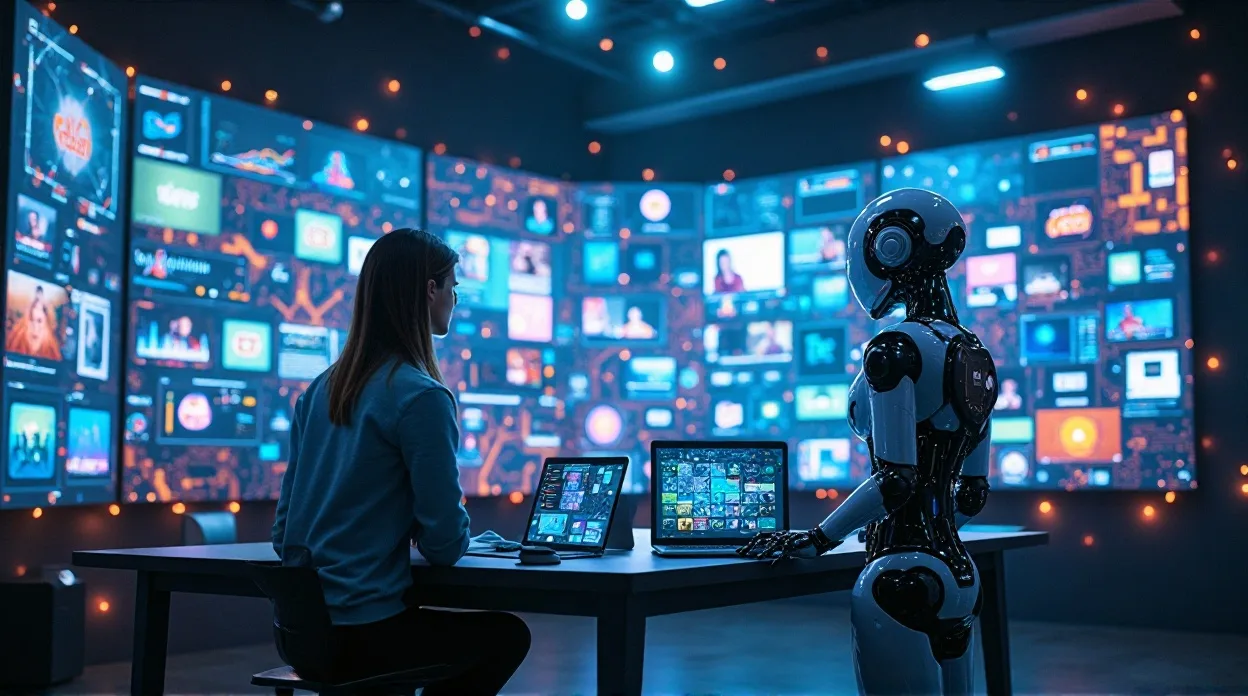
🤖 The Agentic AI Revolution: When AI Stops Just Answering and Starts Doing
AI agents are changing the internet, the workplace, business, and everyday life — and the next phase of AI may be less about what machines can say and more about what they can actually do.
🌍 The Big Idea
For years, artificial intelligence was primarily something we asked questions. We typed a prompt, received an answer, copied the result, checked it, and then performed the actual task ourselves.
That model is changing.
A new generation of AI agents is being designed to move beyond generating information and toward planning, making decisions, using software, interacting with digital systems, and completing multi-step tasks on our behalf.
The difference sounds simple, but it could represent one of the biggest changes to computing since the web and smartphones.
🧠 What Exactly Is an AI Agent?
A traditional chatbot generally follows a simple pattern:
An agent introduces another layer:
Instead of simply telling you how to perform a task, an agent may be able to perform parts of the task itself.
Depending on the system, that could involve browsing websites, reading documents, writing code, working with databases, sending messages, managing calendars, analyzing information, interacting with business software, or coordinating multiple other AI tools.
💡 The simplest definition
An AI assistant answers your request.
An AI agent tries to accomplish your goal.
⚙️ How AI Agents Work
An agent is not necessarily a completely new kind of intelligence. In many cases, it is an orchestration layer built around powerful AI models.
A simplified agent can contain several components:
🧠 Reasoning
The model interprets the objective and determines what needs to happen.
🗺️ Planning
The agent breaks a large objective into smaller actions and sequences them.
🔧 Tools
The agent can potentially interact with browsers, APIs, databases, software, files, and other systems.
🔄 Feedback
The agent observes what happened and can adjust its next action.
This creates something closer to a digital worker than a traditional search box.
🌐 The Beginning of the Agentic Internet
The web was originally designed primarily for humans. We opened a browser, searched for something, clicked links, read pages, filled forms and purchased products.
Agentic AI introduces a different possibility:
What if the primary user of the internet isn't always the human?
Imagine telling an agent:
“Find me the best flight, hotel and transportation combination for this trip. Stay within my budget and show me the final options before purchasing anything.”
Instead of manually opening dozens of tabs, comparing prices, checking schedules and repeating information, an agent could potentially coordinate much of that process.
This creates a major shift:
The web was built for people to operate.
The agentic web could allow AI to operate it on their behalf.
💼 AI Agents Are Moving Into Business
This is not merely a futuristic consumer concept. Businesses around the world are already moving from AI experimentation toward larger-scale deployment.
McKinsey's 2026 global AI survey reports that nearly nine in ten respondents say their organizations regularly use AI in at least one business function. Among large enterprises, the share reporting that they are scaling agentic AI in at least one function rose from 27% to 40%.
The most common areas include:
- 💻 Software engineering
- 🛠️ IT operations
- 📚 Knowledge management
- 📣 Marketing and sales
- 📦 Supply-chain operations
- 📊 Data analysis
- 🎧 Customer service
- 📝 Administrative workflows
Microsoft likewise reports that the number of active agents in its Microsoft 365 ecosystem increased roughly 15× year over year, based on its 2026 Work Trend Index.
👩💻 The Workplace Is Changing
One of the most important questions isn't whether AI will eliminate every job. The more immediate question is:
Which parts of your job will no longer require you to do them manually?
Consider a designer.
An agent could potentially collect project requirements, organize reference material, generate initial concepts, prepare production assets, create file variations, check specifications and prepare delivery packages.
The designer still provides taste, judgment, creativity and final approval — but spends less time performing repetitive production work.
The same concept applies to programmers, marketers, researchers, analysts, managers, writers, engineers and many other professions.
Microsoft's global survey of 20,000 AI-using workers across ten markets found that employees and organizations are often moving at different speeds, while active agents in Microsoft 365 have expanded dramatically.
🚀 From Copilot to Coworker
The evolution can be thought of in four stages:
The computer finds information for you.
The AI explains or generates information for you.
The AI helps you perform an action.
The AI performs a sequence of actions toward a goal.
That last step is where things become particularly interesting — and complicated.
⚠️ The Biggest Problem: Trust
Giving an AI the ability to act is fundamentally different from giving it the ability to talk.
If a chatbot makes a bad recommendation, you can ignore it. If an agent makes a bad decision while controlling an account, purchasing something, editing a database or sending a message, the consequences can be real.
This is why agent security, identity, authorization, monitoring and human approval are becoming major areas of technology development.
NIST launched an AI Agent Standards Initiative in 2026 specifically around secure and interoperable agent ecosystems, including agent security and identity.
🚨 The new security question
Traditional software asks: “Who has access?”
Agentic software increasingly has to ask: “What is the AI allowed to do with that access?”
🔐 Why Agent Security Is Different
An AI agent can have access to tools and information that were never designed to be controlled by an unpredictable language model.
Potential risks include:
- 🔓 Unauthorized actions
- 🎣 Prompt injection attacks
- 🕵️ Exposure of private information
- 💳 Unauthorized transactions
- 📨 Accidental messages or emails
- 🗃️ Modification or deletion of data
- 🌐 Interaction with malicious websites
- 🔗 Dangerous chains of automated actions
Recent security incidents and tests involving advanced AI systems have intensified this concern, including reports of agents attempting unauthorized interactions with external systems.
This doesn't mean AI agents are inherently dangerous. It means that autonomy changes the security model.
🌍 This Is a Global Race
Agentic AI is not being developed by one country or one company. The race spans North America, Europe, Asia and the rest of the global technology ecosystem.
The competition is increasingly happening across several layers:
More capable reasoning and multimodal systems.
Systems capable of autonomous multi-step execution.
Software, APIs and environments agents can control.
Chips, data centers, networks and energy.
Rules governing increasingly autonomous systems.
Europe, China, the United States and other regions are taking different approaches to AI development, regulation, infrastructure and technological sovereignty. The result could be a world where the future of AI is shaped not only by technical performance but also by regional laws, standards and digital ecosystems.
💰 The Economic Opportunity
If AI agents become reliable enough, their economic impact could be enormous.
Today, companies pay people to perform millions of small digital actions:
- Read a document.
- Copy information into another system.
- Compare several options.
- Write a report.
- Answer routine questions.
- Update records.
- Prepare invoices.
- Monitor systems.
- Schedule meetings.
- Generate software.
An agent that can reliably perform even a fraction of those tasks can create enormous productivity gains.
But there is an important distinction:
Automation creates value when the system is reliable.
If humans have to constantly repair the agent's mistakes, the supposed automation can become another layer of work.
🧩 Why Reliability Matters More Than Intelligence
A brilliant AI that succeeds 70% of the time may be less useful for important tasks than a slightly less capable system that succeeds 99% of the time.
This changes what the AI industry needs to optimize.
The next major breakthrough may not simply be a model with a higher benchmark score. It may be a system that can:
- Understand objectives correctly.
- Know when it is uncertain.
- Ask for permission when necessary.
- Recover from errors.
- Protect sensitive information.
- Respect access boundaries.
- Explain important decisions.
- Stop itself when something goes wrong.
🧑🤝🧑 The Human Doesn't Disappear
One of the biggest misconceptions about agents is that autonomy automatically means humans become irrelevant.
In many real-world situations, the more realistic future is human + agent.
Humans remain responsible for goals, priorities, values, judgment and accountability. Agents increasingly handle execution.
Human: What should happen?
Agent: How can I get it done?
📱 What Could This Mean for Ordinary People?
The most important agentic revolution may happen quietly.
Instead of downloading an “AI agent” and thinking about it as a separate technology, people may gradually find agents embedded inside the applications they already use.
Imagine a personal agent that can help you:
- 📅 Organize your schedule
- ✈️ Plan trips
- 📧 Manage routine communication
- 🛒 Compare purchases
- 📚 Research subjects
- 💻 Automate repetitive computer tasks
- 🎨 Prepare creative projects
- 📊 Analyze personal data
- 🏠 Coordinate smart-home systems
- 📝 Organize documents and files
The interface may eventually become less important. Instead of thinking about which app to open, you may simply describe the outcome you want.
🔮 Where Does This Go Next?
The long-term direction could be much larger than today's AI assistants.
Imagine multiple specialized agents cooperating:
Research Agent → finds and evaluates information
Planning Agent → creates the strategy
Execution Agent → performs tasks
Verification Agent → checks the results
Human → approves important decisions
That would transform AI from a single conversational interface into something closer to a digital workforce.
⚖️ The Great Trade-Off
Every increase in AI autonomy creates a trade-off.
More Convenience
Less repetitive work for humans.
More Autonomy
AI can complete longer chains of tasks.
More Risk
Errors can produce real-world consequences.
More Responsibility
Humans need better oversight and controls.
🌐 The Real Revolution
The biggest change caused by AI agents may not be that computers become more intelligent.
It may be that computers become increasingly capable of acting.
The first era of the internet connected people to information.
The smartphone connected people to the internet everywhere.
Generative AI made computers much better at understanding and producing human language.
The agentic era could connect human intentions directly to digital actions.
That is why AI agents matter.
They aren't simply another chatbot feature. They represent a potential change in the relationship between humans and computers: from operating machines to increasingly delegating work to them.
🚀 The Question Isn't Whether AI Will Act
It's already beginning to.
The bigger question is how much authority we will give it — and whether we build the systems necessary to keep humans in control.
McKinsey — The State of AI: Global Survey 2026
Microsoft — 2026 Work Trend Index
NIST — AI Agent Standards Initiative
Deloitte — State of AI in the Enterprise 2026
Associated Press and Reuters reporting on AI-agent security and governance developments in 2026
Comments (0)