HKMedia · Science & Artificial Intelligence
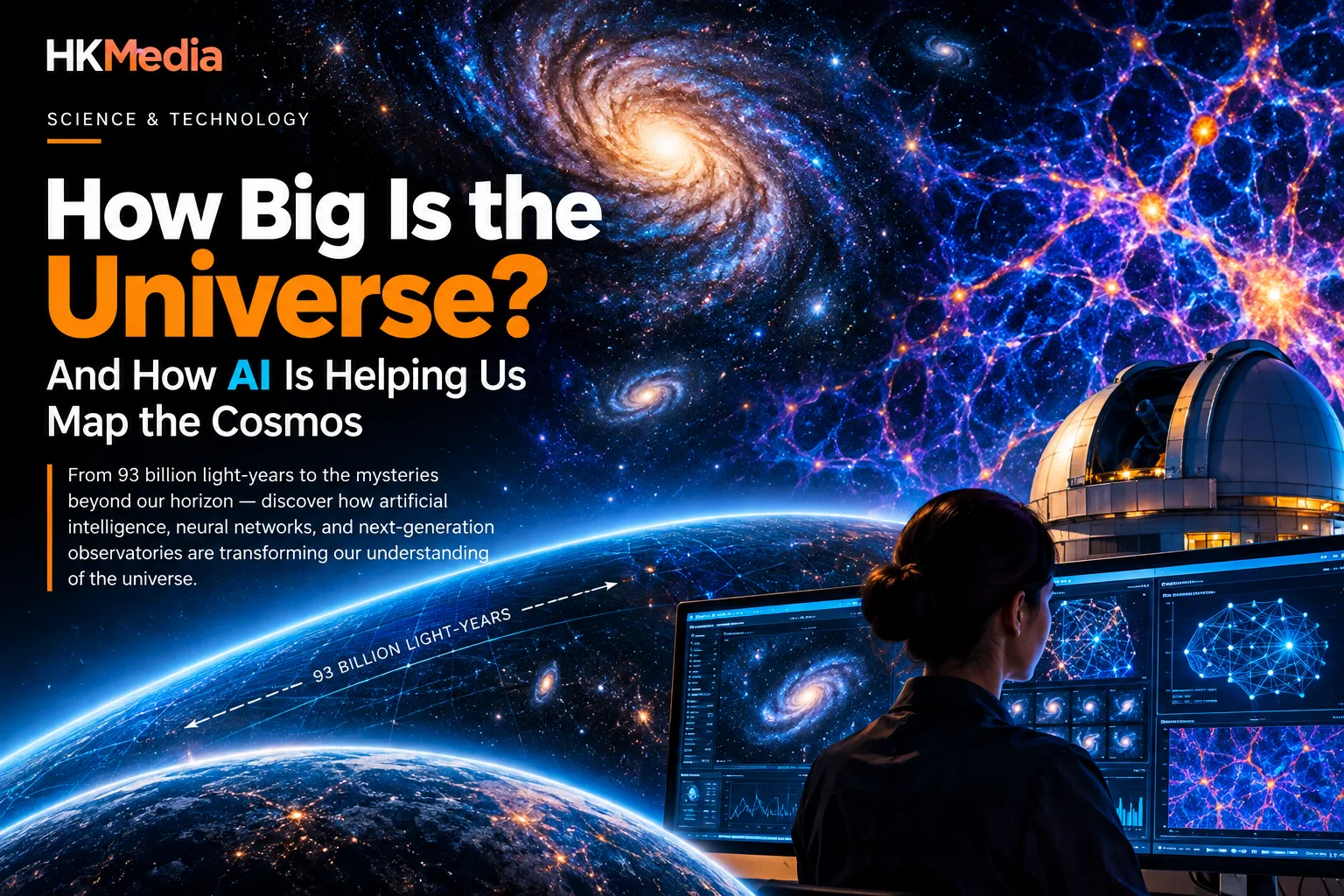
How Big Is the Universe? And How AI Is Helping Us Map the Cosmos
Imagine traveling at the speed of light, moving faster than any spacecraft humanity has ever built. You would still need billions of years to cross the observable universe. Yet the most extraordinary possibility is that everything we can see may represent only a fraction of everything that exists.
For centuries, humanity has looked toward the stars to understand its place in reality. Today, telescopes, supercomputers, artificial intelligence, and neural networks are transforming that ancient quest into one of the most ambitious scientific mapping projects in history.
1. The Observable Universe: A Cosmic Ocean of Space and Time
When scientists ask how large the universe is, the first distinction they must make is between the observable universe and the universe as a whole.
The observable universe is the region from which light or other signals have had enough time to reach us since the universe began expanding approximately 13.8 billion years ago. Its diameter is estimated to be around 93 billion light-years, giving it a radius of roughly 46.5 billion light-years.
At first glance, this seems contradictory. If the universe is only 13.8 billion years old, how can its observable diameter exceed 27.6 billion light-years?
The answer lies in cosmic expansion. Light from extremely distant regions has traveled for billions of years while the space through which it traveled continued to expand. Those regions are now much farther away than the distance the light itself has covered, measured using today's cosmological distance scale.
A crucial distinction
The observable universe is not a spherical shell surrounding Earth with humanity at its physical center. Every observer, wherever they are, has their own observable region. We occupy the center of our observable horizon only because that horizon is defined by what can reach us.
2. How Far Is a Light-Year, Really?
A light-year is a unit of distance, not time. It represents how far light travels through a vacuum in one year: approximately 9.46 trillion kilometers.
Multiply that distance by 46.5 billion, and you obtain a rough light-travel-distance equivalent of 440 billion trillion kilometers from us to the present-day observable horizon. The actual cosmological distance calculation is more subtle, but the scale is staggering.
Astronomers also use the parsec, a distance unit based on stellar parallax. One parsec is approximately 3.26 light-years, while a gigaparsec equals one billion parsecs.
- Light-year: useful for communicating stellar and galactic distances.
- Parsec: commonly used in astronomy and measurements of nearby stars.
- Megaparsec: one million parsecs, useful for distances between galaxies.
- Gigaparsec: one billion parsecs, useful for cosmological-scale calculations.
The radius of the observable universe corresponds to approximately 14.3 gigaparsecs when expressed as a present-day comoving distance. This helps connect everyday descriptions of cosmic distance with the mathematical framework cosmologists use to study expansion.
3. What Lies Beyond the Observable Universe?
Here, the question becomes more profound. The observable horizon is a limit on the information available to us, not proof that space ends at that boundary.
The universe beyond our observable region may contain more galaxies, stars, planets, and structures similar to those we can see. Under standard cosmological models, space may extend vastly beyond our horizon and could even be infinite.
However, an infinite universe has not been established as a fact. Measurements indicate that the universe is very nearly spatially flat on large scales, but near-flatness does not by itself tell us whether space is infinite or finite with a more complicated global geometry.
Three possibilities scientists investigate
- An infinite universe: space continues indefinitely, with no final edge.
- A finite but unbounded universe: space could have finite volume without a conventional edge, depending on its topology and geometry.
- A much larger observable region: the universe may extend far beyond what light has had time to reveal to us, while its total size remains unknown.
There is another important limit. Because the universe expands, some distant regions may never send us signals that can reach us, even with unlimited waiting time. The observable universe is therefore connected to both the age of the cosmos and the history of its expansion.
4. The Cosmic Web: The Hidden Architecture of the Universe
Galaxies are not scattered randomly through space. On the largest scales, matter forms an intricate network known as the cosmic web, made up of enormous filaments, dense clusters, and vast, relatively empty regions called voids.
Gravity gradually amplifies small differences in the density of matter that existed in the early universe. Over billions of years, matter collects along filaments and at their intersections, where galaxy clusters can form. Voids become comparatively emptier as material flows toward denser regions.
Much of this structure is influenced by dark matter, an invisible component that does not emit or absorb light in the ordinary way but reveals its presence through gravitational effects. Its distribution helps shape the locations where galaxies form and evolve.
Why mapping the cosmic web matters
The pattern of galaxies contains clues about how the universe evolved, how matter is distributed, and how cosmic expansion has changed over time. Astronomers can compare observed structures with simulations to test theories of gravity, dark matter, and dark energy.
One especially useful signal is baryon acoustic oscillation, or BAO. These are remnants of pressure waves that traveled through the early universe. Their characteristic scale provides a cosmic ruler that scientists can use to study the expansion history of space.
5. Why Modern Astronomy Needs Artificial Intelligence
Today's astronomical observatories produce enormous volumes of data. Large imaging surveys repeatedly photograph the sky, while space telescopes observe galaxies across different wavelengths. Spectroscopic instruments add another layer of information by separating light into its component wavelengths.
Traditional analysis methods remain essential, but manually inspecting every image or spectrum is impractical at survey scale. Artificial intelligence helps researchers identify patterns, prioritize unusual objects, estimate physical properties, and direct follow-up observations.
Projects such as the Vera C. Rubin Observatory and the Euclid mission are especially relevant to this new era. Rubin is designed to repeatedly survey the southern sky and detect changes over time, while Euclid investigates the geometry and expansion of the universe through galaxy distributions and gravitational lensing.
How AI contributes to astronomical discovery
- Deep-learning image analysis: convolutional neural networks can classify galaxies, identify sources, and help distinguish astronomical objects from imaging artifacts.
- Photometric redshift estimation: machine-learning models estimate a galaxy's redshift from its observed brightness in multiple filters, helping researchers estimate its distance probabilistically.
- Anomaly detection: algorithms can flag rare, unexpected, or unusual objects for human investigation, including transient events and peculiar galaxies.
- Gravitational-lens identification: AI can search large image collections for the distorted arcs and rings produced when gravity bends light around massive objects.
- Automated alert processing: models can help sort rapidly changing observations so astronomers can prioritize supernovae, variable stars, and other time-sensitive events.
The important point is not that AI replaces astronomy. Rather, it helps scientists extract useful information from datasets that would be difficult to analyze efficiently using manual methods alone.
6. Neural Networks, Simulations, and the Search for Dark Matter
AI's contribution extends beyond classifying images. Neural networks can help researchers reconstruct hidden physical processes by comparing observations with simulations and mathematical models.
Graph neural networks and galaxy relationships
A graph neural network represents information as interconnected entities. In a cosmic application, galaxies or regions of space can be represented as nodes, with edges encoding spatial relationships or other measured connections.
These models can learn patterns in galaxy environments, cluster membership, and large-scale structure. Their effectiveness depends on how the graph is constructed and how accurately the available data represent the underlying physics.
Learning from simulated universes
Cosmologists create computer simulations that evolve matter under specified physical laws and cosmological parameters. Machine-learning models can learn relationships between simulation inputs and outputs, accelerating some tasks that would otherwise require repeated, computationally expensive calculations.
Researchers can then compare predictions with astronomical observations to constrain models of cosmic evolution. This approach is useful for exploring large parameter spaces, but it must be tested carefully to ensure that a model works on observations and conditions beyond those used for training.
Weak gravitational lensing
Gravity bends the path of light. When light from distant galaxies passes through foreground matter, the resulting distortions can reveal the distribution of mass, including dark matter that cannot be observed directly.
AI-assisted methods can help measure subtle distortions across millions of galaxy images. Because the effects are extremely small, researchers must account for telescope optics, atmospheric conditions, detector behavior, galaxy shapes, and other sources of measurement bias.
AI does not make uncertainty disappear.
A model can be confidently wrong if its training data are incomplete or biased. Reliable cosmology therefore combines machine learning with physical models, statistical uncertainty estimates, independent validation, and reproducible scientific analysis.
7. The Challenge of Measuring Cosmic Distance
Seeing a distant galaxy is not the same as knowing exactly how far away it is. Astronomers use several complementary techniques, each suited to different objects and distance ranges.
- Parallax: apparent changes in a nearby star's position help establish its distance using Earth's changing observing position.
- Standard candles: objects with known or calibrated luminosities, including certain variable stars and Type Ia supernovae, help establish distances from their observed brightness.
- Redshift: the stretching of light toward longer wavelengths helps astronomers study cosmic expansion. Converting redshift into distance requires a cosmological model.
- Gravitational lensing: distortions and time delays caused by massive foreground objects provide additional ways to investigate cosmic distances and matter distributions.
AI can help combine these measurements, identify calibration problems, estimate redshifts, and quantify uncertainty. However, the results remain dependent on the quality of the observations and the assumptions built into the analysis.
8. Can AI Discover New Physics?
AI can identify patterns that researchers might overlook, generate hypotheses, and help search for discrepancies between observations and existing models. Such capabilities are valuable because the most important discoveries sometimes begin with a signal that does not fit expectations.
Consider an algorithm that identifies a population of galaxies whose measured properties differ systematically from the predictions of a simulation. The discrepancy might reveal a limitation in the model, an unaccounted observational bias, an unexpected astrophysical process, or something genuinely new.
The algorithm cannot determine which explanation is correct merely by detecting the pattern. Scientists must test alternative explanations, reproduce the result, examine the uncertainties, and seek independent evidence.
This is where human reasoning and machine computation complement one another. AI can search enormous datasets rapidly; scientists provide physical interpretation, critical scrutiny, and experimental judgment.
9. What Comes Next? The Future of Cosmic Cartography
Over the coming years, increasingly sophisticated observatories, simulation platforms, and AI systems are likely to deepen our understanding of the universe. Several developments are particularly promising.
- Faster transient discovery: automated systems will help researchers identify short-lived astronomical events and coordinate follow-up observations more efficiently.
- More detailed three-dimensional maps: combining galaxy positions, redshifts, lensing measurements, and other observations will improve reconstructions of large-scale structure.
- Advanced simulation emulators: machine-learning approximations may make it faster to explore how different cosmological assumptions affect predicted observations.
- Improved multimodal analysis: AI systems may combine images, spectra, time-series observations, and theoretical models to provide a more complete picture of individual objects and cosmic populations.
- More autonomous observatories: carefully validated systems may increasingly help prioritize targets and schedule observations in response to newly detected events.
Quantum computing is another area of research, but its role should be described carefully. Quantum technologies may eventually benefit particular scientific calculations, yet a practical, general-purpose quantum advantage for cosmological simulations has not been established. Classical supercomputers and conventional machine learning remain the primary computational tools for these tasks.
Likewise, a continuously updated map of the observable sky is a realistic scientific objective in specific domains, but a perfectly complete, real-time map of the entire universe is not. Light-travel time, observational limits, cosmic expansion, and incomplete data impose fundamental constraints.
10. The Biggest Questions Remain Unanswered
Despite extraordinary progress, some of cosmology's most important questions remain open.
- Is the universe infinite, or does it have a finite total volume?
- What is the fundamental nature of dark matter?
- What physical process drives the accelerated expansion associated with dark energy?
- How did the earliest galaxies and cosmic structures form?
- Are there limits to our current understanding of gravity and the early universe?
AI can help investigate these questions by extracting subtle signals, comparing theories with observations, and making complex analyses more efficient. But computation alone cannot reveal information that observations do not contain, nor can it replace the need for testable scientific explanations.
Conclusion: We Are Learning to Read the Universe
The observable universe spans approximately 93 billion light-years, yet its full extent remains unknown. What lies beyond our horizon may be far greater than what we can currently observe, and the possibility of an infinite universe remains open.
Our growing understanding of the cosmos depends on more than powerful telescopes. It requires mathematical models, precise instruments, enormous computing resources, and increasingly sophisticated methods for interpreting the flood of incoming data.
Artificial intelligence and neural computing are becoming important tools in that effort. They help astronomers classify galaxies, detect unusual phenomena, map large-scale structure, and test models of cosmic evolution. Their greatest value lies not in replacing scientists, but in allowing scientific teams to ask more questions and investigate more evidence.
The universe is not simply a place we observe. It is a history we reconstruct from light, a structure we infer through gravity, and a set of physical laws we continue to test.
The next great astronomical discovery may begin with a pattern hidden in data too vast for any individual to examine alone.
Perhaps the most remarkable fact is that a species living on a small planet around an ordinary star has developed the tools to investigate structures spanning billions of light-years. We do not yet know the ultimate size of the universe. But with every observation and every carefully tested model, we learn a little more about the reality we inhabit.
Further Reading and Scientific Sources
Explore these institutional resources to learn more about the science behind this article.
-
NASA Science — The Universe
Cosmology, galaxies, cosmic expansion, and the observable universe. -
European Space Agency — Euclid
Mapping galaxies and investigating dark matter and dark energy. -
Vera C. Rubin Observatory
Wide-field sky surveys and time-domain astronomy. -
ESA Planck Mission
Measurements of the cosmic microwave background and early-universe cosmology. -
arXiv — Research Papers in Astronomy and Cosmology
Scientific preprints covering machine learning, astrophysics, and cosmological simulations.
Editorial note: Numerical values are approximate and depend on the cosmological model and the distance definition being used. AI applications described here represent established uses or active research directions, not guarantees of future discoveries.
Comments (0)