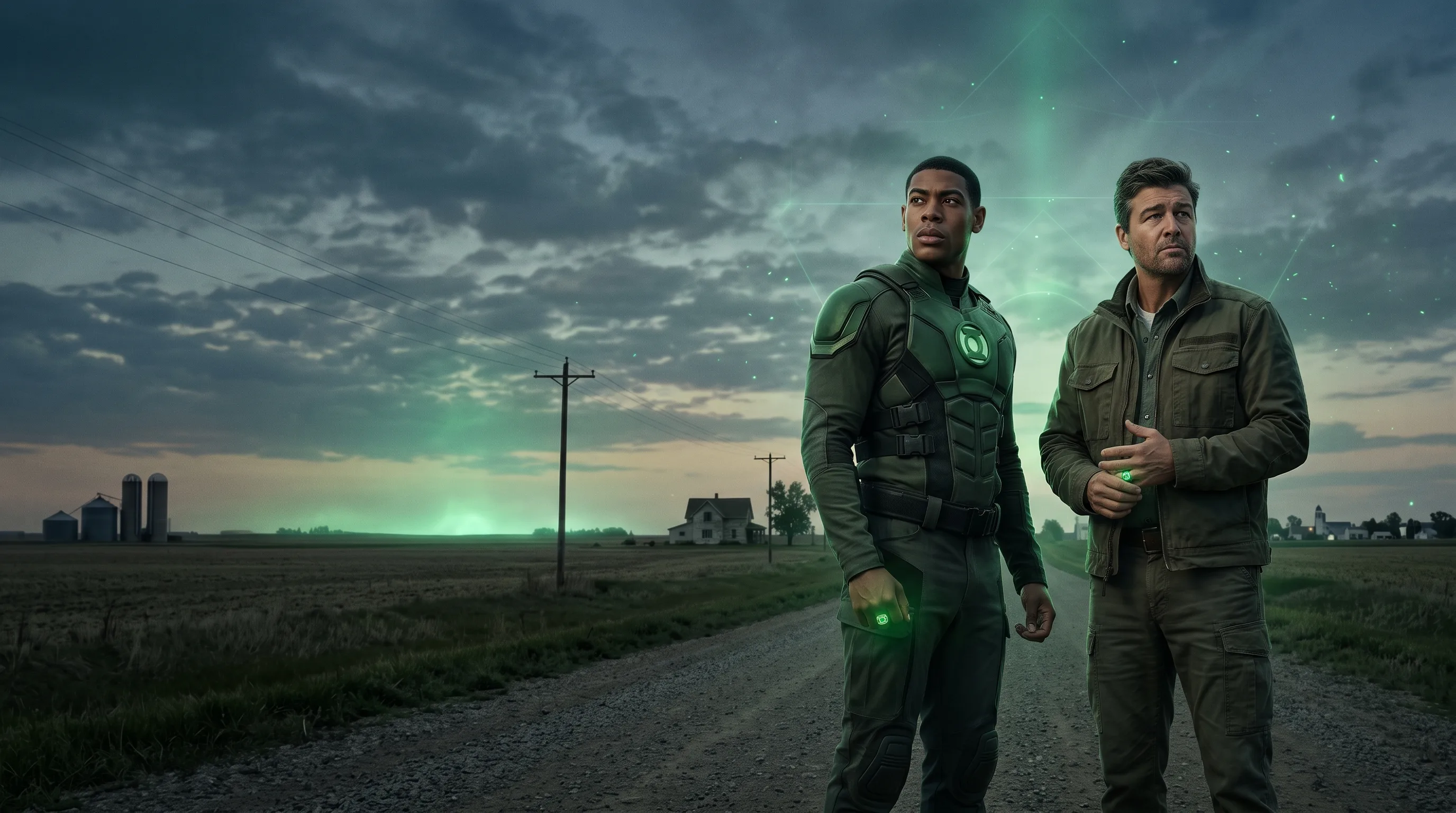
Lanterns: HBO’s Bold New Green Lantern Series Is More Than a Superhero Show
HBO's Lanterns takes one of DC Comics' most recognizable concepts and approaches it from an unusually grounded direction: part superhero story, part science-fiction mystery, part police procedural, and part character drama.
A Different Kind of Green Lantern Story
For years, the Green Lantern mythology has been one of DC's richest but most difficult properties to translate successfully to live action. The concept is enormous: cosmic police officers, alien civilizations, magical-looking power rings, intergalactic politics, ancient enemies and an entire mythology built around willpower and fear.
Lanterns makes an interesting decision. Instead of immediately throwing audiences into a galaxy-spanning superhero spectacle, the series begins with something much more familiar: a murder investigation.
New recruit John Stewart is paired with veteran Lantern Hal Jordan. Their investigation leads them to Rushville, Nebraska, where an apparently local mystery gradually reveals connections to something far larger and stranger.
That contrast becomes the show's central identity. One moment feels like a traditional American crime drama; the next reminds you that the characters are members of an intergalactic law-enforcement organization.
Why the approach works
By starting small, Lanterns gives its enormous mythology somewhere human to land. The cosmic elements become more effective because the audience first becomes invested in the people experiencing them.
The Story: Mystery Before Spectacle
The first season revolves around the investigation surrounding Hal Jordan and a mysterious death. John Stewart is brought into a world that is unfamiliar to him, while Hal carries the confidence, experience and emotional baggage of someone who has spent years dealing with the dangers of the Green Lantern Corps.
Their investigation eventually exposes a much deeper threat involving the people and forces surrounding Rushville. The series deliberately takes its time, allowing seemingly ordinary characters to become increasingly important to the larger mystery.
This structure is one of the show's biggest strengths. Rather than treating every supporting character as an obvious villain or disposable obstacle, Lanterns allows motivations to remain ambiguous.
The result is a story where trust becomes almost as important as superpowers.
Aaron Pierre as John Stewart
Aaron Pierre is arguably the emotional center of the series.
His version of John Stewart is not presented simply as "the next Green Lantern." He is a young man trying to understand what responsibility actually means while standing in the shadow of a legendary predecessor.
Pierre gives John a restrained intensity. His performance doesn't rely on constant speeches or exaggerated superhero poses. Instead, much of the character's development comes through small reactions, hesitation and the gradual realization that being a hero isn't necessarily about being fearless.
That idea becomes especially important as the season progresses: courage is not the absence of fear; it is the decision to act despite it.
Kyle Chandler as Hal Jordan
Kyle Chandler brings a completely different energy to Hal Jordan.
Hal is experienced, confident and occasionally frustrating. He carries himself like someone who has survived enough impossible situations to believe that he already knows how the universe works.
Chandler's performance gives the character a weathered quality that fits the show's grounded approach. Rather than presenting Hal as an untouchable superhero, the series emphasizes his flaws, regrets and complicated relationship with the responsibilities of being a Lantern.
The chemistry between Chandler and Pierre is one of the clearest reasons the series works. Their relationship gradually evolves from professional tension into something much more meaningful.
The real superpower of Lanterns is its character chemistry. The relationship between Hal and John gives the enormous DC mythology a personal scale.
Kelly Macdonald's Kerry Kane
Kelly Macdonald plays Sheriff Kerry Kane, one of the show's most important grounded characters.
Kerry provides a bridge between the ordinary world of Rushville and the increasingly bizarre events surrounding the Lanterns. Her character also complicates the show's moral landscape because she isn't simply a helpful local sheriff or a traditional antagonist.
Macdonald gives Kerry considerable emotional depth, particularly as the season reveals how personal the central mystery really is.
The Supporting Cast
Lanterns benefits from a remarkably strong supporting ensemble.
- Nathan Fillion as Guy Gardner brings comic energy and connects the series to the broader DC Universe.
- Ulrich Thomsen plays Thaal Sinestro, bringing a colder and more intimidating presence to one of Green Lantern's most important characters.
- Garret Dillahunt plays William Macon, a powerful local figure whose presence becomes increasingly significant.
- Jason Ritter plays Billy Macon, adding another layer to the complicated family relationships surrounding the mystery.
- Poorna Jagannathan plays Zoe Macon, whose story becomes increasingly important as the season develops.
- Laura Linney and Nicole Ari Parker add further weight to an ensemble that rarely feels like background decoration.
Sinestro and the Wider DC Universe
One of the biggest questions surrounding Lanterns was always how closely it would connect to the larger DC Universe.
The answer is deliberately restrained.
The series introduces important pieces of Green Lantern mythology without turning every episode into a checklist of references. Sinestro is particularly important because his presence hints at the enormous mythology waiting beyond Earth.
Guy Gardner's appearances also help connect Lanterns to the wider DCU while allowing this series to maintain its own identity.
That balance is important. The show feels connected to the DC Universe without becoming dependent on cameos and references.
The "True Detective" Influence
One comparison appeared repeatedly in early discussion of the series: True Detective.
That comparison is understandable. The rural setting, investigation structure, morally complicated characters and slow-burn mystery all give Lanterns the atmosphere of a prestige crime drama.
Showrunner Chris Mundy has experience with crime-focused television, while creators Damon Lindelof and Tom King bring additional experience in character-driven genre storytelling and comic-book mythology.
The result is not simply "True Detective with Green Lanterns." The show borrows the language of serious crime television while gradually introducing the stranger elements of DC mythology.
What Critics Think
The critical response has been notably positive.
Rotten Tomatoes currently lists the first season at 92% from critics and 73% from audiences. IMDb lists the series at approximately 7.8/10.
The critical consensus is particularly interesting because reviewers tend to praise the same elements: the writing, the performances and the chemistry between Chandler and Pierre.
The main criticism is equally consistent: viewers expecting a conventional superhero blockbuster may find the series too restrained.
In other words, Lanterns is not trying to be a two-hour superhero movie stretched across eight episodes.
It is trying to be a television drama that happens to exist inside a superhero universe.
What Works Best
1. The Performances
The strongest element is the acting. Chandler, Pierre and Macdonald give the story emotional credibility, while the supporting cast prevents the mystery from becoming predictable.
2. The Atmosphere
The rural American setting gives the show a visual identity that separates it from traditional superhero television. The contrast between farmland and cosmic mythology is one of the show's most interesting ideas.
3. The Writing
The series trusts its audience. It doesn't explain every mystery immediately, and many characters have motivations that only become clear after several episodes.
4. The Green Lantern Mythology
Rather than throwing every piece of Green Lantern lore onto the screen at once, the series carefully introduces elements of the mythology while keeping the central human story understandable.
Where the Show May Divide Viewers
The same qualities that critics praise could frustrate some superhero fans.
There isn't always a huge amount of spectacle. If you want constant power-ring constructs, massive space battles and CGI-heavy action, Lanterns may feel deliberately slow.
The show also spends substantial time with family relationships, personal conflicts and investigative details. Those elements are essential to the story, but they mean the series sometimes behaves more like prestige television than conventional superhero entertainment.
That is ultimately the biggest question every viewer needs to answer: Do you want a Green Lantern story, or do you want a superhero spectacle?
Lanterns is much closer to the former.
⚠️ Spoiler Section: What the Finale Changes
Major spoilers for Season 1 below. Skip this section if you have not finished the first season.
Who Killed Hal Jordan?
The season ultimately reveals that Sheriff Kerry Kane was responsible for Hal Jordan's death.
The revelation is not simply a conventional murder twist. It is tied to Kerry's attempt to protect her family and the secrets surrounding Noah Macon and the Manhunter threat.
This decision reinforces one of the show's central themes: good people can make terrible decisions when fear, loyalty and responsibility collide.
John Stewart's Choice
John's most important decision isn't about defeating an enemy. It is about refusing to reduce the situation to simple good versus evil.
His decision regarding Noah demonstrates how much the character has changed. John begins the season learning what it means to be a Lantern; he ends it beginning to define what kind of Lantern he wants to become.
The Beginning of John Stewart's Future
The finale also moves John closer to becoming the Green Lantern audiences know from DC Comics, while deliberately creating a version of the mythology specific to this DC Universe.
His relationship with fear and the unusual circumstances surrounding his Lantern power suggest that the series has much bigger ideas planned for the character.
What Could Season 2 Look Like?
At the end of the first season, the story feels less like a conclusion and more like the opening chapter of John's larger journey.
Showrunner Chris Mundy has indicated that a potential continuation could remain relatively Earth-focused while expanding the mythology introduced during Season 1.
That could be a smart direction. The first season proved that the Green Lantern concept can work without immediately becoming an effects-driven space opera.
A second season could therefore explore John's development as a Lantern while gradually expanding the DCU's cosmic mythology.
Why Lanterns Matters to DC
The importance of Lanterns goes beyond its individual ratings.
DC Studios needs to demonstrate that its new universe can support different genres rather than forcing every project into the same superhero formula. Lanterns does exactly that by proving that a DC property can function as a serious mystery, character drama and science-fiction story at the same time.
Final Verdict
Lanterns is not the Green Lantern adaptation some viewers expected.
And that may be precisely why it works.
Instead of rushing toward spectacle, HBO's series builds its mythology through people. Instead of treating Hal Jordan and John Stewart as interchangeable superheroes, it gives them distinct personalities, histories and philosophies.
Aaron Pierre gives John Stewart a compelling emotional foundation, while Kyle Chandler turns Hal Jordan into a veteran hero whose confidence hides plenty of vulnerability. Kelly Macdonald provides an equally important human anchor, and the supporting cast gives the mystery enough complexity to sustain eight episodes.
The result is a show that feels unusually confident about what it wants to be.
It is a Green Lantern story, but it is also a detective drama. It is science fiction, but it is grounded in human relationships. It belongs to a massive cinematic universe, yet it largely succeeds on its own terms.
Our Rating
A mature, atmospheric and character-driven reinvention of Green Lantern that shows DC's superhero universe can tell stories in more than one language.
Sources and ratings: Rotten Tomatoes, IMDb, HBO/DC Studios and contemporary reviews from major entertainment publications. Ratings can change as additional audience reviews are submitted.
Comments (0)