The Eight-Minute Delay: Light's Final Journey

The Sun is 149.6 million kilometers away. Light, traveling at 299,792 kilometers per second, takes 8 minutes and 20 seconds to bridge that gap. If the Sun ceased fusion this instant, we would continue bathing in its ghost light for those final 480 seconds — a grace period granted by the finite speed of causality. No alarm would sound. No sensor would twitch. The sky would remain blue, the shadows sharp, the warmth familiar. Then, abruptly, the last photon would arrive, and the long night would begin.
Minutes to Hours: The Immediate Aftermath
Within minutes, the solar wind — that stream of charged particles buffeting Earth's magnetosphere — would vanish. The aurorae would fade. Satellites would lose the drag that slowly decays their orbits, but they would also lose the GPS timing signals that depend on solar-referenced clocks. On the surface, the change would be imperceptible at first. The ground and oceans store immense thermal inertia. But the energy budget has flipped: Earth now radiates ~240 watts per square meter to space while receiving zero in return.
Days 1–7: The Great Cooling Begins

Global average surface temperature drops roughly 1°C per day initially. By day three, tropical regions feel like a temperate autumn. By day seven, the equator matches a northern winter. Photosynthesis — the foundation of nearly every food web — halts entirely. Phytoplankton in the oceans, responsible for half of Earth's oxygen production, starve without photons. Crop growth stops. Livestock feed reserves become the only buffer against famine.
"The Sun is not merely a light source; it is the engine of every biological transaction on this planet. Remove it, and the economy of life goes bankrupt in days."
— Hesham Kholef
Even if humans could generate artificial light at industrial scale, the energy required to replace solar insolation (173,000 terawatts) exceeds total human energy production by a factor of 10,000. We cannot out-engineer a star.
Weeks 2–4: The Cryosphere Advances
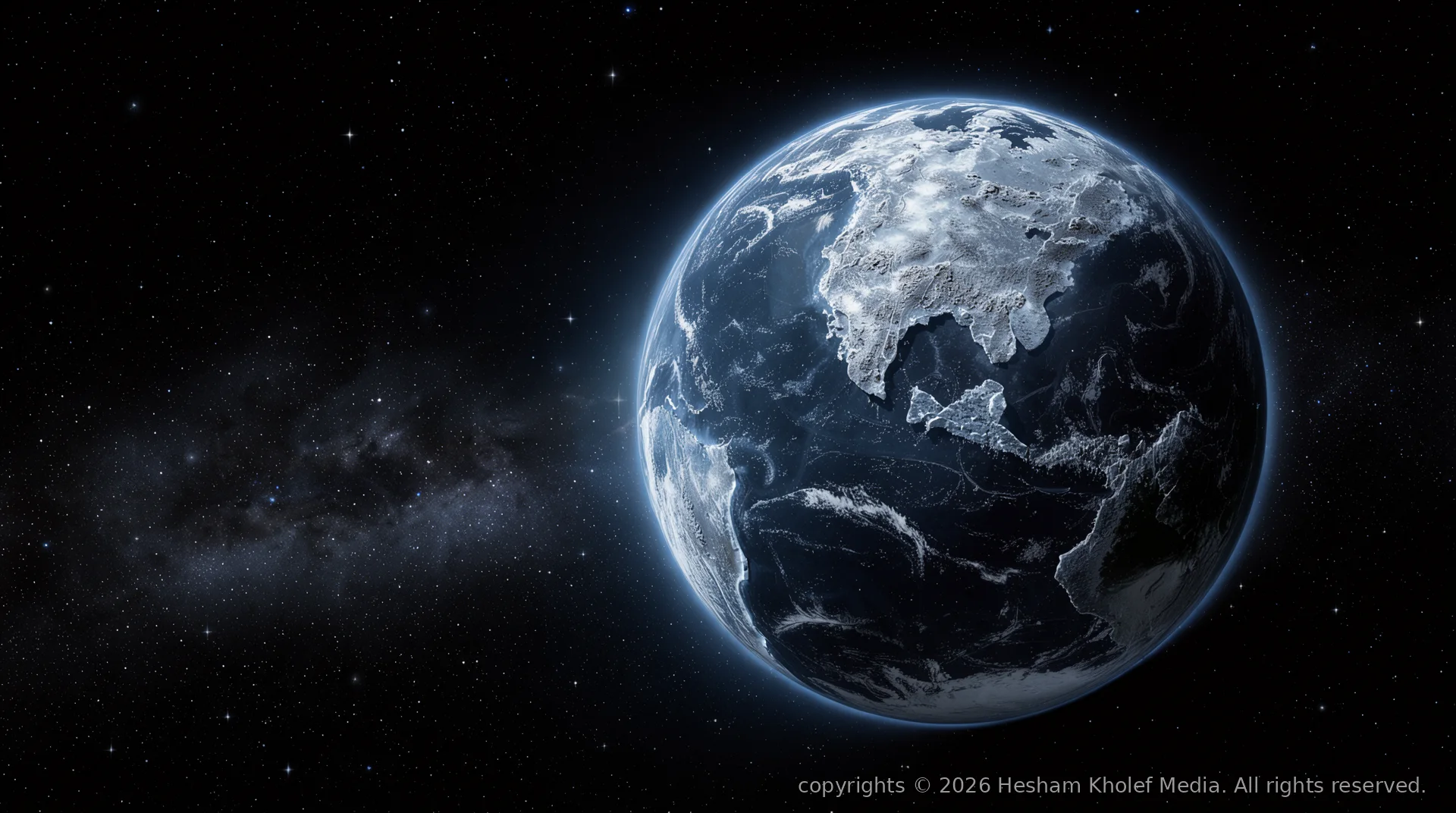
Polar ice expands rapidly. Temperate lakes freeze solid. The ocean surface begins forming a skin of ice, starting at high latitudes and marching equatorward. The latent heat of fusion briefly slows the cooling as water crystallizes, but the thermodynamic arrow is merciless. By week three, the global average temperature reaches –20°C. Most multicellular life — plants, animals, fungi — is dead or dormant. Only extremophile microbes in deep crustal rocks and hydrothermal vent communities persist, untouched by surface catastrophe.
Months 1–12: Atmospheric Collapse

As temperatures plunge below –78°C, carbon dioxide begins depositing as dry ice at the poles. By –190°C, nitrogen and oxygen — the bulk of the atmosphere — condense into liquid and then solid "snow." The sky literally falls. Earth's protective blanket vanishes, exposing the surface to vacuum and cosmic radiation. The planet becomes a vacuum world with a tenuous exosphere of helium and hydrogen, slowly escaping to space. The oceans, now kilometers-deep ice shells, entomb the last liquid water in pressurized pockets near geothermal vents.
Years to Millennia: The Rogue Planet
Earth, untethered gravitationally? No — the Sun's mass remains (unless the thought experiment removes it entirely). But if the Sun simply "turns off" while keeping its mass, Earth continues its orbit around a cold, dark stellar corpse. The planet equilibrates at roughly 30–40 Kelvin (–240°C), heated only by geothermal flux (0.09 W/m²) and radioactive decay in the mantle. It becomes a rogue-like world in a bound orbit: a frozen sphere with a thin hydrogen atmosphere, drifting through the galaxy as a tomb of once-vibrant chemistry.
The Counterfactual: If the Sun's Mass Also Vanished
If the Sun's gravity disappeared simultaneously with its light, Earth would fly off on a tangent at 30 km/s — a true rogue planet. The night sky would shift as nearby stars changed position over centuries. The Milky Way would remain our galaxy, but the solar system would dissolve. Planets would scatter. Earth might eventually be captured by another star, or wander interstellar space forever — a dark ship carrying the fossilized record of a biosphere that once knew warmth.
Conclusion: The Fragility of the Illuminated
The Sun's constancy is an illusion of human timescales. It has shone for 4.6 billion years and will for 5 billion more. But the thought experiment reveals a profound truth: every breath, every harvest, every thought ever thought on this world was purchased with solar photons. We are not merely illuminated by the Sun — we are made of its energy, stored temporarily in chemical bonds, released in the metabolism of life. To lose the Sun is to lose the ledger itself. The darkness that follows is not merely absence of light; it is the unwinding of the thermodynamic story that wrote us.
Comments (0)