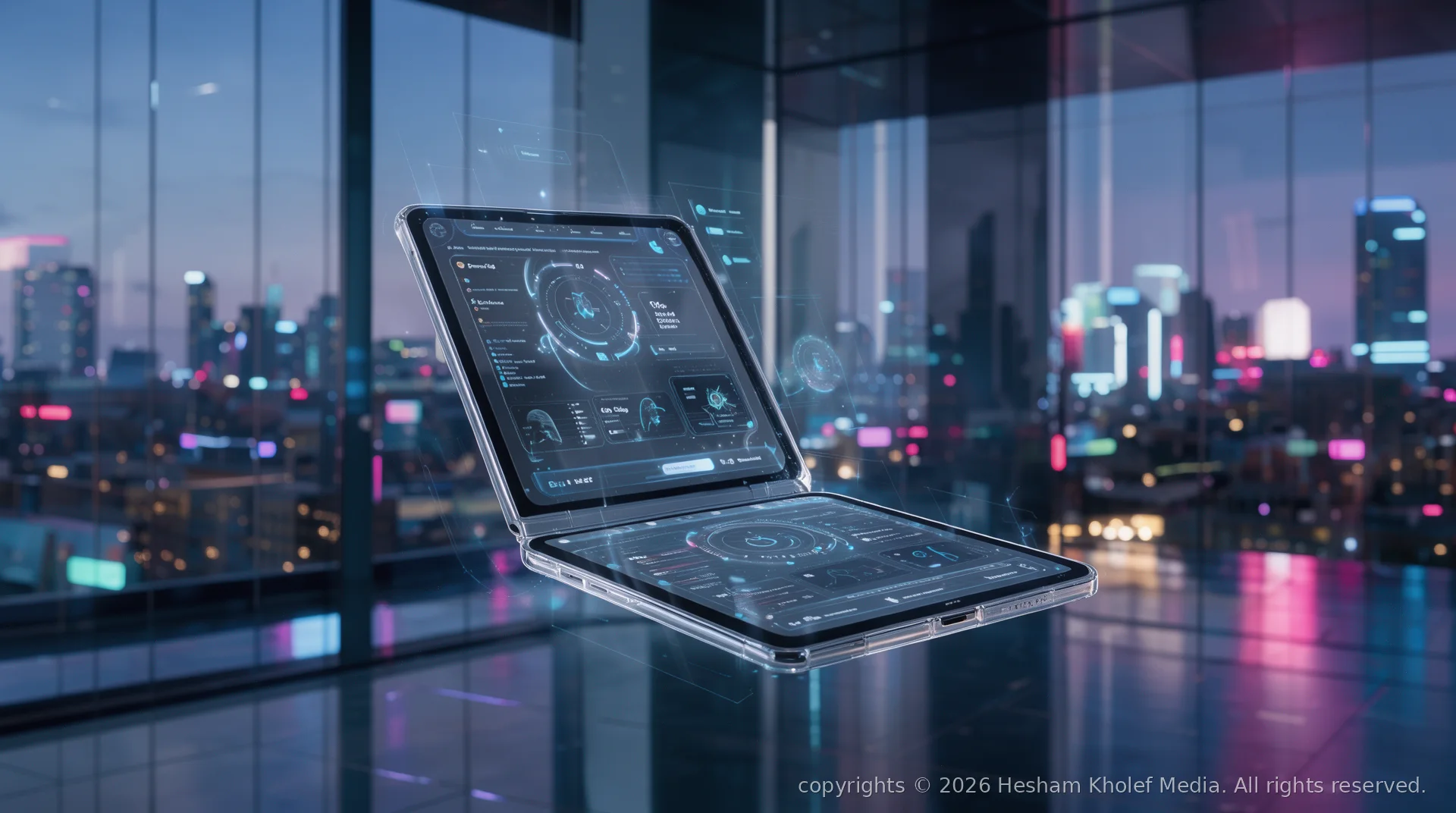
The End of the Slab Era

For seventeen years, the smartphone has been a rectangle of glass and metal. Same silhouette. Same grid of icons. Same fundamental contract: you tap, it responds. But the slab is hitting a physics wall. Batteries cannot densify fast enough. Cameras have run out of bezel to colonize. Processors are thermally throttled before they hit peak clocks. The industry's answer is not a better rectangle — it is a family of form factors that dissolve the rectangle entirely.
Foldables: From Novelty to Default
The first foldables were fragile science projects. The current generation — Samsung's Z Fold 6, Google's Pixel 9 Pro Fold, Honor's Magic V3, Xiaomi's Mix Fold 4 — are daily drivers. Creases have flattened. Hinges survive 400,000 cycles. Outer screens are now usable for full-app workflows. The next leap is tri-fold (Huawei's Mate XT already ships in China) and rollable displays that extend like a scroll, giving you a 10-inch tablet that retracts into a 6.5-inch phone. By 2027, foldables will cross 10% of premium shipments; by 2030, the "candy bar" will be the budget option.
AI-Native: The Death of the App Grid

The app model — download, install, tap, navigate — is thirty years old. It assumes human attention is infinite. It isn't. The emerging paradigm is intent-based computing: you state a goal ("book a dinner for two near the office Thursday, Italian, outdoor seating, under $120") and an on-device orchestration layer decomposes it across services, calendars, maps, payments, and confirmations without you opening a single app. Apple's Apple Intelligence, Google's Gemini Nano, and Qualcomm's Snapdragon 8 Gen 4 NPU (45 TOPS) are the substrate. The interface becomes a conversational canvas — multimodal, contextual, proactive. The home screen becomes a timeline of outcomes, not icons.
"The most profound technologies are those that disappear. They weave themselves into the fabric of everyday life until they are indistinguishable from it."
— Mark Weiser, 1991
Satellite Connectivity: The End of Dead Zones
Apple's Emergency SOS via Globalstar, T-Mobile's Starlink direct-to-cell, and AST SpaceMobile's BlueBird constellation are the vanguard. The spec target: ubiquitous narrowband (text, location, emergency) by 2025; broadband (voice, low-res video, IoT telemetry) by 2027. This rewrites the coverage map — mountains, oceans, disaster zones, rural highways — and quietly dismantles the carrier moat. Your number follows you, not the tower.
6G and the Terahertz Frontier
While 5G struggles with mmWave penetration, 6G research (3GPP Release 19/20) targets sub-terahertz bands (100–300 GHz) for centimeter-precision sensing and multi-gigabit links over meters. The phone becomes a radar: gesture recognition through fabric, vital-sign monitoring at a distance, indoor mapping without beacons. Latency drops to sub-millisecond, enabling real-time cloud rendering for AR glasses tethered to the phone — the phone as compute puck, the glasses as display.
Form Factor Mutation: Beyond the Handset

- AI Pins & Pendants (Humane, Rabbit, Limitless) — screenless, voice-first, projecting UI onto the palm. Early, flawed, but signaling the vector.
- Smart Glasses (Meta Ray-Ban 2, Xreal One, Brilliant Labs Frame) — the display moves to the eye; the phone shrinks to a pocket compute module.
- Wrist-Worn Compute — Apple Watch Ultra and Pixel Watch 3 already run LLM inference locally. Add a projection keyboard and you have a phone without a phone.
- Neural Interfaces — Neuralink, Synchron, and Meta's EMG wristband point to a decade-out future where intent is the input, no voice or gesture required.
The smartphone isn't dying — it's metastasizing. Its sensors, radios, and silicon are dispersing into a personal area network of wearables, hearables, and ambient surfaces. The "phone" becomes the orchestration hub you rarely touch.
Silicon Sovereignty and the On-Device Imperative
Privacy regulation (EU AI Act, state-level US bills) and latency demands are forcing inference to the edge. Qualcomm's Oryon cores, Apple's M-series derived mobile chips, MediaTek's Dimensity 9400, and Google's Tensor G5 (TSMC 3nm) all prioritize NPU throughput per watt. The metric shifting: not Geekbench, but tokens per joule. Models like Llama 3.2 3B, Phi-3.5-mini, and Gemma 2 2B now run entirely on-device with sub-100ms first-token latency. Your data never leaves the secure enclave.
Sustainability: Circular by Design
EU's Ecodesign Regulation (2025) mandates user-replaceable batteries, 5-year OS updates, spare parts for 7 years, and repairability scores on packaging. Fairphone 5 and Framework's future mobile chassis prove modularity need not compromise thinness. Recycled rare earths (neodymium, dysprosium, terbium) in magnets and cobalt-free cathodes are crossing 50% in flagship BOMs. The linear upgrade cycle is legally obsoleted.
Conclusion: The Invisible Companion
The next generation of mobile phones isn't a phone. It's a personal compute constellation — a foldable primary display, AI glasses for glanceable AR, a ring or watch for biometric auth and haptic I/O, earbuds for spatial audio and voice, all synchronized by an on-device agent that knows your context, guards your privacy, and acts on intent. You won't "check your phone" in 2030. You'll simply be in the flow of your own augmented cognition. The rectangle served its purpose. The constellation is just beginning.
Comments (0)