From Pastime to Platform: The Great Inversion

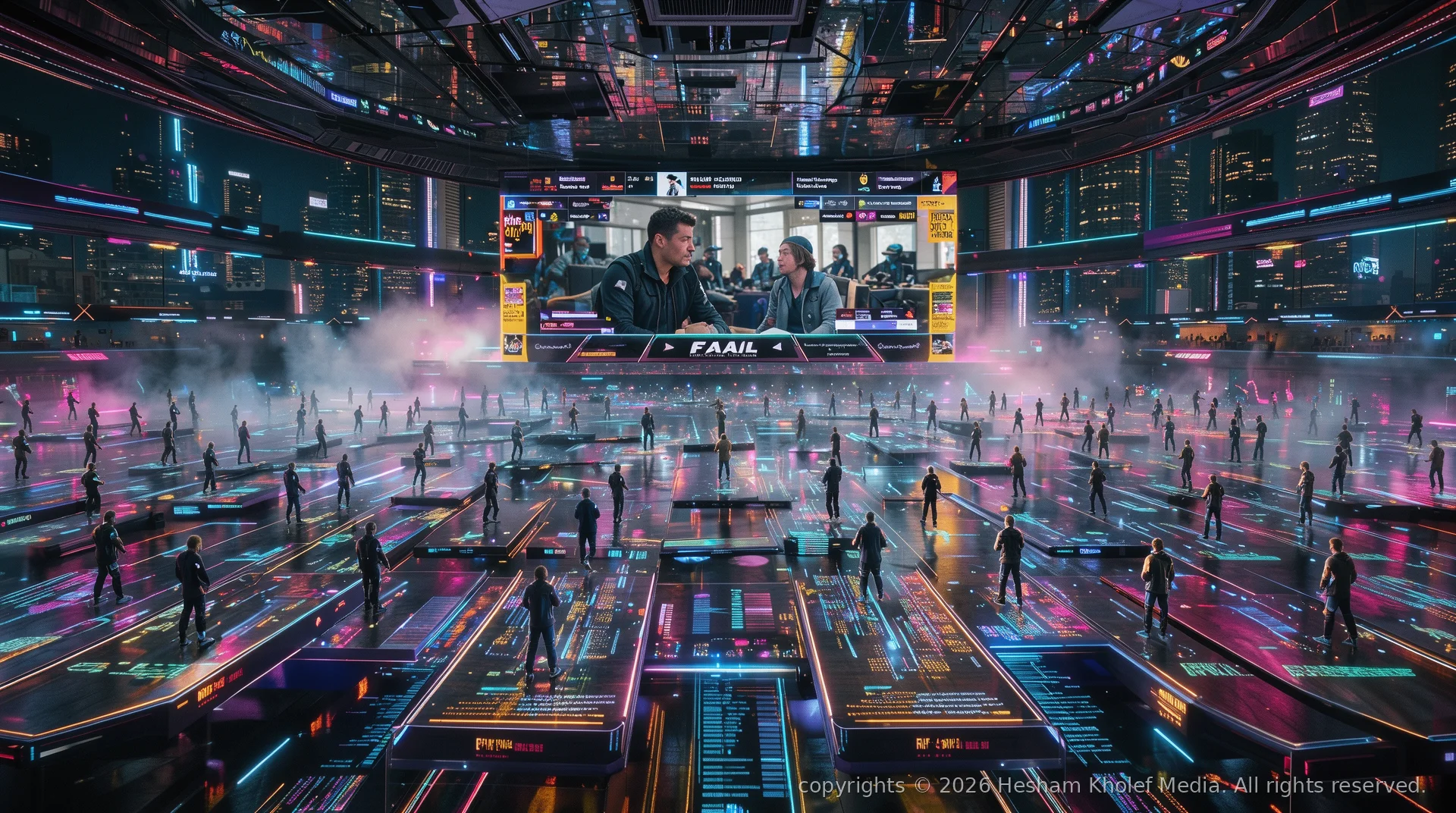
For decades, games were labeled escapism — a retreat from "real life." That framing has collapsed. In 2024, 3.4 billion people play video games. The global market exceeds $200 billion, dwarfing film, music, and streaming combined. But the numbers understate the shift. Games are no longer content you consume; they are infrastructure you inhabit. They are where friendships form, economies operate, identities are forged, and culture is authored. The question isn't whether games will become an important part of life — they already are. The question is what happens when the boundary between "game" and "life" dissolves entirely.
The Social Layer: Discord Was Just the Beginning
Fortnite's concerts (Travis Scott: 27.7 million concurrent), Roblox's graduation ceremonies during lockdown, and Final Fantasy XIV's in-game weddings and funerals revealed a truth: games are the new third places. With physical third places eroding — malls dying, parks privatized, suburbs unwalkable — persistent virtual worlds offer low-friction, high-bandwidth social presence. Voice, video, spatial audio, and shared activity create intimacy that text feeds cannot. The next generation (Rec Room, VRChat, Horizon Worlds, Project Kira) bakes social primitives — identity, reputation, governance, commerce — into the engine itself. Your avatar is your passport; your inventory is your resume.
Cloud-Native: The Death of the Box

Consoles and gaming PCs are single points of failure: expensive, immobile, obsolete in years. Cloud gaming — GeForce Now, Xbox Cloud, PlayStation Portal, Luna, and the rising telco-edge deployments (SK Telecom, Deutsche Telekom, Verizon) — shifts compute to the data center. The screen becomes a thin client: phone, tablet, TV, AR glasses, car dashboard. 5G Advanced and Wi-Fi 7 bring sub-20ms latency to 90% of urban populations. The implication: any screen is a gaming screen. No download. No install. No patch. Instant play becomes the default, expanding the addressable market to every connected human.
Generative AI: Infinite Worlds, Zero Marginal Cost
Traditional content pipelines — hand-crafted levels, scripted dialogue, baked animations — cannot scale to persistent worlds populated by billions. Generative AI changes the economics:
- World Generation: NVIDIA's ACE, Google's Genie 2, and Unity's Muse create 3D environments, quests, and NPCs from text prompts in seconds.
- Living NPCs: Inworld AI and Convai power characters with persistent memory, goals, and unscripted dialogue — no more dialogue trees.
- Player-as-Creator: Roblox's Assistant, Fortnite's UEFN, and Minecraft's AI modding tools let players speak worlds into existence. The skill floor drops; the ceiling rises.
- Real-Time Localization: Seamless voice-to-voice translation across 100+ languages makes global shards truly global.
"The metaverse isn't a place you go. It's a time when the virtual becomes more valuable than the physical."
— Shaan Puri, 2022
The Economy Is Real: Play, Create, Earn, Own
The "play-to-earn" hype cycle of 2021 was premature, but the underlying vector is sound: digital labor deserves digital property rights. Roblox paid creators $740M in 2023. Fortnite's UEFN creators earn millions. Steam Workshop, VRChat avatars, Second Life's land market — all prefigure a creator economy where user-generated content (UGC) is the content. Blockchain rails (Immutable zkEVM, Ronin, Arbitrum) and non-blockchain platforms (Core, Highrise) are converging on interoperable standards for digital assets: portable avatars, wearable NFTs, composable game logic. The next Minecraft won't be a game — it'll be a protocol.
Esports: The New Global Spectacle

League of Legends Worlds 2023 peaked at 6.4 million concurrent viewers (excluding China). Valorant Champions, CS2 Majors, and the Esports World Cup in Riyadh command prize pools rivaling tennis Grand Slams. But the structure is shifting: franchise leagues (OWL, LCS, CDL) are yielding to open circuits with promotion/relegation, co-streaming rights for creators, and integrated betting markets (where regulated). The Olympic Esports Games (debut 2025) signal state-level recognition. For Gen Alpha, Faker and s1mple are the Messi and Jordan.
Spatial Computing: The Screen Falls Away
Apple Vision Pro, Meta Quest 3, Xreal Air 2 Ultra, and the coming wave of lightweight AR glasses (Meta Orion, Snap Spectacles 5, Brilliant Labs Frame) move the display from your hand to your retina. Spatial gaming — where your living room is the level, your hands are the controllers, and digital objects persist in physical space — merges the game layer with reality. Pokémon GO was the prototype; Peridot, NBA All-World, and Niantic's Visual Positioning System are the vanguard. When AR clouds cover cities, every street corner becomes a potential spawn point.
The danger isn't that games become too important — it's that the platforms owning them become too powerful. Interoperability, open standards, and user sovereignty must be architected now, not negotiated later.
Health, Learning, Work: The Serious Game
- Therapeutics: FDA-cleared EndeavorRx treats ADHD; VR exposure therapy treats PTSD; SuperBetter builds resilience.
- Education: Minecraft Education, Kerbal Space Program, and Universe Sandbox teach physics, coding, and systems thinking better than textbooks.
- Work: Digital twins (NVIDIA Omniverse, Unity Digital Twins) let engineers simulate factories, cities, and climate models. The "game engine" is now the simulation engine for the physical world.
Conclusion: The Universal Medium
Games are eating the world the way software did — because games are software, plus narrative, plus social, plus economy, plus simulation. They are the only medium that natively integrates all five. In 2030, you won't "play a game." You'll log into your persistent identity, step into a world that remembers you, collaborate with friends across continents, build something that earns, learn something that transfers, and attend a concert that feels more real than the stadium. The screen was a window. The world is becoming the interface. Welcome to the ludic century.
Comments (0)