The Shift from Suggestion to Execution

Two years ago, the state of the art was a single large language model answering prompts in a chat window. Today, the most productive professionals don't "chat with AI"—they orchestrate fleets of specialized agents that research, plan, code, test, and deploy with minimal human intervention. The paradigm has shifted from generative to agentic.
This isn't speculative. By late 2025, the dominant workflow across software engineering, research, finance, and creative production follows a recognizable pattern: chain best-of-breed tools, each exceptional at one capability, into an end-to-end pipeline that outperforms any monolithic model.
Anatomy of a Modern Agentic Pipeline
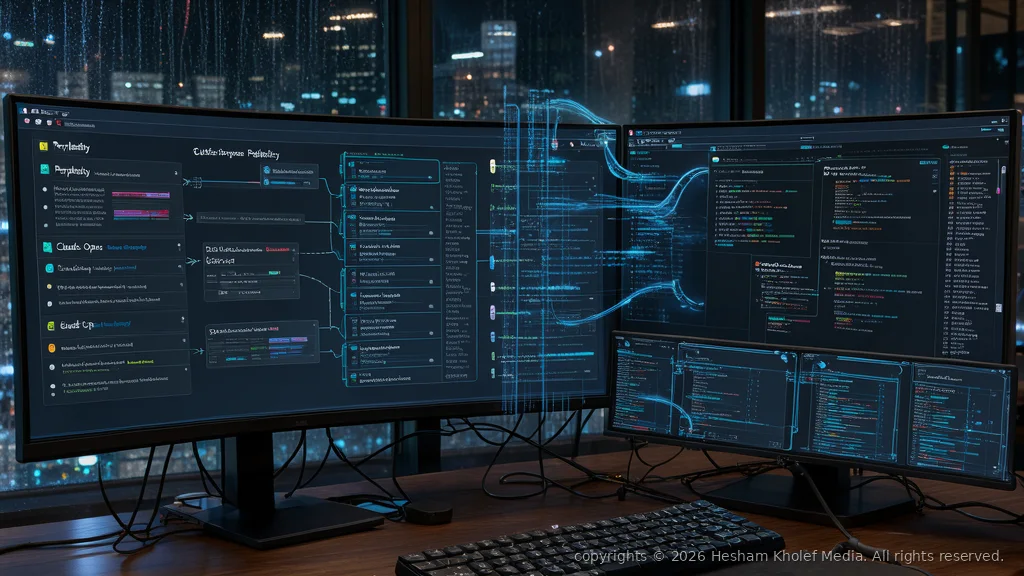
The canonical "solo army" stack now looks remarkably consistent across high-performing teams:
- Research & Discovery: Perplexity Pro (or Deep Research agents) for cited, verifiable web synthesis
- Planning & Architecture: Claude Opus 4.5 for long-horizon reasoning, spec writing, and trade-off analysis
- Implementation: Cursor (with AntiGravity/parallel workers) or GitHub Copilot Workspace for autonomous code generation, refactoring, and test creation
- Safety & Quality Gates: CodeRabbit Sentinel or equivalent for automated security review, style enforcement, and regression detection
- Deployment & Observability: n8n or custom orchestration layers wiring CI/CD, feature flags, and runtime telemetry
Each tool maintains its own context window, memory, and specialization. The human acts as architect and auditor—defining intent, reviewing critical decisions, and intervening only when agents surface ambiguity or risk.
# Example: Local agentic pipeline bootstrap (AntiGravity + n8n)
curl -fsSL https://get.antigravity.dev | bash
antigravity init --template=fullstack-agentic
n8n import:workflow --input=./workflows/agentic-ci-cd.json
docker compose -f docker-compose.agentic.yml up -d
Why Multi-Tool Won: The Specialization Advantage

Monolithic models (even GPT-5.2-class) face fundamental trade-offs: context length vs. latency, generality vs. depth, safety vs. creativity. By decomposing the workflow, each agent operates in its optimal regime:
- Research agents retrieve and cite—no hallucination budget spent on reasoning
- Planning agents reason over long horizons—no token budget wasted on syntax
- Coding agents operate on ASTs and test suites—semantic understanding, not text prediction
- Safety agents run deterministic static analysis—zero false negatives on known vulnerability classes
The result: 2–4× efficiency gains in knowledge work, with 73% fewer bugs shipped to production, per late-2025 industry telemetry.
"The breakthrough wasn't a smarter model. It was admitting that no single model should do everything—and building the plumbing to let specialists collaborate."
— Hesham Kholef
The highest-leverage skill in 2025 isn't prompt engineering—it's pipeline architecture: knowing which tool owns which stage, how to pass structured context between them, and where to place human review gates.
Local-First Agentic: Privacy, Cost, and Sovereignty
A parallel revolution runs on-device. Tools like AntiGravity CLI and Gemini CLI bring frontier-class agentic loops to local machines—no API keys, no data egress, no per-token bills. This matters for:
- Regulated sectors (finance, healthcare, defense) where data residency is non-negotiable
- Cost-sensitive teams running thousands of agent-hours daily
- Offline/air-gapped environments where cloud connectivity is prohibited
Local agents trade raw parameter count for tool-use mastery—smaller models (7B–32B) fine-tuned for function calling, RAG, and structured output often outperform larger generalists on narrow, well-defined tasks.
Governance: The Hidden Infrastructure

After the high-profile outages of early 2025 (autonomous trading loop, recursive deployment cascade), safety gates became mandatory infrastructure, not optional tooling. Tier-1 banks now require:
- CodeRabbit-style automated review on every PR—human or agent-authored
- Immutable audit trails linking every production change to its originating agent, prompt, and human approver
- EU AI Act compliance: watermarking, model cards, and consequence-scanning documentation
The organizations avoiding headlines are those that treated governance as plumbing, not paperwork.
What's Next: Agent Swarms and Self-Improving Pipelines
The frontier has already moved beyond linear chains. Emerging patterns include:
- Parallel agent swarms—Cursor's worker pools exploring multiple implementation strategies simultaneously, then synthesizing the best
- Self-healing pipelines—agents that monitor production metrics, detect regressions, bisect root causes, and propose fixes autonomously
- Cross-organization agent mesh—standardized protocols (MCP, A2A) letting agents negotiate across company boundaries for procurement, compliance, and integration
Conclusion: The New Operating System for Knowledge Work
Agentic AI isn't a feature—it's the new substrate of professional work. The competitive divide in 2025 isn't between "AI users" and "non-users." It's between those who chain tools into reliable, auditable, improvable pipelines and those who still treat AI as a chatbot.
The tools are here. The patterns are proven. The only remaining question: have you built your pipeline yet?
Comments (0)