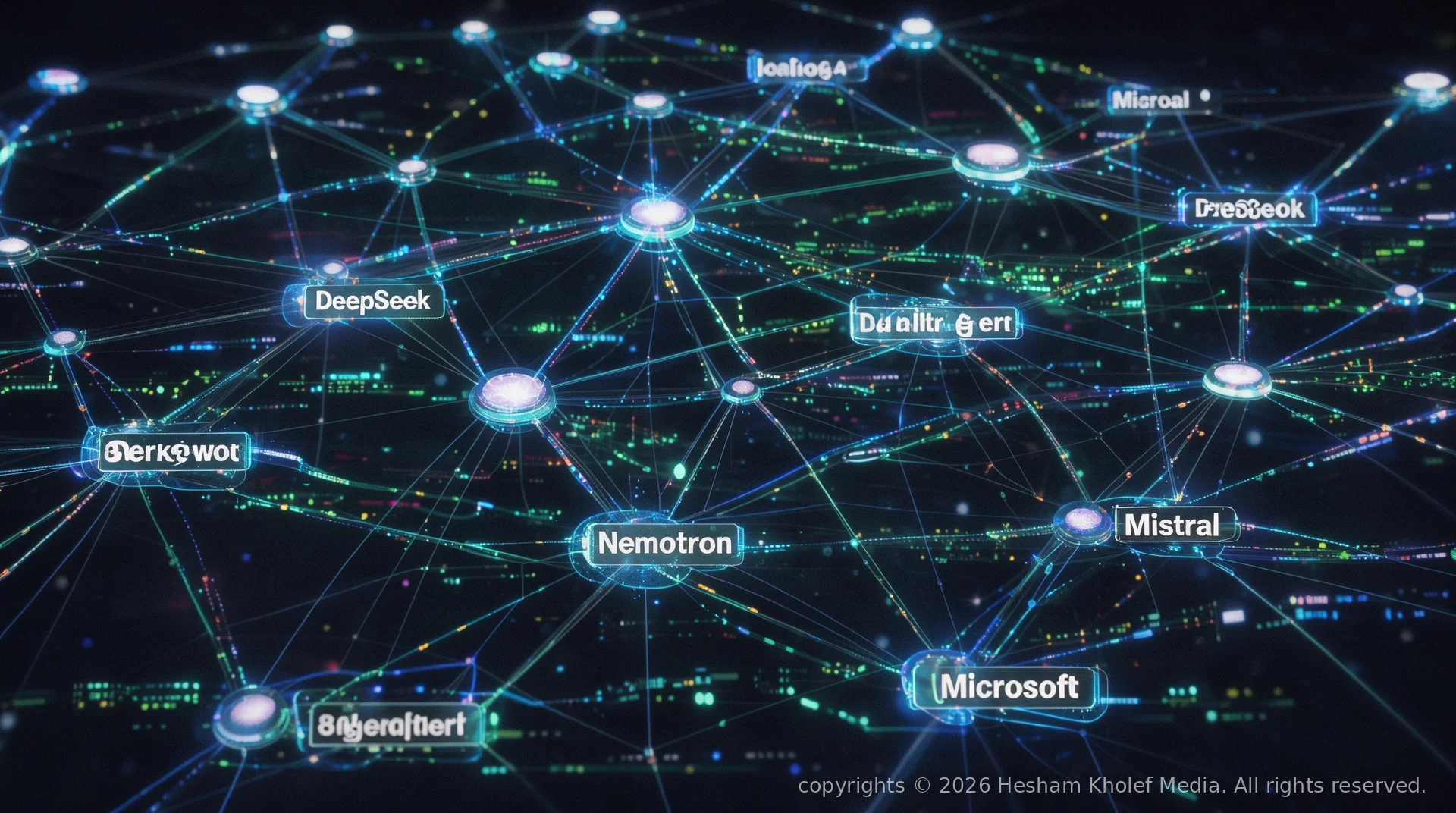
The October Release Wave in Numbers

Between September 21 and October 17, 2026, the AI Flash Report tracker logged 13 major model releases across seven organizations — an average of one new frontier model every 2.3 days. The cadence reflects a maturing ecosystem where specialization (reranking, embedding, code, Arabic NLP) now runs parallel to flagship LLM pushes.
DeepSeek-V4.1-Flash-1017: Speed-Optimized Flagship
Released October 17, DeepSeek-V4.1-Flash-1017 is the latest iteration in DeepSeek's flash-optimized line. Positioned as a high-throughput, low-latency model for production workloads, it inherits the mixture-of-experts architecture from V4 but with further distillation for inference efficiency. Early benchmarks place it at 89.4% on MMLU-Pro and 87.3% on GPQA Diamond — competitive with GPT-5.1-class models at a fraction of the blended token cost (~$0.89/Mtok).
NVIDIA's Nemotron 3.5 Family: Rerank, Embed, and Bolt

NVIDIA shipped three models in five days:
- Nemotron-3.5-Rerank-8B-BF16 (Oct 15) — Purpose-built for retrieval-augmented generation pipelines, optimized for precision@k on BEIR benchmarks.
- Nemotron-3.5-Embed-8B-BF16 (Oct 7) — General-purpose embedding model targeting MTEB leaderboard parity with Cohere v3 and Voyage-large-2.
- Nemotron-3.5-Bolt-74B-A9B-24GB-LiLiCorr (Oct 12) — A 74B-parameter sparse mixture-of-experts model with 9B active parameters, designed for single-GPU (24 GB VRAM) deployment via low-bit correlation compression.
The Bolt release is notable for bringing 70B+ quality to consumer-grade hardware — a practical milestone for self-hosted inference.
Mistral's Multilingual Push: Timestral and LIDstral-Arabic
Mistral released four models in a single week. The Timestral series (5M, 28M, 123M parameters) targets time-series forecasting and temporal reasoning — a relatively underserved niche. More broadly significant is LIDstral-Arabic (Oct 8), Mistral's first dedicated Arabic-language model, covering Modern Standard Arabic and major dialects with competitive scores on ArabicMMLU and ALUE benchmarks.
"The true measure of an AI ecosystem is not how fast the flagship runs, but how many specialized tools it puts in developers' hands."
— Hesham Kholef
Microsoft's Applied Research Trio
Microsoft Research contributed three domain-specific models:
- scFM-dataselection (Oct 16) — Foundation model for single-cell genomics data curation.
- UserRepGen-4B (Oct 14) — User representation generation for recommendation systems.
- AesCode-32B (Sep 29) — Code generation with emphasis on aesthetic code style and maintainability metrics.
These releases signal a shift: major labs are increasingly open-sourcing or API-releasing narrow, high-value models rather than only chasing generalist benchmarks.
The October wave underscores a new reality: competitive advantage now lives in the long tail of specialized models — rerankers, embedders, code stylists, language-specific LLMs — not just in the headline MMLU score of the month.
Leaderboard Context: Who's Leading Now?

As of the October 30 tracker update, the GPQA Diamond leaderboard is topped by MiniMax-M3 (92.9%), followed by Anthropic's Claude Fable 5 (92.6%) and Alibaba's Qwen3.7 Max (92.3%). On price/quality (MMLU-Pro per $Mtok), Zhipu AI's GLM-5 leads at 373.5 pts/$, with Google's Gemini 2.0 Flash (240.6) and DeepSeek V3.2 (101.0) rounding out the top three — confirming that open-weight and Chinese labs are dominating the efficiency frontier.
What This Means for Builders
For engineering teams, the takeaway is clear: the model selection matrix has expanded horizontally. A production RAG pipeline in October 2026 might reasonably combine Nemotron-3.5-Rerank for retrieval, Nemotron-3.5-Embed for indexing, DeepSeek-V4.1-Flash for generation, and LIDstral-Arabic for MENA-facing surfaces — all API-accessible, all released within weeks of each other. The integration challenge has replaced the access challenge.
Looking Ahead
With 24 models released in the last 90 days and the tracker showing ~1 new model per day, the velocity is unlikely to slow. The next inflection point will be tooling: unified routers, automatic model selection by task, and cost/latency/quality arbitrage layers that abstract away the model zoo. Until then, the October 2026 release wave stands as a snapshot of an ecosystem that has learned to ship specialization at scale.
Comments (0)