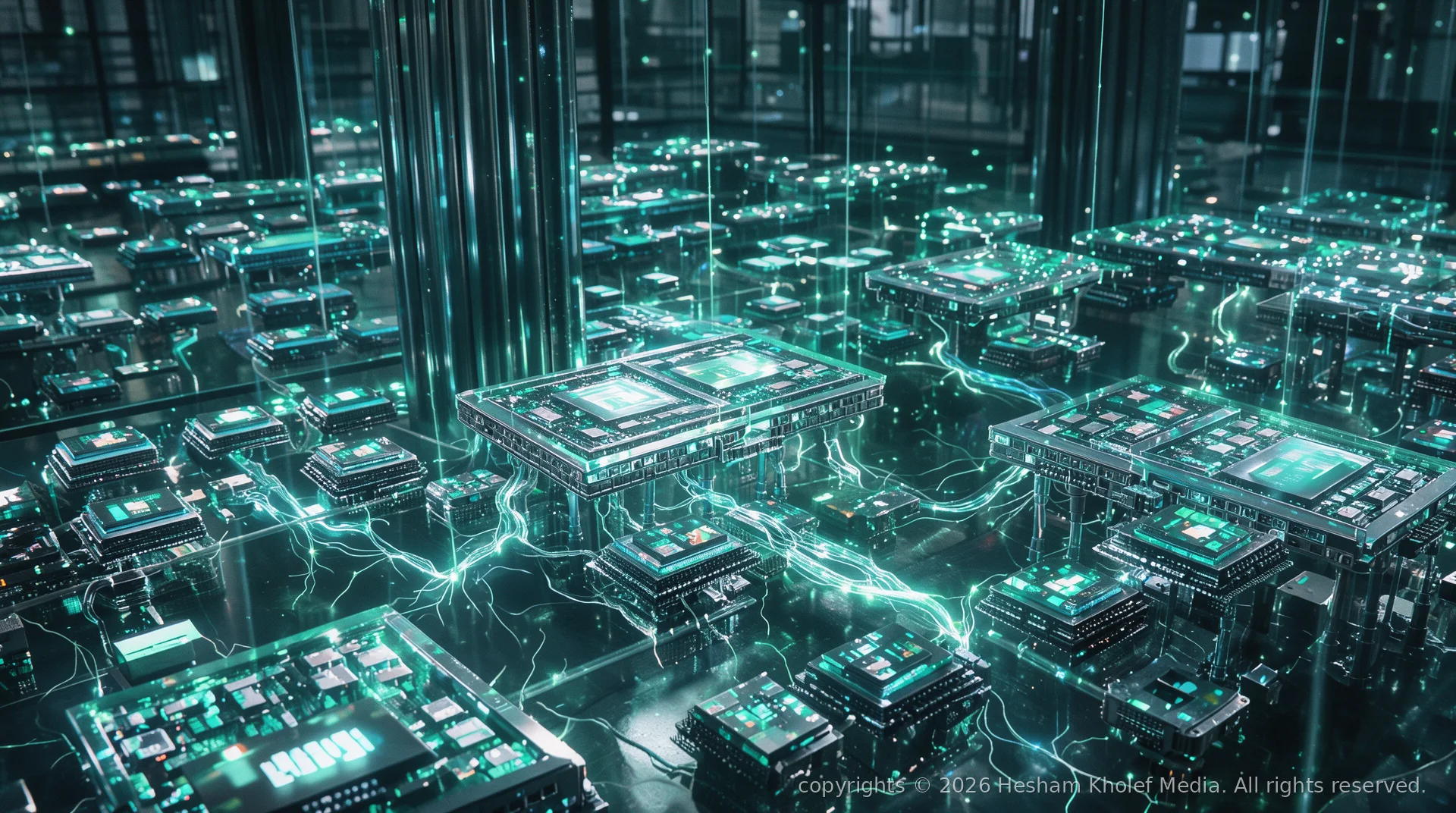
The Von Neumann Bottleneck Has Met Its Match

For seven decades, computing has revolved around a single paradigm: a central processing unit (CPU) fetching instructions and data from a separate random-access memory (RAM) over a shared bus. This von Neumann architecture powered everything from mainframes to smartphones. But it carries a fundamental flaw — the bus between compute and memory is a bottleneck. As AI models scale to trillions of parameters, shuffling weights between GPU VRAM and system RAM across PCIe lanes has become the dominant latency and energy cost.
The industry's response is not incremental. It is architectural rebellion.
Unified Memory: Erasing the CPU-GPU Divide
Apple's M-series chips fired the opening salvo. By placing CPU, GPU, and Neural Engine on a single SoC with a shared high-bandwidth memory pool, they eliminated the PCIe transfer tax. The GPU no longer "copies" data from CPU RAM — it simply accesses it. NVIDIA followed with Grace Hopper Superchip, linking CPU and GPU via NVLink-C2C at 900 GB/s bidirectional bandwidth, presenting a single coherent memory address space. AMD's MI300A APU takes it further: CPU cores, GPU compute units, and HBM3 memory on one package, 128 GB of unified memory, no discrete GPU card required.
The implication is profound: the CPU is no longer the "host" that manages a "device." It becomes a peer — or in some workloads, an afterthought.
Processing-in-Memory: Compute Where Data Lives

If moving data to compute is expensive, why not bring compute to data? Processing-in-memory (PIM) and near-memory compute embed arithmetic units directly into memory controllers or DRAM banks. Samsung's HBM-PIM adds FP16 MAC units to each memory bank. UPMEM places DPU cores alongside DRAM arrays. SK hynix's AiM (Accelerator-in-Memory) integrates vector engines into GDDR6.
These architectures turn memory from passive storage into active compute fabric. For bandwidth-bound kernels — attention matrices, embedding lookups, graph traversals — the speedup is measured in orders of magnitude, with energy per operation plummeting.
The Rise of AI-First Silicon: No CPU Required
Cerebras Wafer-Scale Engine (WSE-3) packs 900,000 AI cores and 44 GB on-chip SRAM on a single wafer-scale chip — no external RAM, no CPU sockets. Groq's LPU (Language Processing Unit) uses a deterministic tensor streaming architecture with 230 MB on-chip SRAM, eliminating external memory latency entirely for inference. Tenstorrent's Grayskull and Wormhole connect RISC-V cores with tensor accelerators in a mesh, but their programming model treats the CPU as just another tile in the fabric.
In these systems, the traditional CPU is absent or reduced to a management co-processor. The accelerator is the computer.
CXL and the Disaggregated Future
Compute Express Link (CXL) 3.0 enables memory pooling and sharing across multiple hosts and devices. A rack can now present terabytes of coherent memory to any accelerator — GPU, FPGA, ASIC — without a CPU owning it. This enables composable infrastructure: need more memory for a training run? Allocate it from the pool. Need more compute? Add an accelerator sled. The CPU becomes a resource manager, not the system anchor.
The "No RAM" Claim: Reality Check

Headlines about "no RAM computers" conflate two distinct trends. First, on-chip memory replacing off-chip DRAM for working sets — SRAM, MRAM, ReRAM integrated into the compute die. Second, storage-class memory (SCM) blurring the line between RAM and persistent storage — Intel Optane (discontinued but influential), CXL-attached DRAM, and emerging ReRAM/PCM technologies.
We are not eliminating the memory hierarchy. We are collapsing its levels. The distinction between "register," "cache," "RAM," and "storage" is dissolving into a continuum of capacity, latency, and persistence — all addressable, all compute-adjacent.
"The computer of the future is not a CPU with accelerators attached. It is an accelerator with memory attached — and the CPU is just one of many optional clients."
— Hesham Kholef
The "no CPU, no RAM" vision is not about removing compute or memory — it's about removing the boundaries between them. Unified memory, in-memory compute, and accelerator-native architectures make the traditional CPU/RAM split an optional legacy mode, not a mandatory foundation.
What This Means for Developers and Operators
- Programming models shift: CUDA, Triton, and MLIR now target unified address spaces. Explicit
cudaMemcpycalls vanish. Code runs identically on laptop, server, and wafer-scale cluster. - OS kernels adapt: Linux's HMM (Heterogeneous Memory Management) and CXL kernel subsystems treat device memory as first-class citizens. The scheduler places tasks near data, not data near tasks.
- Capacity planning changes: You provision compute-memory composites, not separate CPU/RAM/GPU pools. A "node" is a sovereign compute-memory unit.
The Road Ahead: 2025–2030
Expect three converging trajectories:
- Chiplet-based SoCs (AMD MI400, Intel Falcon Shores, NVIDIA Vera Rubin) where CPU, GPU, NPU, and HBM are mix-and-match chiplets on a universal interconnect.
- Optical I/O (TSMC COUPE, Ayar Labs, Lightmatter) moving data between chiplets and packages at terabits/second with picojoule/bit energy, making disaggregation practical at rack scale.
- Non-von Neumann architectures — neuromorphic (Intel Loihi 2, BrainChip), analog in-memory compute (Mythic, Analog Devices), and photonic tensor cores (Lightmatter Envise) — where multiply-accumulate happens in the physics of the device, not digital logic.
Conclusion: The Center Has Shifted
The CPU was the sun around which memory, I/O, and accelerators orbited. That solar system has collapsed. The new center of gravity is the tensor operation — the fundamental unit of modern compute. Everything else — memory hierarchy, control flow, instruction decode — exists only to feed tensor engines faster, cheaper, and with less energy.
We are not entering a "no CPU, no RAM" world. We are entering a post-von Neumann world where the distinction between processor and memory, host and device, control and data, is no longer architectural law — it is a software-configurable policy.
The GPU, broadly defined as "the thing that does tensor math," has won. The only question is what we call its descendants.
Comments (0)