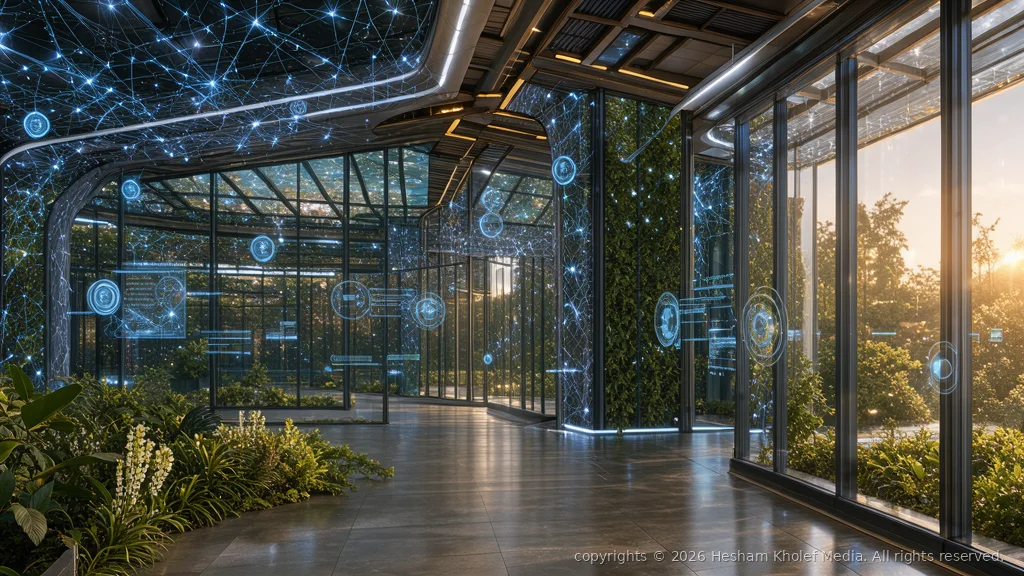
The Genesis of Computational Spatial Intelligence

The history of architecture has always been a dialogue between human intent and material constraint. For millennia, that dialogue was mediated through hand, eye, and static geometry. The digital revolution introduced CAD and BIM, yet these remained essentially representational tools — faster drafting, not deeper thinking. The emergence of neural frameworks marks a categorical shift: the built environment is acquiring a nervous system.
At the forefront of this transformation stands a new generation of computational design tools that do not merely execute geometry but learn spatial logic. Generative adversarial networks (GANs) trained on thousands of floor plans can now propose spatial configurations that satisfy complex programmatic constraints while optimizing for daylight, circulation, and structural efficiency. Variational autoencoders compress the latent space of architectural precedent, allowing designers to interpolate between typologies — morphing a courtyard house into a high-rise tower while preserving their essential spatial DNA.
"We are not designing buildings anymore. We are designing the rules that generate buildings, and increasingly, the rules that allow buildings to redesign themselves."
— Hesham Kholef
From Static Geometry to Living Systems
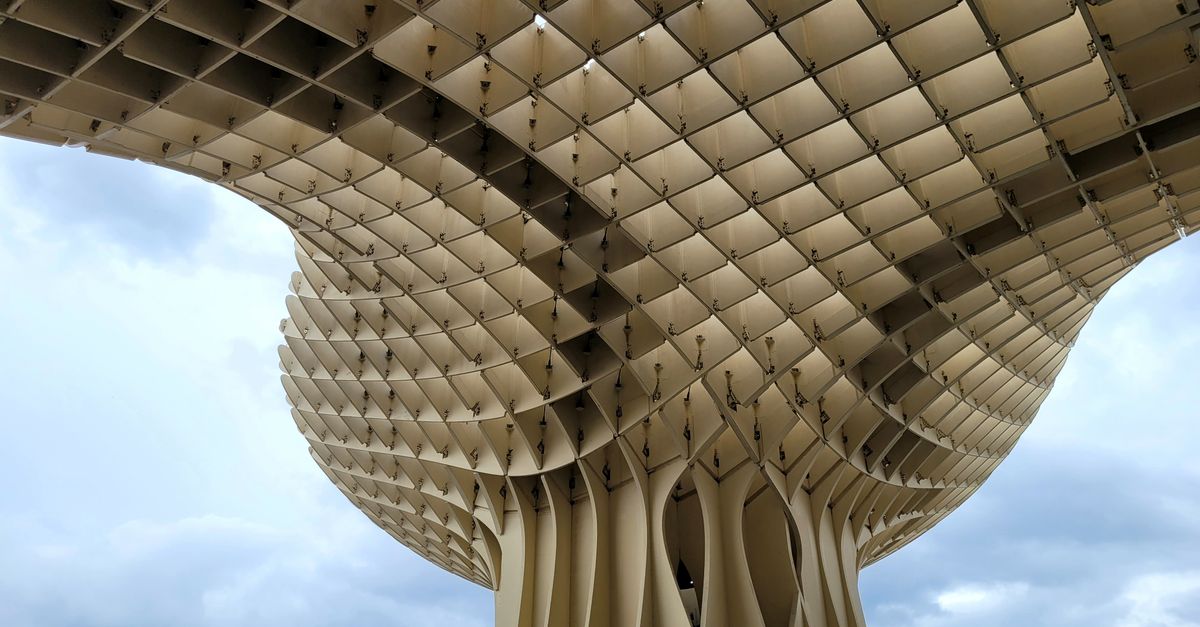
The paradigm shift from static to dynamic spatial intelligence manifests across three interconnected layers: generative synthesis, real-time adaptation, and predictive anticipation.
Generative Synthesis: The Latent Space of Form
Modern neural frameworks treat architectural form as a probability distribution rather than a fixed solution. Diffusion models, originally developed for image synthesis, have been adapted to generate 3D spatial configurations conditioned on performance criteria. A designer specifies high-level objectives — "maximize cross-ventilation while maintaining acoustic privacy between units" — and the model navigates the latent space of viable solutions, presenting a curated spectrum of options that would take human teams months to explore.
This approach fundamentally alters the architect's role. The designer becomes a curator of intent, defining objective functions, constraint hierarchies, and evaluation metrics. The neural system handles the combinatorial explosion of geometric possibilities, surfacing Pareto-optimal solutions that balance competing demands. Early adopters report 60–80% reduction in early-stage iteration cycles, with measurable improvements in energy performance and spatial quality.
# Conceptual neural architecture generation pipeline
import torch
from diffusers import DiffusionPipeline

class SpatialDiffusionModel:
    def __init__(self, checkpoint_path):
        self.pipeline = DiffusionPipeline.from_pretrained(checkpoint_path)
        self.condition_encoder = SpatialConditionEncoder()

    def generate_layouts(self, program, site_constraints, objectives, num_samples=16):
        conditions = self.condition_encoder.encode(
            program=program,
            constraints=site_constraints,
            objectives=objectives  # e.g., {"daylight": 0.8, "circulation_efficiency": 0.7}
        )

        layouts = self.pipeline(
            prompt_embeds=conditions,
            num_inference_steps=50,
            guidance_scale=7.5,
            num_images_per_prompt=num_samples
        ).images

        return self.post_process(layouts, objectives)

# Objective function for multi-criteria evaluation
def evaluate_spatial_quality(layout, objectives):
    metrics = {
        "daylight_autonomy": compute_sDA(layout),
        "circulation_efficiency": compute_circulation(layout),
        "structural_feasibility": compute_structural_score(layout),
        "programmatic_fit": compute_program_adherence(layout)
    }
    return sum(metrics[k] * objectives.get(k, 0) for k in metrics)
Real-Time Adaptation: Buildings That Feel
Beyond the design phase, neural frameworks are embedding intelligence into the built fabric itself. Edge-deployed transformer models process streams from dense sensor networks — CO₂, occupancy, daylight, thermal comfort, acoustic signatures — to continuously optimize building systems. Unlike traditional BMS (Building Management Systems) that operate on rigid schedules and threshold triggers, these learned policies anticipate needs.
A conference room prepares its thermal and lighting environment before occupants arrive, having learned the temporal patterns of meeting schedules. Facade systems adjust electrochromic glazing not just to current sun position but to predicted glare conditions based on weather forecasts and occupant gaze tracking. The building becomes a predictive organism, minimizing energy expenditure while maximizing human comfort.
The most profound shift is not technological but ontological: spaces are no longer passive containers for activity. They become active participants in the choreography of daily life, learning the rhythms of their inhabitants and evolving in response.
Predictive Anticipation: The Digital Twin as Crystal Ball
The convergence of neural simulation and high-fidelity digital twins enables a new mode of design: operational forecasting. Physics-informed neural networks (PINNs) can simulate year-long building performance in seconds, learning the complex mappings between design parameters and outcomes. Architects can now ask "what-if" questions at unprecedented scale: How does this facade pattern perform under 2050 climate projections? What happens to thermal comfort if occupancy density doubles?
This predictive capacity extends beyond energy. Social dynamics, wayfinding efficiency, even cognitive load can be modeled through agent-based simulations driven by learned behavioral priors. The design process becomes a form of spatial scenario planning, where neural surrogates replace costly physical prototyping.
The Materiality of Intelligence
Neural frameworks demand a rethinking of materiality itself. The intelligence of a space is no longer confined to its control systems — it is distributed into the very fabric of walls, floors, and ceilings.
Programmable Matter and Sensing Skins
Research into neuromorphic materials — substrates that compute through their physical dynamics rather than discrete transistors — promises to embed neural processing directly into building envelopes. Memristive concrete can store and process structural health data. Photonic fibers woven into facade membranes perform matrix multiplication at the speed of light, running inference on environmental data without a central processor.
These developments blur the boundary between structure and sensor, between shelter and cognition. A wall that monitors its own stress state, communicates with adjacent elements, and adjusts its porosity in response to humidity is not science fiction — it is the logical endpoint of current material science trajectories.
Human-Centric Latent Spaces
Critically, the most sophisticated neural architectures are those that model the human occupant not as a data point but as a cognitive agent. Multimodal transformers trained on physiological signals (heart rate variability, skin conductance, pupil dilation) correlated with spatial parameters are learning the latent dimensions of spatial experience. The result: design tools that can predict not just whether a space meets code, but whether it induces calm, focus, or inspiration.
# Spatial experience prediction config
model:
  type: "MultimodalTransformer"
  inputs:
    - spatial_features: ["daylight_factor", "acoustic_reverb", "thermal_gradient", "visual_complexity"]
    - physiological_signals: ["HRV", "EDA", "pupil_dilation", "EEG_alpha"]
    - behavioral_traces: ["dwell_time", "path_tortuosity", "gaze_entropy"]
  latent_dim: 256
  heads: 8
  layers: 12

objectives:
  - cognitive_load: minimize
  - restoration_potential: maximize
  - creative_facilitation: maximize
  - social_cohesion: context_dependent

training:
  dataset: "NeuroArchitecture Corpus v3.2"
  subjects: 2400
  spaces: 340
  modalities: ["fNIRS", "eye_tracking", "motion_capture", "environmental_sensing"]
Ethics, Agency, and the Algorithmic Environment

As spaces gain intelligence, they gain influence. A building that knows your circadian rhythm and adjusts lighting accordingly is helpful. A building that shares that data with your employer, insurer, or landlord is something else entirely. The architecture of intelligent spaces must be accompanied by an architecture of rights.
Key questions remain unresolved: Who owns the behavioral models trained on occupant data? Can a space refuse to adapt to a user's preferences if those preferences conflict with collective efficiency? When a neural facade optimizes for energy but creates glare for pedestrians outside, where does accountability lie?
The field needs more than technical standards — it needs a spatial ethics framework grounded in the recognition that intelligent environments shape human agency as profoundly as any law or social norm.
Toward a Synthetic Vernacular
History suggests that every major technological shift in architecture eventually produces a new vernacular — a shared language of form, technique, and culture adapted to local conditions. The neural vernacular is still emergent, but its contours are visible: buildings that grow like organisms, learn like apprentices, and remember like elders.
In this vernacular, the distinction between design and operation dissolves. The building is never finished; it is perpetually becoming, tuned by the interplay of human intent, environmental flux, and computational insight. The architect's signature is not a fixed form but a generative logic — a seed from which infinite context-sensitive expressions can flower.
"The intelligent space does not impose a single vision. It creates the conditions for many visions to coexist, adapt, and evolve."
— Hesham Kholef
Conclusion: The Space Between Neurons
The architecture of intelligent spaces is ultimately about the space between neurons — between the artificial neurons of our models and the biological neurons of our bodies. It is in that gap that meaning resides. Neural frameworks give us unprecedented power to shape that gap, to design not just the container but the conversation.
The buildings that emerge from this convergence will not be smarter versions of what came before. They will be something categorically different: environments that listen, learn, and remember. Environments that do not merely house us, but understand us. The responsibility is ours to ensure that understanding serves liberation, not control — that the neural architecture of our spaces amplifies the neural architecture of our minds.
The blueprint is not a drawing. It is a living algorithm. And it has only just begun to compile.
Comments (0)