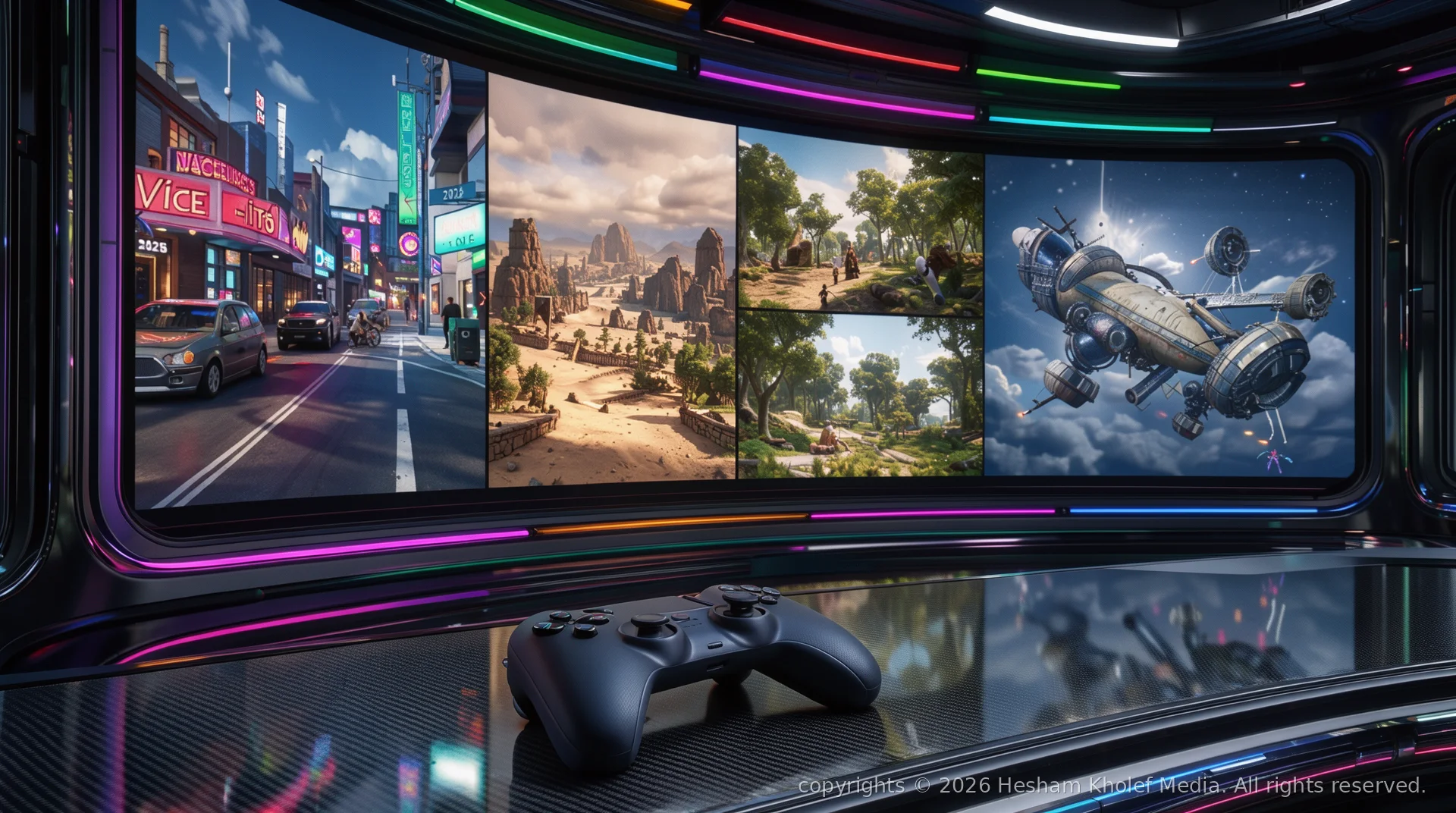
The Calm Before the Storm: Why 2026 Matters

The video game industry operates in cycles. Console generations settle, engines mature, and studios that spent years in silent development finally emerge with their magnum opuses. 2026 sits at a fascinating inflection point: the PlayStation 5 and Xbox Series X|S are fully established, Unreal Engine 5 has become the de facto standard for high-fidelity production, and a wave of projects greenlit in the post-pandemic boom are finally reaching completion.
This list is not a ranking of quality—none of these games have been reviewed yet—but a curation of cultural weight, technical ambition, and the sheer anticipation radiating from developer track records and early showings. These are the games that will dominate discourse, drive hardware sales, and likely define the medium's direction for years to come.
1. Grand Theft Auto VI — Rockstar Games
No conversation about 2026 can begin anywhere else. The return to Vice City represents the single largest entertainment launch in history, full stop. Rockstar's decade-plus gestation period has produced a simulated Florida of staggering density: a persistent, evolving online world (GTA Online 2.0) built atop a narrative campaign starring the series' first female protagonist, Lucia, alongside her partner Jason. Early footage showcases a simulation layer where NPCs remember player actions across sessions, wildlife behaves with ecological authenticity, and the "Leonida" map encompasses swamps, keys, and urban sprawl at a 1:1 scale unseen in open-world design. The economic implications are staggering—analysts project $1 billion in pre-orders alone.
2. The Elder Scrolls VI — Bethesda Game Studios
Fifteen years after Skyrim rewrote the rules of player freedom, Todd Howard's team finally returns to Tamriel. Set in Hammerfell—home of the Redguards and a landscape of blistering deserts, ancient Dwemer ruins, and naval city-states—The Elder Scrolls VI leverages a heavily overhauled Creation Engine 2 with procedural planet-tech borrowed from Starfield's development. The promise: a world where every NPC has a dynamic schedule, every faction remembers your reputation across decades of in-game time, and magic systems allow for spell-crafting at a molecular level. Mod support is being architected from day one for seamless cross-platform integration.
3. Fable — Playground Games
The legendary British RPG returns after a 16-year hiatus, now in the hands of the Forza Horizon studio. Playground's pivot from racing to Albion is bold: they've built a "reactive narrative engine" where the world physically transforms around your moral choices—not just cosmetic changes, but topological shifts. Towns prosper or crumble, forests grow or wither, and the very geometry of the map rewrites itself across a playthrough. The art direction blends storybook whimsy with grotesque British satire, and the combat system merges Fable's signature flourish with Forza's accessibility-first control philosophy. Peter Molyneux is notably absent; the vision is now entirely Playground's.
4. Metroid Prime 4: Beyond — Retro Studios / Nintendo

The longest gestation in Nintendo's modern history concludes on Switch 2 (backward compatible with Switch 1). Retro Studios restarted development in 2019 after a false start, and the result is a Metroid built for dual-screen play: the TV renders Samus's first-person visor at 4K/60fps with ray-traced visor reflections, while the handheld screen functions as a persistent scan visor, map, and inventory manager. The setting—the uncharted "Beyond" sector—introduces zero-gravity exploration across derelict Chozo megastructures. Sequence-breaking is not just preserved but designed for, with multiple critical paths baked into the world graph.
5. Marvel's Wolverine — Insomniac Games
Following the twin triumphs of Spider-Man 2 and Ratchet & Clank: Rift Apart, Insomniac turns to Logan. This is not a Spider-Man reskin. The studio has built a "berserker combat system" centered on visceral, weighty melee—claws interact with physics-driven gore systems (toggleable for rating boards), healing factors visualize in real-time on Logan's model, and the "feral senses" mechanic translates detective vision into a synesthetic audio-visual language. The narrative spans decades, jumping between Weapon X, Madripoor, and a dystopian future, with player choices determining which timeline survives. Mature rating confirmed.
6. Project: The Periphery — Hideo Kojima / Kojima Productions
Kojima's first original IP since Death Stranding is, predictably, defying categorization. Described as a "social stealth horror" set in a near-future orbital habitat, The Periphery uses cloud-streamed physics simulation to synchronize environmental destruction across all players in real-time—your decompression event ripples into another player's session as a pressure wave. The "strand" mechanics return, evolved: you leave not just ladders and signs, but psychological anchors—memories, fears, hopes—that other players can discover and resonate with. Norman Reedus, Léa Seydoux, and a surprise A-list cast perform full performance capture. No release window beyond "2026."
7. BioShock 4 — Cloud Chamber / 2K
The series that defined "narrative through environment" returns under a new studio formed by veterans of Irrational, Arkane, and MachineGames. Set in a floating Antarctic city-state founded by Objectivist dissidents who fled Rapture before its fall, BioShock 4 introduces a "living ideology" system: the city's districts physically reconfigure based on the dominant philosophy of its inhabitants, shifting between collectivist brutalism, anarcho-capitalist neon, and theocratic art deco in real-time. Plasmids are replaced by "epigenetic serums" that rewrite the player's genome mid-playthrough, with permanent morphological consequences. Ken Levine serves as creative consultant only.
8. The Witcher 4 (Polaris) — CD Projekt Red

After Cyberpunk 2077's redemption arc, CDPR's next saga begins—not with Geralt, but with Ciri. Built on Unreal Engine 5 with a proprietary "REDengine 6" rendering layer, Polaris targets a "living world" simulation where monster ecosystems hunt, migrate, and evolve without player presence. The "Trial of Grasses" character creator lets players define Ciri's mutation path—Cat, Wolf, Griffin, or entirely new schools—each rewriting combat, dialogue options, and world reaction. The narrative spans the Continent's unexplored eastern reaches: the Korath desert, the Far East's dragon courts, and the enigmatic Nilfgaardian successor states. Multiplayer co-op is confirmed for post-launch.
9. Silksong — Team Cherry
The most anticipated indie game in history finally emerges from its cocoon. Hornet's journey to the haunted kingdom of Pharloom expands Hallownest's formula into a vertical, kingdom-spanning pilgrimage. Team Cherry has hand-animated over 1,200 new enemy frames, composed a dynamic score that shifts instrumentation based on player aggression, and designed a "silk-weaving" traversal system that lets players stitch their own paths through the map. The "Silk Soul" mode—unlocked at launch—permadeletes your save upon death. No publisher, no compromise, no crunch: the Australian duo self-publishes on all platforms simultaneously.
10. Star Wars: Eclipse — Quantic Dream
Quantic Dream's narrative expertise meets the High Republic era—200 years before the prequels, when the Jedi Order stood at its zenith and the Nihil marauders threatened the galaxy's fringe. Eclipse abandons the studio's traditional QTE-heavy formula for a "branching simulation" where every major character can live, die, fall to the dark side, or vanish based on systemic interactions rather than scripted choices. The Force manifests as a probabilistic field the player manipulates across multiple protagonists simultaneously. Lucasfilm Games grants unprecedented canonical authority: Eclipse's events will be referenced in future films and series. Performance capture wraps late 2025.
"The best games don't just entertain—they expand the vocabulary of what interactive media can express. 2026 looks to be a lexicon-shifting year."
— Hesham Kholef
Release windows in this industry are aspirations, not promises. Several titles here—particularly Kojima's Project: The Periphery and BioShock 4—have historically fluid dates. This list reflects official targeting as of early 2025; treat firm dates as provisional until gold master discs ship.
Honorable Mentions: The Dark Horses
Three titles narrowly missed the top ten but deserve radar space: Dragon Age: Dreadwolf (BioWare's redemption attempt after Inquisition's mixed legacy), Perfect Dark (The Initiative/ Crystal Dynamics' espionage reboot with emergent AI-driven level simulation), and Hollow Knight: Silksong's spiritual cousin, Rain World: The Watcher (Videocult's expansion adding a playable Overseer with god-mode ecology tools). Each could vault into the conversation with a single compelling trailer.
Conclusion: A Year of Reckoning
2026 will test whether the blockbuster model—decade-long cycles, nine-figure budgets, cultural monopoly—remains sustainable. It will also reveal if the medium's most visionary creators can deliver on promises made in a pre-pandemic world. For players, it offers a rare embarrassment of riches: ten distinct visions of what games can be, arriving in a single orbit around the sun. Choose your entry point. The future is loading.
Comments (0)