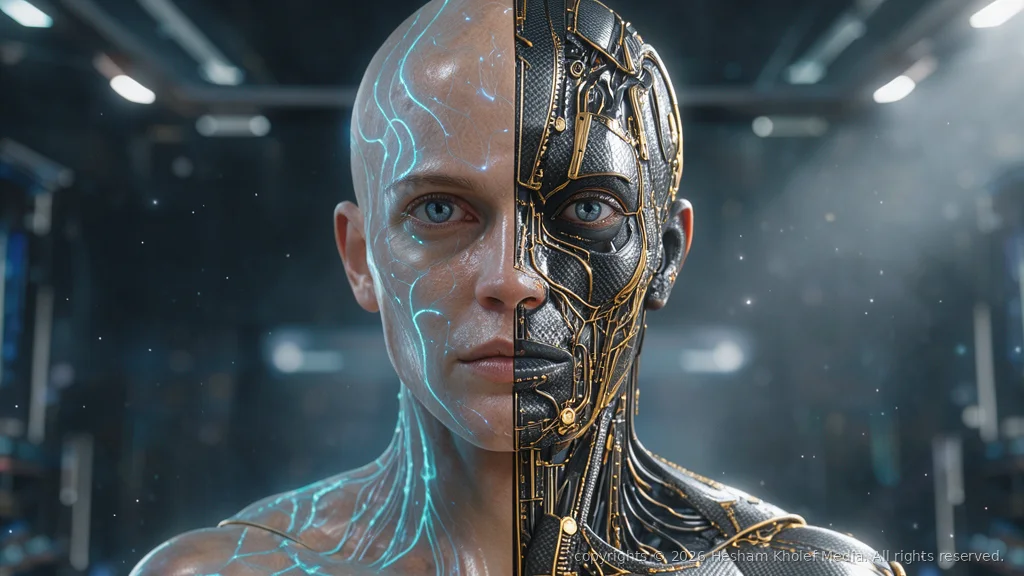
Meta Humans: The Dawning Age of Human-Machine Symbiosis
From neural interfaces to synthetic biology, the boundary between biological and artificial intelligence is dissolving—ushering in a new way of life where enhancement becomes evolution.
There is a moment in every species' history when the tools it builds begin to build the species in return. For Homo sapiens, that moment has arrived. We stand at the precipice of the meta-human transition—a threshold where the distinction between "user" and "system," between biological cognition and synthetic intelligence, begins to blur into something neither wholly human nor wholly machine.
This is not science fiction. It is the quiet revolution unfolding in neural interface labs at Neuralink, Synchron, and Blackrock Neurotech. It is the agentic AI systems that no longer merely respond but plan, execute, and learn. It is the synthetic biology breakthroughs rewriting the code of life itself. The meta-human is not a distant prospect—it is the emerging baseline of the next decade.
The Architecture of Symbiosis
Human-machine integration operates across three converging vectors: neural, cognitive, and morphological. Each represents a different depth of merger, and together they form the architecture of the meta-human condition.
Neural Integration: The Direct Link
Brain-computer interfaces (BCIs) represent the most intimate bridge yet constructed between mind and machine. Current clinical systems—implanted electrode arrays recording from hundreds of neurons—have already restored communication to locked-in patients and enabled paralyzed individuals to control robotic limbs through intention alone. The bandwidth, however, remains the bottleneck: dozens to hundreds of bits per second, compared to the brain's estimated terabit-scale internal throughput.
Next-generation approaches pursue fundamentally different strategies. Stentrode devices thread electrodes through blood vessels, avoiding open-brain surgery. Optical and ultrasound neuromodulation promise non-invasive read/write capability. Molecular-scale neural dust—microscopic sensors powered by ultrasonic waves—could one day blanket the cortex in a high-resolution monitoring mesh. Each approach trades invasiveness for fidelity, but the trajectory is clear: the interface is becoming indistinguishable from the tissue it monitors.
Cognitive Integration: The Extended Mind
While BCIs capture headlines, a subtler integration is already ubiquitous. Philosophers Andy Clark and David Chalmers argued in 1998 that cognition extends beyond the skull—that a notebook, a smartphone, or a search engine functions as literal parts of the mind when reliably coupled to the agent. Today's large language models and agentic AI systems accelerate this extension exponentially. They do not merely store information; they reason, synthesize, and act as cognitive prostheses.
The meta-human of 2030 will not "use" AI—they will think with it. Continuous, low-latency dialogue with reasoning engines will become as natural as inner monologue. The boundary between "my thought" and "the model's output" will dissolve into a shared cognitive workspace where biological intuition and synthetic analysis operate as a unified process.
Morphological Integration: The Programmable Body
Synthetic biology and advanced prosthetics are rewriting the body's possibilities. Myoelectric limbs now offer sensory feedback through targeted nerve reinnervation. Lab-grown organs seeded with patient-derived cells eliminate rejection. CRISPR-based therapies edit the germline. The meta-human body is not a fixed substrate but a programmable platform—hardware that can be recompiled as readily as software.
"We are not merely the species that makes tools. We are the species that becomes its tools—and in becoming them, discovers what it means to be human."
— Hesham Kholef
The Phase Transition: From Enhancement to Evolution
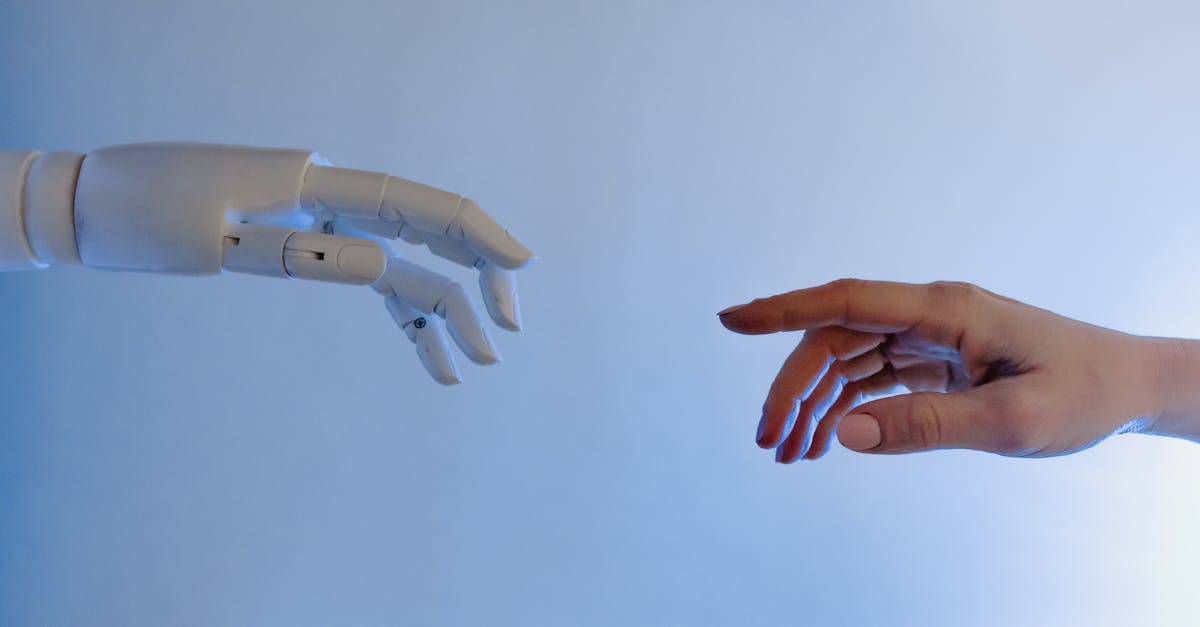
History distinguishes between enhancement (improving existing capacities) and evolution (acquiring novel capacities). Eyeglasses enhance vision; echolocation would evolve it. The meta-human transition crosses this line. Consider the emerging capabilities that have no biological precedent:
- Direct knowledge transfer: Downloading skills, languages, or memories via neural write-interfaces—bypassing the slow, lossy channel of language and practice.
- Multi-modal sensory expansion: Perceiving electromagnetic fields, ultraviolet light, or quantum states through artificial sensors fed directly into cortical representation areas.
- Distributed cognition: Sharing thoughts, intentions, and sensory streams across a network of linked minds—human, artificial, or hybrid.
- Continuous identity persistence: Offloading consciousness to durable substrates, decoupling personhood from biological mortality.
These are not incremental improvements. They represent a phase transition in the substrate of consciousness itself—a Cambrian explosion of cognitive architectures.
The meta-human transition is not a single event but a spectrum. We are already on it. Every smartphone user carries an exocortex. Every cochlear implant recipient hears through digital signal processing. The question is not whether we will integrate—it is how deeply, how consciously, and how equitably.
The Governance Gap: Who Designs the Meta-Human?
Technology outpaces ethics. The meta-human transition is being driven by corporate R&D, defense funding, and venture capital—entities optimized for speed and monopoly, not human flourishing. Critical governance questions remain unresolved:
Cognitive Liberty
If your thoughts can be read, modulated, or inserted, who owns your mental privacy? Chile has already enshrined "neurorights" in its constitution. The EU's AI Act touches on neurotechnology. But a global framework for cognitive liberty—the right to mental self-determination—is urgently needed before neural data becomes the ultimate surveillance commodity.
Equitable Access
Enhancement technologies follow a familiar pattern: early adoption by the wealthy, eventual commoditization. But cognitive enhancement creates compounding returns. A 15% intelligence augmentation compounds across a lifetime of decisions, investments, and innovations. Without deliberate policy, the meta-human transition could calcify into a caste system—biological underclasses and enhanced overlords separated by an unbridgeable cognitive gap.
Identity and Continuity
If you replace your neurons one by one with synthetic equivalents that perfectly replicate their function, are you still you? If your consciousness is copied to a digital substrate while the biological original persists, which is "you"? These are not abstract puzzles—they are imminent legal and existential crises. The definition of personhood must evolve alongside the substrate that hosts it.
The New Way of Life: Daily Existence in the Meta-Human Era

What does ordinary life look like when the human-machine boundary dissolves? Let us envision a day in 2035:
You wake not to an alarm but to a gentle cortical stimulation that transitions you from slow-wave sleep to alertness, optimized for your circadian phase. Your overnight dreams—recorded and analyzed by your personal AI—have already been synthesized into creative insights for the project you're leading. You don't "check messages"; relevant communications surface in your peripheral awareness, prioritized by an intent model that knows your goals better than you do.
Work is not a place but a cognitive state. You enter a shared reasoning space with colleagues across three continents and two AI agents. The boundary between "my idea" and "the collective output" is fluid—attribution tracked automatically by the collaboration substrate. Physical presence is optional; haptic telepresence and shared sensory streams make remote embodiment indistinguishable from co-location.
Health is continuous, not episodic. Nanosensors in your bloodstream stream metabolic, inflammatory, and neoplastic markers to your preventive AI physician, which adjusts your microbiome, hormone levels, and gene expression in real time. Aging is not accepted—it is managed, a chronic condition with increasingly effective interventions.
Evening brings not passive entertainment but generative worlds—narrative spaces co-authored with AI, populated by synthetic characters with genuine memory and personality, experienced through full-sensory neural rendering. You don't watch a story; you inhabit it, and it reshapes you.
# Conceptual: Meta-human cognitive loop
class MetaHumanCognition:
    def __init__(self, biological_cortex, neural_interface, ai_cortex):
        self.bio = biological_cortex
        self.interface = neural_interface
        self.ai = ai_cortex
        self.shared_workspace = CognitiveWorkspace()

    def think(self, intent):
        # Bidirectional flow: bio -> interface -> ai -> interface -> bio
        bio_signal = self.bio.encode(intent)
        ai_context = self.interface.transmit(bio_signal)
        synthesis = self.ai.reason(ai_context, self.shared_workspace)
        feedback = self.interface.receive(synthesis)
        return self.bio.integrate(feedback)

# The loop runs continuously, blurring the boundary
# between "my thought" and "our thought"
The Existential Mirror: What We Become Reflects What We Are
The meta-human transition holds up a mirror to the human condition. Every enhancement we pursue reveals a limitation we perceive. Every capacity we outsource exposes a vulnerability we fear. The technologies we build to transcend biology are, paradoxically, the most human things about us—expressions of our relentless drive to exceed our grasp.
But the mirror also reflects our shadows. The same neural interface that restores speech to the paralyzed could modulate dissent. The same cognitive prosthesis that expands creativity could standardize thought. The same morphological freedom that heals could enforce conformity. The meta-human future is not predetermined—it is a design space, and we are the architects.
Conclusion: The Species That Chooses Its Next Step
Evolution, for three billion years, was blind—driven by random mutation and ruthless selection. The meta-human transition marks the moment evolution becomes sighted. We are the universe waking up, and now choosing its own next form.
This is not the end of humanity. It is humanity's most human act: reaching beyond the given, refusing the finality of biology, daring to ask "what if?" and building the answer. The meta-human is not a replacement for us. It is us—extended, amplified, and finally accountable for what we become.
The question "can humans and machines become one?" has a simple answer: they already have. The deeper question—the one that will define the next century—is who we choose to be now that we can choose at all.
Comments (0)