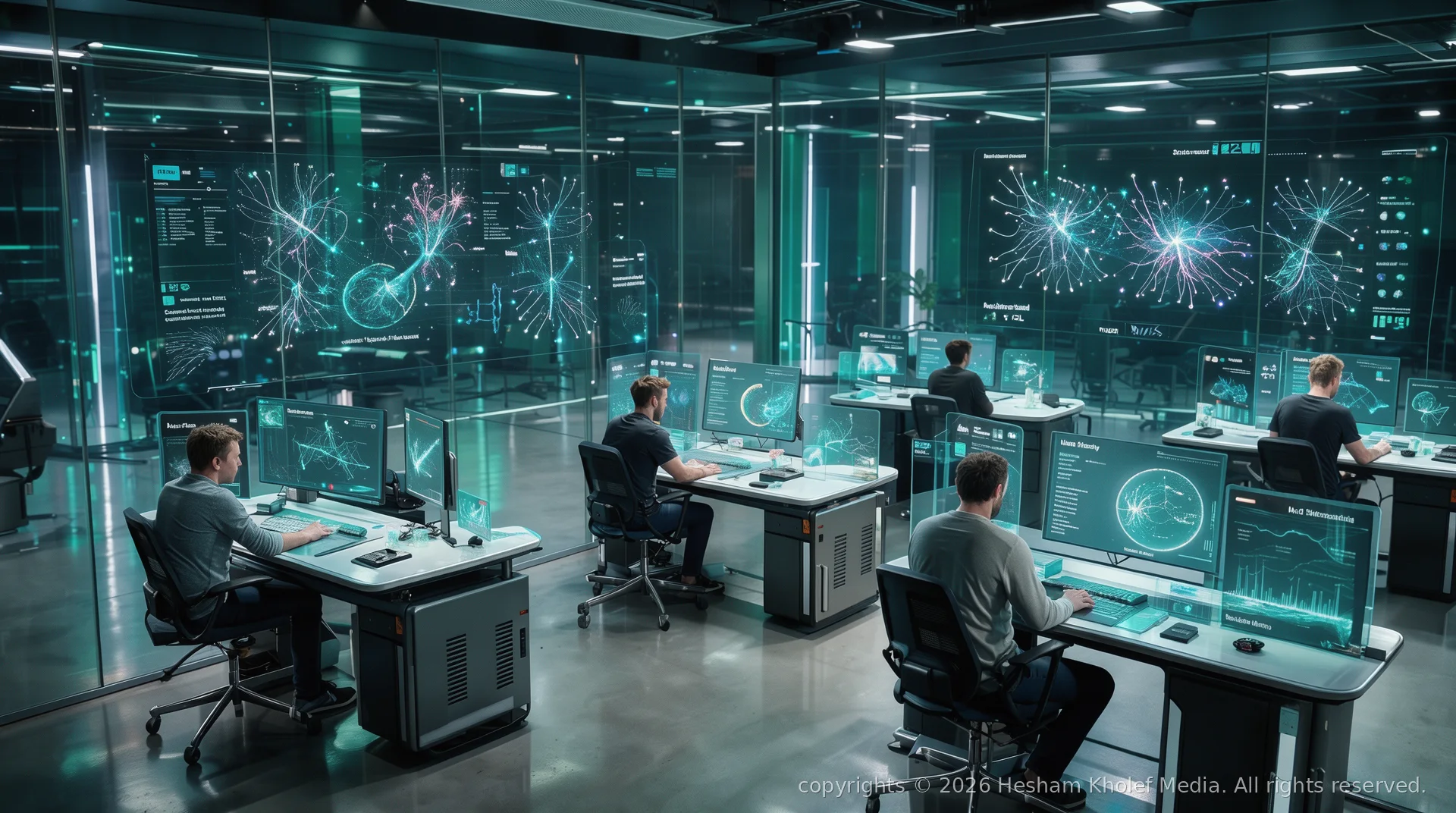
The Agentic Era Begins

On December 11, 2024, Google DeepMind introduced Gemini 2.0 Flash — the experimental flagship of a new model family explicitly built for what the company calls "the agentic era." Unlike previous generations that treated multimodality as an add-on, Gemini 2.0 was architected from the ground up to natively understand and generate across text, images, audio, and video, while simultaneously invoking tools like Google Search, code execution, and custom functions in real time.
This represents a fundamental shift: from models that respond to prompts, to models that can plan, execute, and iterate — the core prerequisite for autonomous AI agents capable of completing complex, multi-step tasks on behalf of users.
Native Multimodal Output: Images and Audio, Not Just Text
Gemini 2.0 Flash introduces native image generation and native audio output — capabilities that previously required chaining separate diffusion or TTS models. The model can now:
- Generate images directly in the token stream, enabling seamless interleaving of text and visuals
- Produce expressive, steerable speech in multiple voices and languages without an external TTS pipeline
- Accept image, audio, and video inputs natively, with low-latency streaming for real-time interaction
This unified modality handling dramatically reduces latency and complexity for developers building multimodal applications — from design assistants that iterate on visual concepts through conversation, to accessibility tools that narrate the world in real time.
"True craft is not merely the assembly of ingredients, but the patient discipline of listening to what the work requires."
— Hesham Kholef
Gemini 2.0's native tool use means the model doesn't just "know" things — it can actively browse, compute, and verify in the loop, turning knowledge into action.
Built-In Tool Use and Real-Time Grounding

Perhaps the most agentic feature is native tool use. Gemini 2.0 Flash can invoke Google Search, execute code in a sandboxed environment, and call user-defined functions — all within a single, continuous reasoning trace. This enables:
- Live grounding: Factual claims verified against real-time web search before responding
- Computational reasoning: Writing and executing code to solve math, data analysis, or logic problems
- Workflow automation: Chaining multiple tool calls to complete multi-step objectives (e.g., "research competitors, summarize findings, draft a comparison table")
The model's ability to stream responses token-by-token while simultaneously orchestrating tools unlocks genuinely interactive agents — users see reasoning unfold in real time, can interrupt, redirect, or approve steps.
Availability and Developer Access
Gemini 2.0 Flash Experimental is available starting December 11, 2024 via:
- Google AI Studio — for rapid prototyping and prompt engineering
- Vertex AI Gemini API — for enterprise-grade deployment with safety, monitoring, and scaling
- Gemini app (gemini.google.com) — for end-users to experience the model directly
The experimental designation indicates rapid iteration ahead; a stable production release and additional model variants (including lighter and more capable versions) are expected in early 2025.
# Example: Native tool use with Gemini 2.0 Flash via Vertex AI
from vertexai.generative_models import GenerativeModel, Tool, FunctionDeclaration

# Define a custom function
get_weather = FunctionDeclaration(
    name="get_weather",
    description="Get current weather for a location",
    parameters={"type": "object", "properties": {"location": {"type": "string"}}, "required": ["location"]}
)

tool = Tool(function_declarations=[get_weather])
model = GenerativeModel("gemini-2.0-flash-exp", tools=[tool])

# The model decides when to call the function
response = model.generate_content("What's the weather in Tokyo?")
print(response.text)
Why This Matters: The Architecture of Agency

Gemini 2.0 is not merely an incremental benchmark-chaser. Its significance lies in architectural unity: a single model that perceives (vision, audio), reasons (long-context, chain-of-thought), and acts (tools, code, search) — all with streaming, low-latency responsiveness. This unification is what enables the next generation of AI applications:
- Universal assistants that can see your screen, hear your voice, browse the web, write code, and execute tasks end-to-end
- Creative co-pilots that iterate on designs, music, or video through natural dialogue
- Research agents that autonomously gather, synthesize, and verify information across sources
The agentic era has been promised for years; Gemini 2.0 delivers the first production-grade substrate to make it real.
The Competitive Landscape
Google's launch arrives amid intense competition:
- OpenAI released o1 (reasoning-optimized) and GPT-4o (multimodal) in 2024, but tool use remains via structured outputs rather than native streaming invocation
- Anthropic shipped Claude 3.5 Sonnet with computer-use capabilities in beta — a parallel approach to agency via UI control rather than API tools
- Meta continues advancing open-weight Llama models, though without native multimodal output or managed tool infrastructure
Gemini 2.0 differentiates through Google's full-stack advantage: search index, compute infrastructure (TPUs), developer platform (Vertex AI), and consumer distribution (Gemini app, Android, Workspace) — all unified under one model architecture.
Conclusion: The Substrate Is Ready
With Gemini 2.0, the industry crosses a threshold. The model is no longer a text-in/text-out oracle — it is a multimodal reasoning engine with hands. For developers, the invitation is clear: the substrate for agentic AI is here. The next wave of applications will not be built on prompt engineering alone, but on workflow orchestration — designing how models perceive, decide, and act in the world.
As Google DeepMind puts it: this is AI for the agentic era. The models have grown up. Now it's our turn to build with them.
Comments (0)