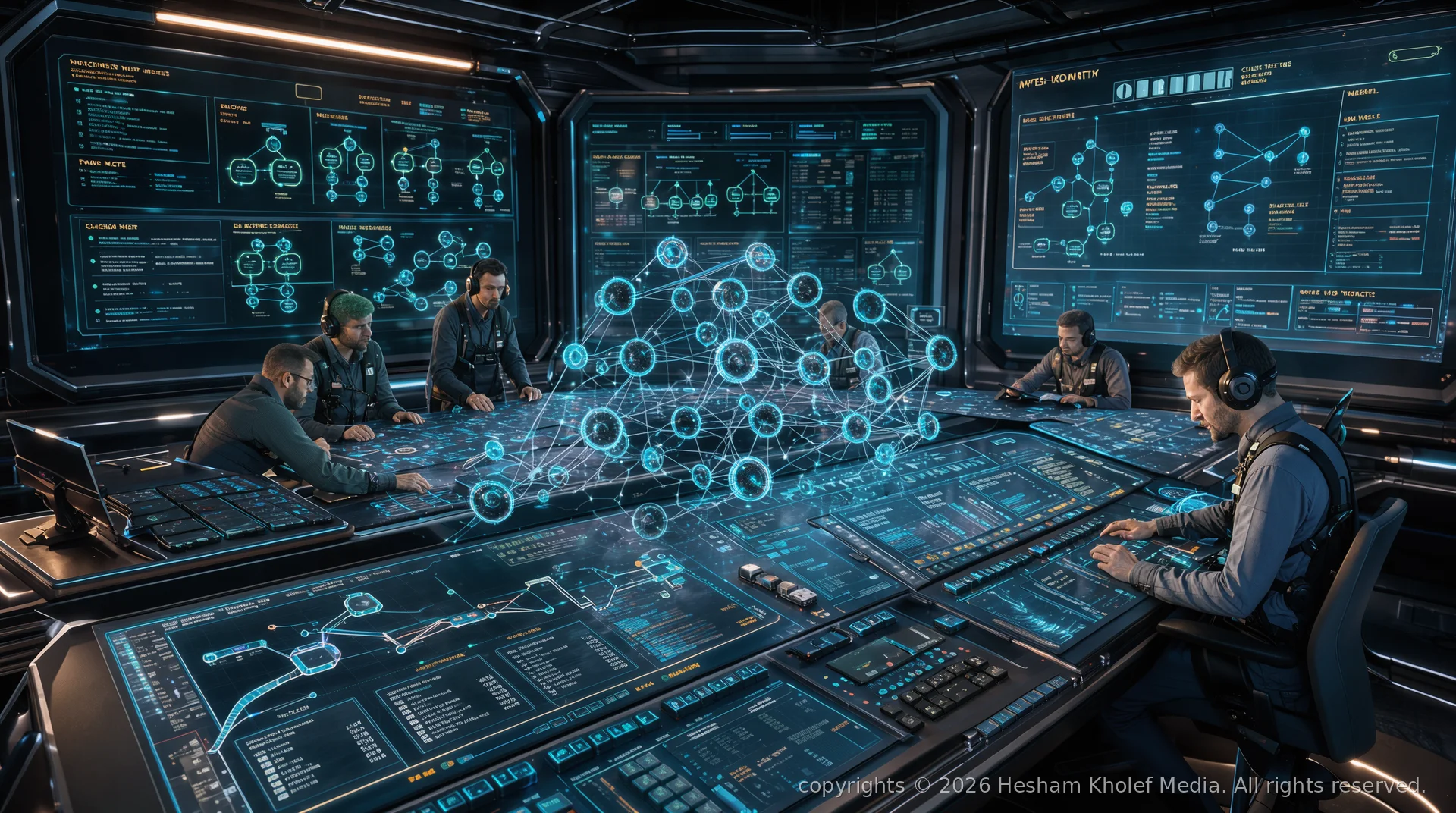
The Paradigm Shift: From Reaction to Agency

For years, large language models operated as sophisticated pattern-matchers — impressive conversationalists that responded to prompts but lacked the ability to persist, plan, or act across time. The transition to agentic AI represents a architectural inflection point: models that don't just answer questions but pursue objectives.
An agent, in this context, is an LLM augmented with four critical capabilities: tool use (invoking external APIs, code execution, browser automation), memory (working context, episodic recall, long-term knowledge stores), planning (decomposing goals into sub-tasks, reasoning about sequencing), and autonomy (self-directed iteration, error recovery, and decision-making without human-in-the-loop at every step).
Tool Use: The Hands of the Model
The first breakthrough was giving models the ability to reach beyond their training weights. Function calling, pioneered in 2023, allowed LLMs to emit structured JSON that external runtimes could execute — querying databases, sending emails, spinning up cloud resources, or controlling browsers.
But raw tool access isn't enough. Early implementations suffered from hallucinated function signatures, parameter confusion, and no mechanism for retry or fallback. Modern agent frameworks (LangGraph, AutoGen, CrewAI, OpenAI Assistants API) introduce tool schemas with strict validation, execution sandboxes, and observability hooks that let agents observe tool results, diagnose failures, and try alternative approaches.
"The model is not the product. The system — model plus tools, memory, and orchestration — is the product."
— Hesham Kholef
Memory Architectures: Beyond the Context Window
A stateless model forgets everything between turns. An agent must remember. Three memory tiers now define production agentic systems:
- Working Memory: The active context window — current task, recent tool outputs, scratchpad reasoning. Managed via sliding windows or hierarchical summarization.
- Episodic Memory: Vector-indexed records of past trajectories — what the agent did, what succeeded, what failed. Retrieved via semantic similarity when facing analogous situations.
- Semantic/Procedural Memory: Curated knowledge bases, API documentation, domain-specific playbooks, and learned skills (e.g., "how to reconcile a Stripe payout report").
Frameworks like MemGPT and Letta formalize this with OS-inspired virtual memory management — paging relevant context in and out of the finite context window, enabling agents that operate coherently over days or weeks.
Planning and Reasoning: The Prefrontal Cortex

Chain-of-thought prompting was the prototype. Production agents now employ structured planning modules:
- Task Decomposition: Breaking a high-level goal ("migrate the legacy billing service to Kubernetes") into a directed acyclic graph of executable steps.
- Reflection/Reflexion: Post-action critique loops where the agent evaluates its own output, identifies errors, and revises — often using a separate critic model or prompt.
- Tree/Graph Search: Exploring multiple action branches (MCTS-style) before committing, critical for coding agents navigating large repositories.
The most capable systems (Devin, OpenDevin, SWE-agent) combine these with environment grounding — running tests, linting, and verifying changes in real sandboxes — turning planning into a closed-loop control process.
Agency is not a binary property but a spectrum. The industry is converging on Levels of Autonomy (L0–L5), analogous to self-driving cars: L0 = pure chat, L1 = single-tool use, L2 = multi-step with human approval, L3 = supervised autonomy with guardrails, L4 = high autonomy in bounded domains, L5 = general-purpose autonomous knowledge worker.
Multi-Agent Orchestration: Specialization over Monoliths
Just as human organizations thrive on division of labor, agentic systems increasingly decompose into specialized agents with distinct roles — Planner, Coder, Reviewer, Researcher, QA — communicating via structured message passing.
Frameworks like AutoGen, CrewAI, and LangGraph enable agent topologies: sequential pipelines, hierarchical trees (manager → workers), debate graphs (pro/con critics), and swarm patterns. This modularity improves reliability (smaller, testable units), interpretability (auditable decision traces), and maintainability (swap a Researcher agent without rewriting the Coder).
The Infrastructure Layer: Where Agents Actually Run
Agents need more than model weights — they need persistent compute, secure sandboxes, and durable state. The emerging stack:
- Agent Runtimes: E2B, Modal, Fly.io machines, Modal's ephemeral containers — providing sub-second cold starts for code execution sandboxes.
- State Management: Temporal, DBOS, or custom event-sourcing — durable execution that survives crashes, enabling exactly-once semantics for billable actions.
- Observability: LangSmith, Arize, Braintrust — tracing every LLM call, tool invocation, and decision node for debugging and evaluation.
- Evaluation Harnesses: Not unit tests, but simulation suites — replaying historical trajectories, adversarial inputs, and edge cases against new agent versions.
# Minimal LangGraph agent with tool use and memory checkpointing
from langgraph.graph import StateGraph, END
from langgraph.checkpoint.sqlite import SqliteSaver
from langchain_core.tools import tool
from langchain_openai import ChatOpenAI

@tool
def search_docs(query: str) -> str:
    """Search internal knowledge base."""
    # ... vector search implementation
    return results

@tool
def execute_sql(query: str) -> str:
    """Run read-only SQL against analytics warehouse."""
    # ... parameterized query execution
    return rows

tools = [search_docs, execute_sql]
model = ChatOpenAI(model="gpt-4o").bind_tools(tools)

def agent_node(state):
    response = model.invoke(state["messages"])
    return {"messages": [response]}

def tool_node(state):
    # Execute tool calls from last message
    return {"messages": tool_results}

graph = StateGraph(AgentState)
graph.add_node("agent", agent_node)
graph.add_node("tools", tool_node)
graph.set_entry_point("agent")
graph.add_conditional_edges("agent", should_continue)
graph.add_edge("tools", "agent")

checkpointer = SqliteSaver.from_conn_string("checkpoints.db")
app = graph.compile(checkpointer=checkpointer)

# Resume across sessions via thread_id
config = {"configurable": {"thread_id": "user-123-session-7"}}
for chunk in app.stream({"messages": [HumanMessage(content="Analyze Q3 churn")]}, config):
    print(chunk)
Real-World Deployments: Where Agency Creates Leverage

Theory meets practice in three domains where agentic systems are already delivering ROI:
Software Engineering
Agents that navigate unfamiliar codebases, reproduce bugs, write fixes, run test suites, and open PRs — reducing median time-to-merge for routine tasks from hours to minutes. Companies report 30–50% velocity gains on maintenance work.
Financial Operations
Reconciliation agents that fetch bank statements, match against ERP entries, flag discrepancies, draft investigation tickets, and escalate only the truly ambiguous cases — cutting month-end close from days to hours.
Customer Experience
Not chatbots. Agents that access order history, initiate returns, coordinate with logistics APIs, negotiate goodwill credits within policy bounds, and follow up proactively — resolving 70%+ of tickets end-to-end without human handoff.
Guardrails, Governance, and the Trust Boundary
Autonomy without accountability is liability. Production agentic systems implement layered safeguards:
- Capability Scoping: Agents receive minimal tool sets per task (principle of least privilege).
- Approval Gates: High-impact actions (financial transfers, data deletion, production deploys) require human sign-off via signed attestations.
- Audit Trails: Immutable logs of every decision, tool call, and rationale — queryable for compliance and incident response.
- Constitutional AI / Rule Engines: Hard-coded policies (e.g., "never expose PII," "never execute DDL") enforced at the runtime layer, not just via prompting.
The Horizon: From Assistants to Colleagues
The next frontier isn't better single-agent performance — it's agent societies that negotiate, delegate, and learn from each other across organizational boundaries. Imagine a procurement agent negotiating directly with a vendor's pricing agent, both bound by shared protocols and verifiable credentials.
Standards like Agent Communication Protocols (ACP), Verifiable Credentials for Agents, and Inter-Agent Payment Rails (stablecoin micropayments for API calls) are emerging. The web was built for humans browsing documents. The agentic web is being built for software negotiating outcomes.
Conclusion: Designing for Agency
Building agentic systems demands a shift in engineering mindset: from deterministic pipelines to probabilistic control loops; from testing inputs/outputs to evaluating trajectories; from feature flags to capability boundaries.
The organizations that master this transition won't just automate tasks — they'll instantiate digital labor that scales expertise, operates 24/7, and compounds institutional knowledge. The chatbot era taught machines to speak. The agentic era teaches them to act. The difference is everything.
Comments (0)