The Clay Tablets Speak: Discovery and Reconstruction

The story of Gilgamesh did not survive in a single manuscript but in fragments scattered across the ancient Near East. In 1853, Hormuzd Rassam unearthed the library of Ashurbanipal at Nineveh — over 30,000 clay tablets, among them the most complete version of the epic, the "Standard Babylonian" recension compiled by the scribe Sîn-lēqi-unninni around 1200 BCE. Older Sumerian poems (c. 2100 BCE) and an Old Babylonian version (c. 1800 BCE) reveal a tradition that evolved over a thousand years.
Modern reconstruction owes much to George Smith, who in 1872 identified the Flood tablet among the British Museum's holdings, and to generations of Assyriologists who have pieced together the lacunae. The epic survives in about 70% completeness; new fragments still surface, subtly shifting our reading.
The Historical Gilgamesh: King of Uruk
Gilgamesh was not merely myth. The Sumerian King List records him as the fifth ruler of Uruk's First Dynasty, reigning 126 years — a symbolic number, but his historicity is corroborated by inscriptions mentioning "Gilgamesh, son of Lugalbanda" and archaeological evidence of Uruk's massive walls, which the epic attributes to him. Radiocarbon dating places the historical Gilgamesh around 2800–2600 BCE, Early Dynastic II period.
Uruk (modern Warka, Iraq) was the world's first true city — 6 km², 40,000–80,000 inhabitants, monumental temples (Eanna and Anu districts), writing (proto-cuneiform), and long-distance trade. The king who built its walls was a builder, a warrior, and likely a tyrant — exactly as the epic portrays him before his transformation.
Enkidu: The Wild Man Made Civil
Enkidu has no historical counterpart. He is a literary invention — the "natural man" created by Aruru from clay and spat into the steppe, living with gazelles, destroying traps, freeing animals. His civilization comes through a week of lovemaking with the hierodule Shamhat, a ritual act that severs his kinship with beasts and grants him human speech, reason, and mortality.
This narrative encodes a profound Mesopotamian worldview: civilization (me) is not innate but transmitted through sexuality, bread, beer, clothing, and law. Enkidu's tragedy is that he gains humanity only to lose it — his death is the price of becoming fully human.
The Friendship That Changes Everything
Tablet I establishes Gilgamesh's tyranny: he claims ius primae noctis, exhausts young men in contests, leaves no daughter to her mother. The gods answer by creating Enkidu as his equal. Their first meeting is a wrestling match in the doorway of a wedding feast — Gilgamesh wins, but instead of killing Enkidu, he embraces him. "You are unique," Gilgamesh says, "the one born in the wild, reared on the steppe."
This bond — ḫubbû, deep male friendship — becomes the epic's emotional core. They are mirrors: city and wilderness, culture and nature, mortality and the desire for fame. Together they achieve what neither could alone.
The Cedar Forest and Humbaba

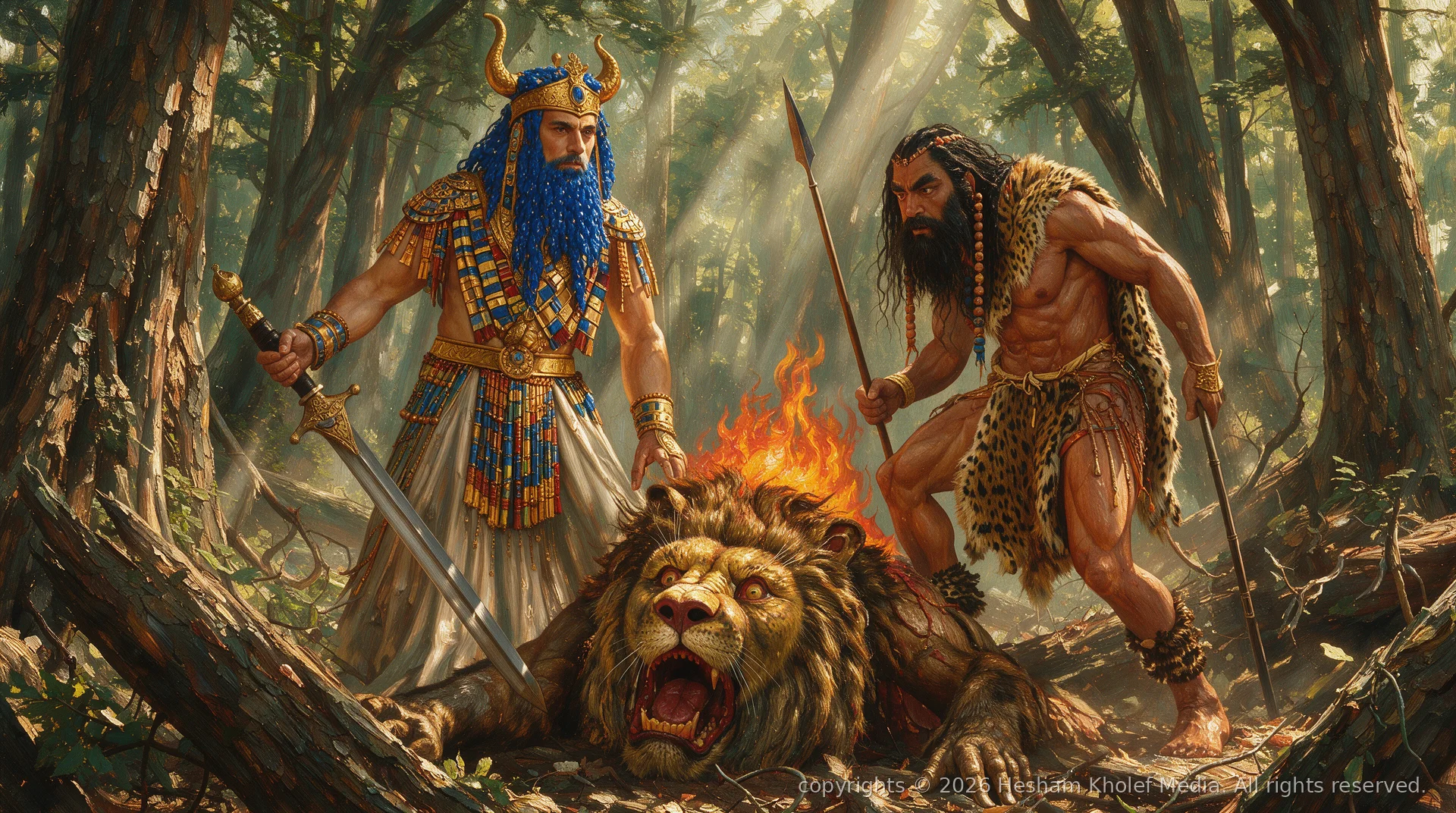
Seeking eternal fame (šumma), they journey to the Cedar Forest, guarded by Humbaba (Huwawa), a demonic giant with seven auras. The journey takes six days; each night Gilgamesh dreams ominous dreams that Enkidu interprets favorably. At the forest's edge, fear paralyzes Gilgamesh; Enkidu urges him on.
The battle is brutal. Shamash sends thirteen winds to bind Humbaba. The monster pleads for his life, offering servitude. Enkidu insists on death — "If you spare him, he will return to the forest and plot revenge." Gilgamesh strikes; Enkidu decapitates. They fell the sacred cedars, build a raft, and return with Humbaba's head — but the killing curses them both.
Ishtar, the Bull of Heaven, and the Death of Enkidu
Ishtar propositions Gilgamesh. He rejects her with a litany of her discarded lovers — the shepherd Tammuz, the lion, the horse, the gardener. Enraged, she demands the Bull of Heaven from Anu. It descends, snorting destruction. Gilgamesh and Enkidu kill it; Enkidu hurls the bull's thigh at Ishtar in defiance.
The gods convene. Anu, Enlil, and Shamash decree: one must die. Enkidu falls ill — a wasting fever. He curses the gate he made for Enlil's temple, then blesses Shamhat. In a vision, he sees the underworld: dust-eaters, feather-clad shadows, kings serving as attendants. "I shall not die like a man fallen in battle," he weeps. He dies after twelve days. Gilgamesh refuses to let him be buried until a worm falls from his nose — the final proof of corruption.
The Quest for Immortality
Grief shatters Gilgamesh. He commissions a statue of Enkidu, lets his hair grow, dons animal skins, and wanders the steppe. "Shall I not die like Enkidu? Sorrow has entered my heart." He seeks Uta-napishti, the Flood survivor granted eternal life.
The journey is a descent: through the Mountain of Mashu (the sun's gate), across the Waters of Death, past the scorpion-people, to the garden of the gods where gems grow on trees. Siduri the alewife advises him to accept mortality — "Fill your belly, dance, make music, cherish the child who holds your hand." He ignores her.
Uta-napishti tells the Flood story — the gods' secret council, Ea's warning, the cube-boat, the seven-day deluge, the dove, swallow, raven, the sacrifice, Enlil's rage turned to blessing. "No one sees Death, no one hears Death's voice," Uta-napishti says. "But savage Death cuts down mankind."
The Two Tests and the Return
Uta-napishti offers two tests: stay awake for seven days (Gilgamesh fails instantly), and retrieve the "Plant of Heartbeat" from the ocean floor. Gilgamesh succeeds, but a snake steals it while he bathes — shedding its skin, renewing itself. Gilgamesh weeps: "For whom have I labored? For whom has my heart's blood roused?"
He returns to Uruk. Standing on its walls, he shows the boatman Urshanabi the city's foundations, the kiln-fired brick, the seven sages' plans. "This is the wall of Uruk, which no future king will equal." The epic ends where it began — not with immortality, but with the enduring work of civilization.
"The life you seek you never will find: when the gods created mankind, death they dispensed to mankind, life they kept for themselves."
— Siduri to Gilgamesh, Tablet X
The Flood narrative in Tablet XI parallels the Atrahasis Epic and the biblical Genesis account — all three descend from a common Mesopotamian tradition, likely preserving a cultural memory of the Black Sea deluge (c. 5600 BCE) or repeated Tigris-Euphrates flooding. Uta-napishti's cube-boat (120 cubits per side) is structurally impossible; the biblical ark's 300×50×30 cubits reflects naval engineering knowledge.
Literary Structure and Innovation

The Standard Babylonian epic comprises eleven tablets (a twelfth, a Sumerian poem appended, recounts Enkidu's descent to retrieve Gilgamesh's drum). Its ring composition — opening and closing on Uruk's walls — frames the journey as a circle. The poet uses formulaic epithets ("Gilgamesh, perfect in strength"), repeated dream sequences, and balanced dialogues to create oral resonance in a written text.
Innovations include: the first literary "buddy narrative," the first Flood survivor, the first explicit confrontation with mortality as existential crisis rather than fate, and the first portrayal of grief as transformative. Gilgamesh's arc — tyrant → friend → griever → seeker → builder — is the prototype of the hero's journey.
Reception and Legacy
Lost for two millennia, the epic re-entered world literature in 1872. It influenced Rilke ("Gilgamesch"), Hermann Hesse, Philip Roth (The Plot Against America), and countless modern works. The Flood tablet sparked Victorian crisis of faith. Today it is taught as world literature's foundation — proof that 4,700 years ago, humans asked the same questions: Why do we die? What survives us? What does it mean to love?
What Remains Uncertain
- Enkidu's origin: Pure invention? Or a dim memory of a rival chieftain assimilated into myth?
- The Cedar Forest: Lebanon? Amanus? A symbolic space?
- Sîn-lēqi-unninni: Compiler or author? The colophon calls him ummânū (master scholar), suggesting editorial authority.
- Oral vs. written: How much reflects a living oral tradition versus scribal composition?
Why It Still Matters
Gilgamesh fails to gain immortality but succeeds in becoming human. He learns that fame is not eternity — the walls of Uruk are his monument, but even they crumbled. What endures is the story itself, pressed into clay by anonymous hands, surviving empires, languages, and the silence of millennia to speak to us now: You will die. Love while you can. Build what lasts.
Comments (0)