My Journey · Culinary History
Long before we wrote poetry or built cathedrals, we cooked. The mastery of fire — roughly 1.8 million years ago — was not merely a survival technique; it was the first great externalization of human cognition. Cooking predigested our food, shrunk our guts, and expanded our brains. It turned eating into a social ritual, and that ritual became the scaffold upon which all human culture rests.
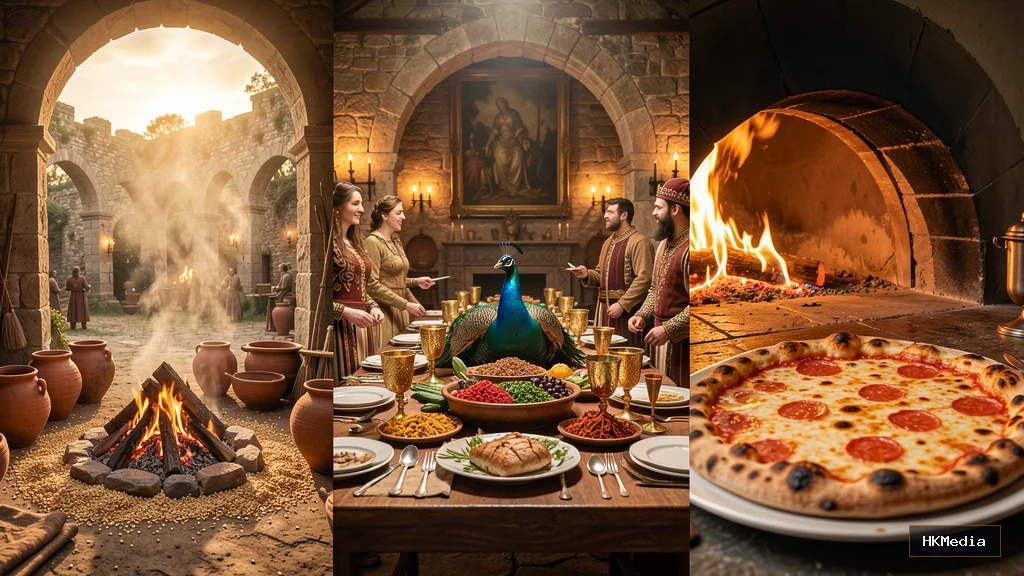
This is the story of how sustenance became meaning. How a handful of wild grasses became the staff of civilizations. How spice routes rewrote maps and toppled empires. And how a humble flatbread topped with tomatoes — once feared as poison — conquered every continent to become the world's most recognized dish.
The Neolithic Larder: Domestication and the First Staples

Around 10,000 BCE, in the Fertile Crescent's sweeping arc from the Levant to Mesopotamia, humans made a pact with wild grasses. Einkorn wheat, emmer, barley — these were not gifts of nature but products of patient selection. We chose the seeds that clung to the stalk rather than shattering in the wind. In doing so, we bound our destiny to theirs.
Parallel revolutions unfolded independently: rice in the Yangtze Valley, maize in the Balsas River basin of Mexico, potatoes in the Andean altiplano, sorghum and millet in the Sahel. Each staple grain or tuber carried with it a cosmology — rituals of planting, deities of harvest, calendars etched in stone. Bread and beer emerged as the twin pillars of early urban life in Sumer and Egypt; the worker's ration at Giza was measured in loaves and jugs of beer. To eat was to participate in the cosmic order.
The Spice Routes: When Flavor Ruled the World
If grain built cities, spice built empires. A handful of black peppercorns from the Malabar Coast was worth its weight in gold in Roman markets. Cinnamon, cloves, nutmeg, mace — these aromatics grew only in the remote islands of the Moluccas, yet flavored the banquets of Baghdad, Constantinople, and Venice.
The pursuit of direct access to the Spice Islands drove Portuguese caravels around Africa, Spanish galleons across the Pacific, and Dutch and English companies into the world's first corporate wars. The Columbian Exchange — the vast biological translocation triggered by 1492 — rewrote the planet's pantry. Chilies traveled from Mesoamerica to Thailand and Sichuan. Tomatoes reached Naples. Potatoes fed Ireland and then the industrial proletariat of Europe. Maize became the backbone of African agriculture. Nothing in the modern kitchen is native to where it is most loved.
Feasts of Power: The Royal Table as Theater

In the great courts of the Renaissance and Baroque eras, food became diplomacy by other means. The banquet was a staged spectacle: sugar sculptures of castles and ships, live birds released from pie crusts, roasted peacocks reassembled in their iridescent plumage. The Medici, the Valois, the Habsburgs, the Ottomans — each used the table to project magnificence, to awe ambassadors, to codify hierarchy.
Yet these spectacles birthed the professional kitchen brigade. The French cuisine classique codified by Carême and later Escoffier introduced the partie system — saucier, pâtissier, rôtisseur — turning culinary chaos into military precision. The restaurant itself emerged in revolutionary Paris when displaced aristocratic chefs opened doors to the paying public. Haute cuisine democratized, then globalized.
"True craft is not merely the assembly of ingredients, but the patient discipline of listening to what the work requires."
— Hesham Kholef
The Tomato's Triumph: From Poison to Pizza
No ingredient better embodies food's unpredictable journey than the tomato. Domesticated in Mesoamerica, carried to Spain by conquistadors, it languished for two centuries as an ornamental curiosity — a "love apple" suspected of toxicity because of its kinship with deadly nightshade. In Naples, the lazzaroni (the city's poor) began placing tomato on their flatbreads out of necessity. The pizza marinara (tomato, garlic, oregano, olive oil) and pizza margherita (tomato, mozzarella, basil — the colors of the new Italian flag) were born in the late 18th and late 19th centuries respectively.
Italian immigrants carried pizza to New York, Buenos Aires, São Paulo. American GIs returning from Italy craved it. The post-war boom birthed the gas-fired deck oven, the franchise model, the frozen disc. Today, roughly five billion pizzas are sold annually worldwide. A Neapolitan street food became the planet's shared vocabulary — infinitely adaptable, universally understood.
The true secret of pizza's global conquest lies not in the complexity of its technique, but in the clarity of its intention: fire, dough, and the best of what the land offers that day.
The Modern Pantry: Industrialization and Its Discontents

The 20th century brought the great acceleration: nitrogen fixation (Haber-Bosch) decoupled soil fertility from manure; refrigeration severed seasons; canning and later freeze-drying collapsed distance; monoculture and commodity markets standardized flavor into uniformity. The Green Revolution averted famine but narrowed genetic diversity. Today, just three crops — rice, wheat, maize — provide 60% of human caloric intake.
Yet a counter-current rises. The fermentation revival (kimchi, kombucha, sourdough, garum reborn as fish sauce), the heirloom seed movement, the farm-to-table ethos, the rediscovery of indigenous foodways — these are not mere nostalgia. They are acts of resilience, reasserting that food is relationship: between soil and hand, between cook and eater, between memory and future.
Epilogue: The Shared Hearth
To study the history of food is to study the history of humanity's most persistent negotiation — with nature, with each other, with time. Every meal echoes the Neolithic granary, the spice-laden caravel, the royal banquet, the immigrant's oven. When we break bread — or share a slice of pizza on a paper plate in Tokyo, Lagos, or Buenos Aires — we participate in a conversation older than language.
The next chapter is being written in vertical farms, in precision fermentation vats, in kitchens where AI designs flavor pairings no human imagined. But the hearth remains. We still gather. We still feed each other. And in that simple act, we remain human.
Comments (0)