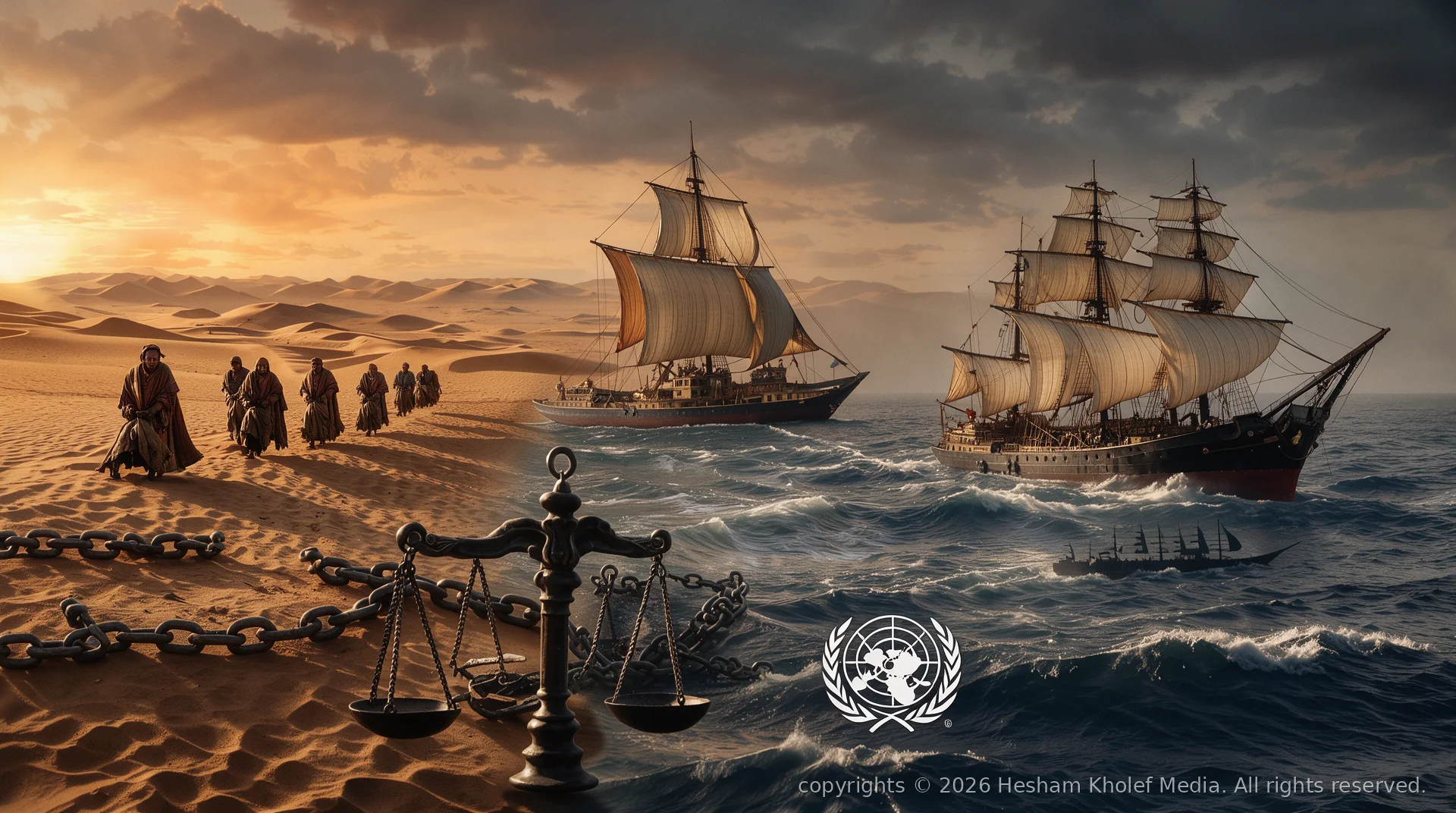
Introduction: The Universal Institution
Slavery — the ownership, purchase, sale, and forced labor of human beings — is not the invention of any single civilization, race, or religion. It is a near-universal historical phenomenon documented in the earliest written records of Mesopotamia, Egypt, China, India, Greece, and Rome. What distinguishes the history of slavery is not its existence, but its varied legal frameworks, economic functions, demographic scales, and the ideological justifications societies constructed to sustain it. This article presents a comparative, evidence-based survey of slavery across major historical theaters, with particular attention to the Islamic world, the African continent, the Atlantic system, and the global abolition movement that reshaped international law.
Slavery in Pre-Islamic Arabia

In the Arabian Peninsula before the seventh century CE, slavery was an entrenched social and economic institution. Enslaved persons — known as abīd (sing. ʿabd) or mawālī (clients/freedmen) — were acquired through capture in tribal raids, debt bondage, birth into slavery, and the long-distance caravan trade linking Arabia to Byzantium, Persia, and East Africa. The Quraysh of Mecca and other tribal elites held enslaved people as domestic servants, pastoral laborers, and concubines. There was no systematic racial ideology attached to enslavement; Arabs, Africans, Persians, Byzantines, and others could all be found in bondage. Manumission existed as a meritorious act but was neither legally mandated nor socially expected on a large scale.
Islamic Teachings on Slavery and the Encouragement of Emancipation
The advent of Islam in the seventh century did not abolish slavery outright — a fact acknowledged by Muslim and non-Muslim scholars alike — but it introduced a regulatory and ethical framework that fundamentally altered the institution's trajectory within Muslim societies. The Qur'an and Hadith literature recognize slavery as an existing reality while simultaneously establishing mechanisms for its contraction and eventual dissolution:
- Sources of enslavement restricted: The Qur'an (47:4) permits enslavement only of war captives (asrá) in legitimate defensive warfare, effectively closing the pre-Islamic avenues of debt bondage, kidnapping, and hereditary chattel slavery as sharʿī (legally valid) sources.
- Manumission as expiation and virtue: Freeing a slave is prescribed as expiation (kaffārah) for broken oaths (5:89), accidental killing (4:92), and breaking the Ramadan fast (2:184). The Prophet Muḥammad stated: "Whoever frees a Muslim slave, Allah will save every part of his body from the Fire for every part of the slave's body" (Ṣaḥīḥ al-Bukhārī).
- Contractual emancipation (mukātaba): Qur'an 24:33 mandates that masters allow enslaved persons to contract for their freedom through installment payments, establishing a legal pathway to liberty unknown in Roman or Atlantic law.
- Zakāt allocation: One of the eight categories eligible for obligatory alms (9:60) is fī al-riqāb — "for the freeing of necks" (i.e., purchasing and manumitting slaves).
- Prohibition of enslaving free Muslims: The consensus (ijmāʿ) of classical jurists held that a freeborn Muslim could never be legally enslaved, a principle that gradually eroded the domestic supply of slaves within expanding Muslim territories.
"The Qur'anic legislation on slavery represents a regulatory framework designed to restrict the institution's sources, improve the enslaved's condition, and incentivize manumission — a trajectory that, if fully implemented, leads to slavery's extinction."
— William Gervase Clarence-Smith, Islam and the Abolition of Slavery (2006)
Classical Islamic law (fiqh) regulated the treatment of enslaved persons — guaranteeing food, clothing, protection from abuse, the right to marry, and the prohibition of separating mothers from young children — but it did not declare slavery inherently sinful or categorically forbidden. The gap between legal theory and historical practice varied widely across time and region.
The Trans-Saharan, Red Sea, and Indian Ocean Slave Trades
Long before European ships rounded the Cape of Good Hope, a vast, multi-directional slave trade operated across the Sahara Desert, the Red Sea, and the Indian Ocean. Estimates by historians such as Paul Lovejoy, Ralph Austen, and Joseph Harris suggest that between the seventh and nineteenth centuries, approximately 6–9 million enslaved Africans were transported northward across the Sahara, 2–4 million across the Red Sea, and 1–3 million via the Indian Ocean to the Middle East, North Africa, the Ottoman Empire, and South Asia.
Structure and Demography
Unlike the Atlantic trade, which disproportionately targeted adult males for plantation labor, the Indian Ocean and Saharan trades demanded a higher proportion of women and children — for domestic service, concubinage, eunuch production, and elite military corps (e.g., Mamluks in Egypt, Janissaries in the Ottoman Empire). Mortality rates on trans-Saharan caravans were extreme; some primary accounts (e.g., Ibn Baṭṭūṭa, 14th c.) suggest 20–50% perished en route.
African Agency and Intermediaries
These trades were not imposed unilaterally by external powers. West African empires (Ghana, Mali, Songhai, Bornu), the Hausa city-states, and East African Swahili city-states (Kilwa, Mombasa, Zanzibar) actively participated as suppliers, intermediaries, and consumers. African merchants, rulers, and warlords captured or purchased captives from interior societies — often through warfare, judicial enslavement, or raiding — and delivered them to North African and Arab traders at designated entrepôts (e.g., Sijilmasa, Awjila, Cairo, Suakin).
The Transatlantic Slave Trade: Scale, Structure, and Racialization

Between 1501 and 1867, the transatlantic slave trade forcibly transported an estimated 12.5 million Africans to the Americas, of whom ~10.7 million survived the Middle Passage (Voyages Database, Emory University). This trade was distinct in three critical dimensions:
- Industrial scale and velocity: At its peak (1700–1850), over 80,000 Africans per year were embarked — a throughput enabled by European capital, credit networks, insurance, and purpose-built ships.
- Plantation complex: The destination was not domestic service but large-scale, capital-intensive production of sugar, tobacco, cotton, coffee, and rice — commodities that fueled European industrialization and global trade.
- Racial ideology: The Atlantic system constructed a pseudo-scientific racial hierarchy (white/free vs. Black/enslaveable) to justify perpetual, hereditary chattel slavery — a legal innovation codified in Virginia (1662), Barbados (1661), and the French Code Noir (1685).
European Colonialism and the Institutionalization of Slavery
European powers — Portugal, Spain, Britain, France, the Netherlands, Denmark — did not merely participate in the slave trade; they built colonial empires whose economic foundations rested on enslaved labor. The Treaty of Tordesillas (1494), the asiento system, and the Royal African Company (1672) exemplify state-sanctioned monopolies. Colonial legal codes stripped enslaved persons of legal personality, criminalized manumission, and authorized extreme violence. The Haitian Revolution (1791–1804) — the only successful large-scale slave revolt in history — shattered the myth of invincibility and accelerated abolitionist momentum.
Historical Muslim Empires and Slavery
From the Umayyads and Abbasids to the Ottomans, Safavids, Mughals, and Sokoto Caliphate, Muslim polities utilized enslaved labor in diverse roles: agricultural (Iraq's Zanj plantations, 9th c.), military (Mamluk and Janissary corps), administrative (Ottoman kul system), and domestic. The Ottoman Empire alone may have absorbed 1–2 million enslaved persons (Circassians, Georgians, Africans) between the 15th and 19th centuries. Importantly, the kul system allowed enslaved elites to wield sovereign power — a structural anomaly absent in the Atlantic world. However, the 19th-century expansion of Egyptian and Ottoman demand for African slaves (e.g., Muḥammad ʿAlī's Sudan campaigns, the Mahdist state) intensified the Nile Valley and East African trades precisely as Atlantic abolition gained force.
The Role of African Kingdoms in Slave Trading

African participation in slave supply is a documented historical fact, not a polemical invention. Kingdoms such as Dahomey, Oyo, Asante, Kongo, and the Aro Confederacy derived revenue, firearms, and political leverage from selling captives to European and Arab traders. Yet this participation was neither monolithic nor uncomplicated:
- Some rulers (e.g., Afonso I of Kongo, 1526) protested the trade's depredations.
- Others (e.g., Dahomey's Agaja, Ghezo) centralized their militaries around slave raiding.
- Internal African slavery systems — often kin-based, non-hereditary, and assimilative — differed radically from the chattel model exported to the Americas.
Scholars such as John Thornton, Toyin Falola, and Sandra Greene emphasize that African agency operated within constraints imposed by global demand, firearms imports, and interstate competition — not as equal partners in a voluntary exchange.
The Abolition of Slavery: A Century of Struggle
Abolition was not a single event but a protracted, multi-theater campaign spanning 1780–1980:
First Wave: Atlantic Abolition (1780–1888)
- 1787: Society for Effecting the Abolition of the Slave Trade founded in London (Clarkson, Wilberforce, Equiano).
- 1807/1808: Britain and the U.S. ban the transatlantic trade; Britain deploys the West Africa Squadron (~1,600 ships, 150,000 Africans freed by 1867).
- 1833/1848: British and French empires abolish slavery in colonies (with compensation to enslavers, not the enslaved).
- 1865/1888: U.S. (13th Amendment) and Brazil (Golden Law) end legal slavery in the Americas.
Second Wave: Islamic World and Indian Ocean (1840s–1960s)
- 1846–1890: Ottoman firmāns restrict the Circassian and African trades; the 1890 Brussels Conference Act commits signatories (including Ottoman Empire, Zanzibar, Persia) to suppress the slave trade.
- 1926: League of Nations Slavery Convention — first binding international treaty defining and prohibiting slavery.
- 1962: Saudi Arabia and Yemen formally abolish slavery (the last sovereign states to do so).
- 1981: Mauritania becomes the last country to legally abolish slavery (criminalized only in 2007).
Abolition in Muslim-majority regions was driven by a confluence of internal reformist scholarship (e.g., Aḥmad Bābā al-Timbuktī, 16th c.; Muḥammad ʿAbduh, 19th c.), European diplomatic and naval pressure, and colonial administration — not by a single indigenous movement analogous to Anglo-American abolitionism.
The Evolution of Human Rights: From Abolition to Universal Declaration
The abolition movement generated the conceptual vocabulary of modern human rights: the inviolability of the person, the prohibition of ownership of human beings, the right to liberty, and the duty of states to protect these rights extraterritorially. The 1926 Slavery Convention, the 1948 Universal Declaration of Human Rights (Article 4), the 1956 Supplementary Convention, and the 1966 International Covenant on Civil and Political Rights codified slavery's prohibition as jus cogens — a peremptory norm of international law from which no derogation is permitted. Contemporary challenges — human trafficking, forced labor, debt bondage, child soldiering — are prosecuted under this legal architecture.
Comparative Timeline and Scale: Summary Table
┌────────────────────────┬──────────────┬──────────────┬──────────────────────────────┐
│ Slave Trade System     │ Period       │ Est. Total   │ Primary Demographic Profile  │
├────────────────────────┼──────────────┼──────────────┼──────────────────────────────┤
│ Trans-Saharan          │ 7th–20th c.  │ 6–9 million  │ Majority female; domestic,   │
│                        │              │              │ concubinage, military        │
├────────────────────────┼──────────────┼──────────────┼──────────────────────────────┤
│ Red Sea / Indian Ocean │ 7th–20th c.  │ 3–7 million  │ Majority female/children;    │
│                        │              │              │ domestic, eunuchs, pearl     │
│                        │              │              │ diving, plantation (Zanzibar)│
├────────────────────────┼──────────────┼──────────────┼──────────────────────────────┤
│ Transatlantic          │ 1501–1867    │ 12.5 million │ Majority adult male;         │
│                        │ (peak 1700–  │ embarked;    │ hereditary chattel;          │
│                        │ 1850)        │ ~10.7M       │ racialized; plantation       │
│                        │              │ arrived      │ complex (sugar, cotton)      │
├────────────────────────┼──────────────┼──────────────┼──────────────────────────────┤
│ Internal African       │ Ancient–     │ Tens of      │ Varied: kin-based, pawnship, │
│ Systems                │ 20th c.      │ millions     │ assimilative; not            │
│                        │              │ (uncounted)  │ primarily commercial export  │
└────────────────────────┴──────────────┴──────────────┴──────────────────────────────┘
Conclusion: Confronting the Full Record
The history of slavery resists simple moral binaries. No major civilization escaped complicity; no single religion, race, or continent holds a monopoly on either the perpetration or the abolition of bondage. The Islamic legal tradition introduced unprecedented manumission mechanisms but failed to mandate immediate abolition. African polities were both victims and active suppliers in multiple slave trades. European powers industrialized the trade, racialized its logic, and then led the naval and legal campaign to suppress it. The transatlantic system stands apart in its scale, velocity, racial architecture, and enduring legacy of structural inequality in the Americas. The Saharan and Indian Ocean trades lasted longer, moved millions across brutal terrains, and left demographic and cultural imprints across the Middle East and South Asia that remain understudied.
A rigorous, comparative history of slavery — grounded in archaeology, linguistics, merchant records, ship manifests, court cases, manumission deeds, travelogues, and oral testimony — honors the memory of the enslaved not by flattening their experiences into a single narrative, but by mapping the specific conditions, resistances, and afterlives of bondage in each historical theater. The unfinished work of human rights begins where such honest accounting ends.
Comments (0)