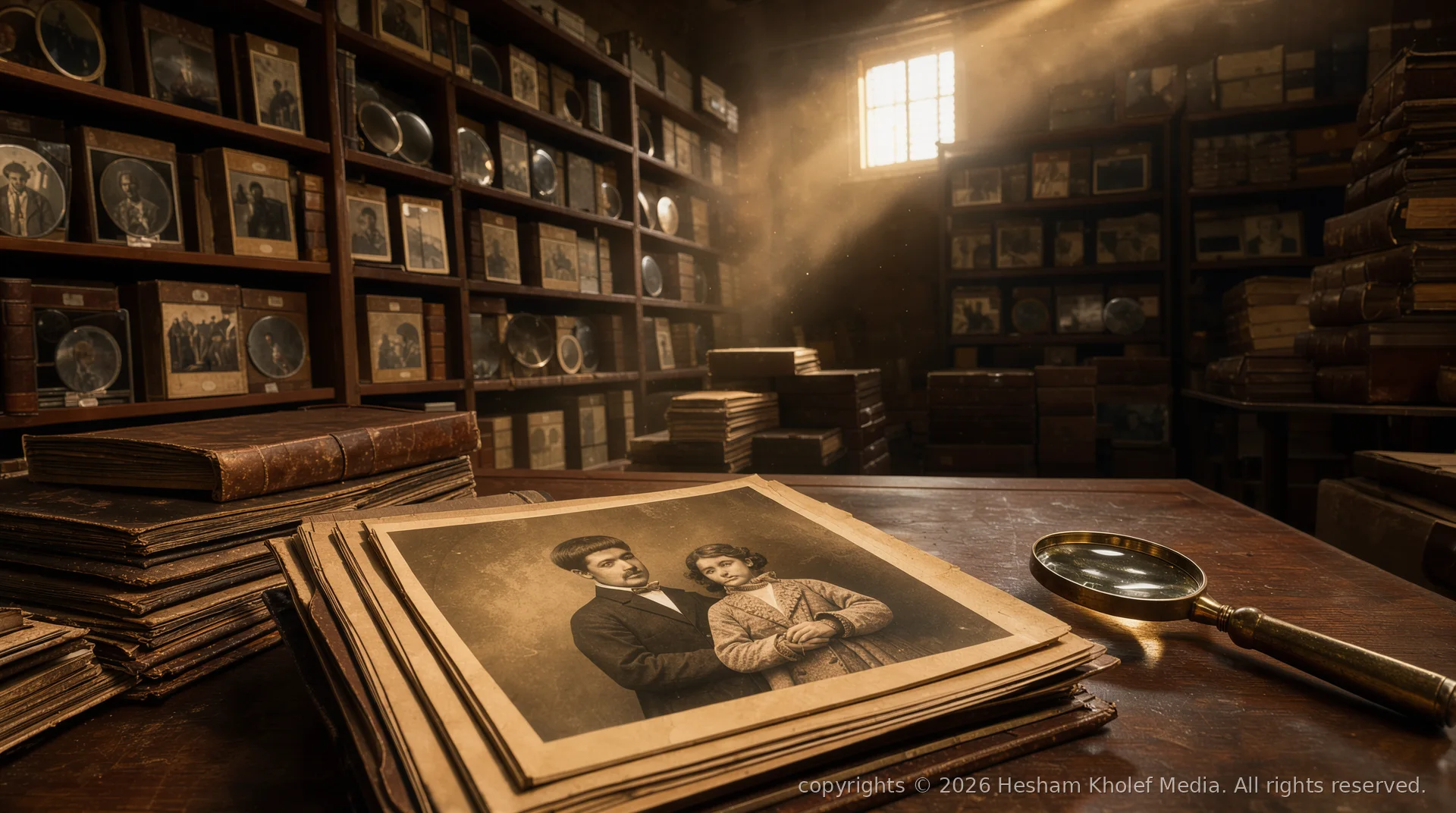
We tend to imagine history as a procession of dates, treaties, and battles—grand narratives enacted by figures larger than life. Yet the truest access to the past often arrives not through proclamations but through the accidental poetry of a photograph: a child's shoes abandoned on a Warsaw street, the weathered hands of a sharecropper cradling cotton, the electric tension in a control room seconds before humanity first touched the moon. The camera, that relentless witness, does not merely record; it resurrects. It forces us to confront the past not as abstraction but as lived experience—textured, immediate, and startlingly familiar.
What follows is a curated journey through forty photographs that do more than document. They disrupt. Each image was selected not for its fame but for its capacity to overturn assumption, to collapse the distance between then and now, to whisper that the people staring back from the emulsion were never "historical figures"—they were simply us, born into circumstances we can scarcely imagine.
The Archaeology of the Everyday: Domestic Worlds Vanished

Before the great events, there were the small rooms where life actually happened. A 1909 autochrome of a Parisian seamstress pausing at her window, dust motes dancing in afternoon light—the first color photograph many Parisians ever saw. A 1937 Farm Security Administration portrait of an Alabama tenant farmer's kitchen: a wood stove, a kerosene lamp, a calendar from 1932 still hanging because the new year brought no reason to change it. These images resist the romance of nostalgia. They show us poverty without pity, dignity without performance. The seamstress is not a symbol; she is a woman who woke up, threaded a needle, and wondered if the rent would be paid. The calendar is not a prop; it is a ledger of time measured in scarcity.
"The past is not a foreign country; it is a mirror we have forgotten how to read. Every photograph is a sentence in a language we once spoke fluently."
— Hesham Kholef
Consider the 1913 photograph of a New York tenement family—seven people in two rooms, captured by Jacob Riis's successor. The father's expression is not despair but calculation: how to stretch twelve cents into supper. The mother's hands, blurred from motion, tell a story no census record can. These are not "the poor." They are architects of survival, engineers of the invisible labor that built the cities we inherit.
The most revolutionary photographs are rarely the ones that make headlines. They are the quiet documents of ordinary endurance—the laundry lines of 1920s Glasgow, the communal ovens of a Moroccan medina, the midnight vigil of a Japanese rice farmer watching water levels. In these frames, history breathes.
Faces of Power, Faces of Resistance
History's marquee names arrive in textbooks as statues—marble, inevitable, foreordained. The camera catches them unguarded. A 1945 photograph of Churchill in his siren suit, cigar unlit, staring at a map of Europe he knows he cannot hold. The light falls across his face in a way no painter would choose: harsh, unflattering, human. He looks tired. He looks like a man who has sent thousands to die and will send thousands more.
Beside him in the archive, a 1930 image of Gandhi at his spinning wheel—not the saint of retrospect, but a lawyer in homespun cotton, fingers moving with the rhythmic certainty of someone who has made a weapon of cloth. The British Empire, which spanned a quarter of the globe, had no vocabulary for this resistance. The photograph frame holds the empire's defeat before a single shot was fired.
The Unseen Architects
Power's true face often belongs to those excluded from the frame. The 1963 March on Washington is remembered for King's dream. But look at the edges: the woman in the floral dress holding a handmade sign, the teenager perched on his father's shoulders, the elderly man leaning on a cane who walked three days from Mississippi. They did not know they were making history. They knew only that the cost of silence had become unbearable.
A 1989 photograph from Leipzig: a Stasi officer and a protester sharing a cigarette in the gathering dusk, the wall behind them already weeping mortar. The officer's uniform is crisp; his eyes are not. The protester's coat is threadbare; her posture is absolute. No caption explains who won. The image explains everything.
Science as Witness: The Photographs That Changed What We Know
Some photographs do not merely record discovery—they are the discovery. The 1952 X-ray diffraction image labeled "Photo 51": a fuzzy cross of dark bands that revealed the double helix to Rosalind Franklin before Watson and Crick ever saw it. The pattern is elegant, almost indifferent—the universe's blueprint rendered in shadow and silver. Franklin's notebook entry beside it reads simply: "Helix. Clear."
Science advances not only through equations but through the stubborn act of looking—through telescopes, microscopes, cloud chambers, and the patient accumulation of photographic plates. The image is the evidence that persuades the skeptic.
The 1968 "Earthrise" from Apollo 8: our world rising over a dead horizon, fragile and unbordered. No photograph has ever done more to dismantle the illusion of national permanence. Astronaut Bill Anders later said, "We came all this way to explore the moon, and the most important thing is that we discovered the Earth." The image launched the modern environmental movement, not through argument but through awe.
Medical Frontiers Captured in Light
A 1922 photograph from a Toronto hospital: a fourteen-year-old boy named Leonard Thompson, skeletal from diabetes, before and after insulin. The transformation is not miraculous—it is metabolic, measurable, the result of Banting and Best's relentless isolation of a pancreatic extract. But the boy's face in the second frame—alert, alive, present—carries a weight no data table can convey. Photography made the invisible visible: a molecule's triumph, a child's future restored.
War's Unvarnished Truth
Governments have always understood photography's danger. The Crimean War's Roger Fenton was instructed to avoid the dead. World War I's censors banned images of British casualties. Vietnam became the first "living room war" precisely because the cameras could not be contained. But the most devastating war photographs are rarely the combat shots. They are the aftermaths.
A 1945 image from Hiroshima: a wristwatch frozen at 8:15, fused to a wrist that no longer exists. The hands point to the moment the world changed. No mushroom cloud, no devastation panorama—just a small domestic object, intimate and final. The photographer, Yoshito Matsushige, could only take five frames that day. His hands shook too violently for more.
"We do not photograph war to remember it. We photograph war so that we cannot forget what we are capable of."
— Hesham Kholef
The 1972 "Napalm Girl" – Phan Thi Kim Phuc, nine years old, running naked down a highway, her skin burning. Nick Ut's photograph did not end the war, but it made the war impossible to ignore. The girl survived. The photographer won a Pulitzer. The image became a shorthand for civilian suffering—but behind the shorthand is a woman who spent decades in hospitals, who now runs a foundation for child victims of war. The photograph is not the story. The life is the story.
Cultural Crossroads: The World Before It Was Mapped
Some photographs preserve worlds that no longer exist—not destroyed by war but dissolved by time, commerce, and the slow erosion of isolation. A 1910 autochrome of a Tuareg caravan crossing the Ténéré: salt blocks strapped to camels, the navigator reading stars the GPS satellites will never replace. The colors are startling—indigo robes against ochre sand, the blue of the desert sky at noon. This is not "anthropology." This is a technology of survival perfected over millennia.
A 1934 photograph of the last speaker of the Yahi language, Ishi, demonstrating arrow-making to anthropologists at UC Berkeley. His hands move with the certainty of a tradition unbroken for thousands of years. The anthropologists take notes. The camera records. Within a decade, the knowledge dies with him. The photograph is the only arrow that remains.
Every vanished culture leaves behind a silence that no archive can fill. The photograph is not a preservation—it is a witness to the loss. Our responsibility is not to mourn the image but to honor the world it testifies to.
The Technological Mirror: How the Camera Changed What It Saw
The camera does not merely observe history; it participates in its making. The 1860 photograph of Abraham Lincoln by Mathew Brady—retouched to smooth the candidate's rugged features, distributed as carte de visite to voters who would never hear him speak. The image made the president. Lincoln later joked, "Brady and the Cooper Institute made me president." He understood: in the age of mechanical reproduction, the portrait precedes the man.
The 1960 Kennedy-Nixon debate: the first televised confrontation. Radio listeners thought Nixon won; television viewers saw Kennedy's composure against Nixon's five-o'clock shadow, his refusal of makeup, his sweat. The camera elected a president. It has been electing them ever since.
The Digital Rupture
Today, the photograph has escaped the archive. Billions of images are uploaded daily—more photographs in a single year than existed in the first 150 years of the medium. The historical record has become a deluge. But the principles remain: the images that endure will be those that refuse the performance, that catch the unguarded moment, that make the viewer feel the weight of another life.
A 2011 photograph from Tahrir Square: a protester holding a sign in Arabic and English, "Game Over," while behind him a tank's gun barrel points skyward in surrender. The photographer's name is lost to the viral current. The image traveled the world in minutes. The revolution it documented took years, and its ending is still unwritten. The photograph captured a hope, not a conclusion.
The Ethics of the Frame
To look at historical photographs is to accept an invitation—and an obligation. The people in these frames did not consent to become our teachers. They lived, suffered, triumphed, and died in contexts we can never fully inhabit. Our gaze is always partial, always mediated by the photographer's choice, the editor's selection, the archive's survival.
Yet the gaze is also a form of respect. To look closely—to see the calluses on a 19th-century docker's hands, the determination in a suffragist's jaw, the terror and courage in a child's eyes at a border crossing—is to refuse the reduction of history to statistics. It is to say: you mattered. Your moment mattered. I will not let it dissolve.
The photograph is a covenant between the moment and the witness. We who inherit the image inherit the duty to look honestly, to contextualize rigorously, and to carry forward the stories the frame can only begin to tell.
Conclusion: The Archive That Never Closes
Forty photographs. Forty apertures into the vast dark of the past. Each one a reminder that history is not a finished book on a shelf but a conversation we are still having with the dead. The images do not speak for themselves—they require us to speak for them, to ask the questions they provoke, to sit with the discomfort they induce, to carry their testimony into the decisions we make today.
The next extraordinary photograph is being taken right now. In a war zone, a delivery room, a laboratory, a protest square, a kitchen where a family calculates the cost of bread. We will not see most of them. But some will survive—curated, contextualized, contested—and they will ask the same question every genuine historical photograph asks: Now that you have seen, what will you do?
The answer is not in the archive. The answer is in the living.
Comments (0)