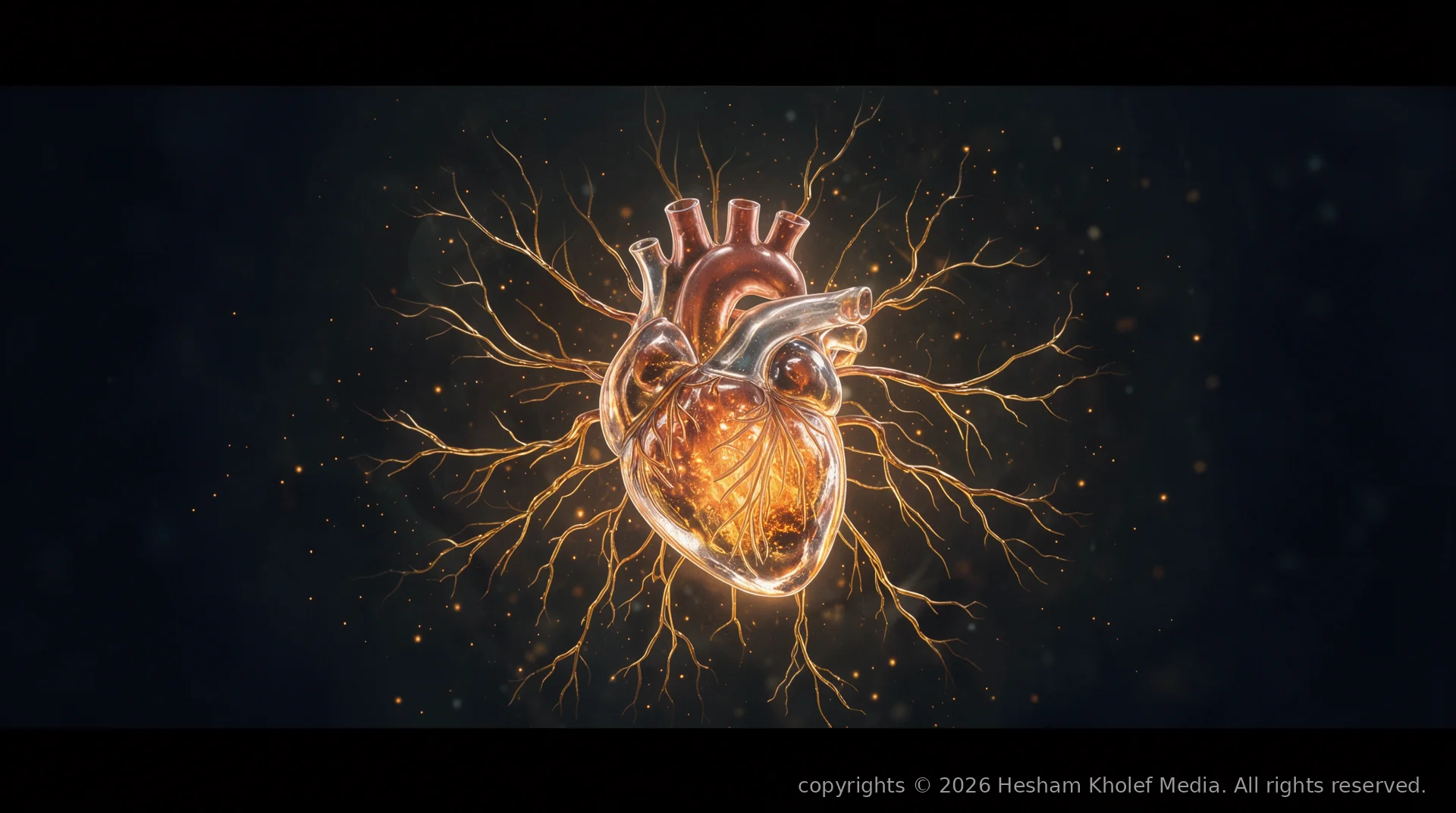
There is a particular silence that settles in a room after someone says, "You need to grow a heart." It is not the silence of accusation. It is the silence of recognition — the moment a mirror is held up, and the reflection shows something hollow where a chest should be.
We treat the heart as a noun, a static organ pumping rhythmically beneath the ribs. But the phrase grow a heart insists on the verb. It implies cultivation. Seasons. Soil. The slow, unbidden labor of turning scar tissue into something that can beat in time with another's sorrow.
The Etymology of Feeling
The Old English heorte meant not only the physical organ but also "mind, spirit, courage, desire." The Proto-Germanic root *hertō reaches back toward *ḱerd- — "heart" — which also gave us courage (from Old French corage, "heart, innermost feelings"). To have heart was to have the seat of the self. To lose heart was to lose the self entirely.
Modern medicine maps the heart's circuitry: the sinoatrial node, the Purkinje fibers, the electrical whispers that coordinate contraction. But the older language knew something cardiology is only now remembering — that the heart sends more signals to the brain than the brain sends to the heart. The heart is not a servant. It is a collaborator.
"True craft is not merely the assembly of ingredients, but the patient discipline of listening to what the work requires."
— Hesham Kholef
To grow a heart, then, is not to acquire a new organ. It is to rewire the conversation between chest and skull. It is to stop overriding the signals that say this matters, this hurts, this is yours to carry.
The First Fracture

No heart grows without breaking. The biology is clear: cardiac muscle hypertrophies under pressure. The metaphor holds — emotional capacity expands only when stretched past its current limit.
The first fracture rarely announces itself. It arrives as a quiet morning when you watch a stranger weep on a train and feel the phantom ache in your own ribs. It arrives as the night you forgive someone who never apologized, because the weight of resentment has become heavier than the injury itself. It arrives as the afternoon you choose to stay — in a conversation, in a relationship, in a room full of grief — when every instinct screams run.
These are not grand gestures. They are the microscopic tears in muscle fiber that, healed over, become stronger tissue.
The Architecture of Empathy
Neuroscience calls it mirror neuron activation. The poet calls it feeling with. Both describe the same phenomenon: the dissolution of the boundary between self and other.
But empathy is not a switch. It is a structure built beam by beam:
- Attention — the deliberate turning toward another's reality
- Imagination — the ability to simulate a life you have not lived
- Vulnerability — the willingness to be changed by what you witness
- Action — the translation of feeling into consequence
Miss one beam, and the structure lists. Attention without vulnerability becomes surveillance. Imagination without action becomes fantasy. Vulnerability without attention becomes self-indulgence.
The heart that grows does not become softer. It becomes more tensile — capable of holding greater tension without snapping. Tenderness is not fragility. It is strength that has learned where to yield.
The Word as Seed

Grow a heart. Four syllables. A command, a plea, a prophecy.
Words are strange seeds. They require no soil, only a mind willing to receive them. Once planted, they root in the subconscious and flower in behavior. A single phrase — spoken by a teacher, a lover, a stranger, or your own voice in the dark — can alter the trajectory of a life.
But the word grow carries its own truth: you cannot force the harvest. You can only tend. Water. Wait. Protect the tender shoot from the frost of cynicism. Trust that the season of flowering arrives on its own schedule.
The Long Answer
How far will a word like this be true?
As far as you let it. As far as you live it. As far as the next fracture, the next healing, the next morning you wake and choose — against every reasonable argument — to remain open.
The heart is not a destination. It is a practice. A daily returning to the work of feeling. And the word? The word is merely the bell that calls you to the practice.
Grow a heart.
Not because you lack one. But because the one you have is still becoming. And the becoming — slow, painful, invisible, inevitable — is the only life worth living.
Comments (0)