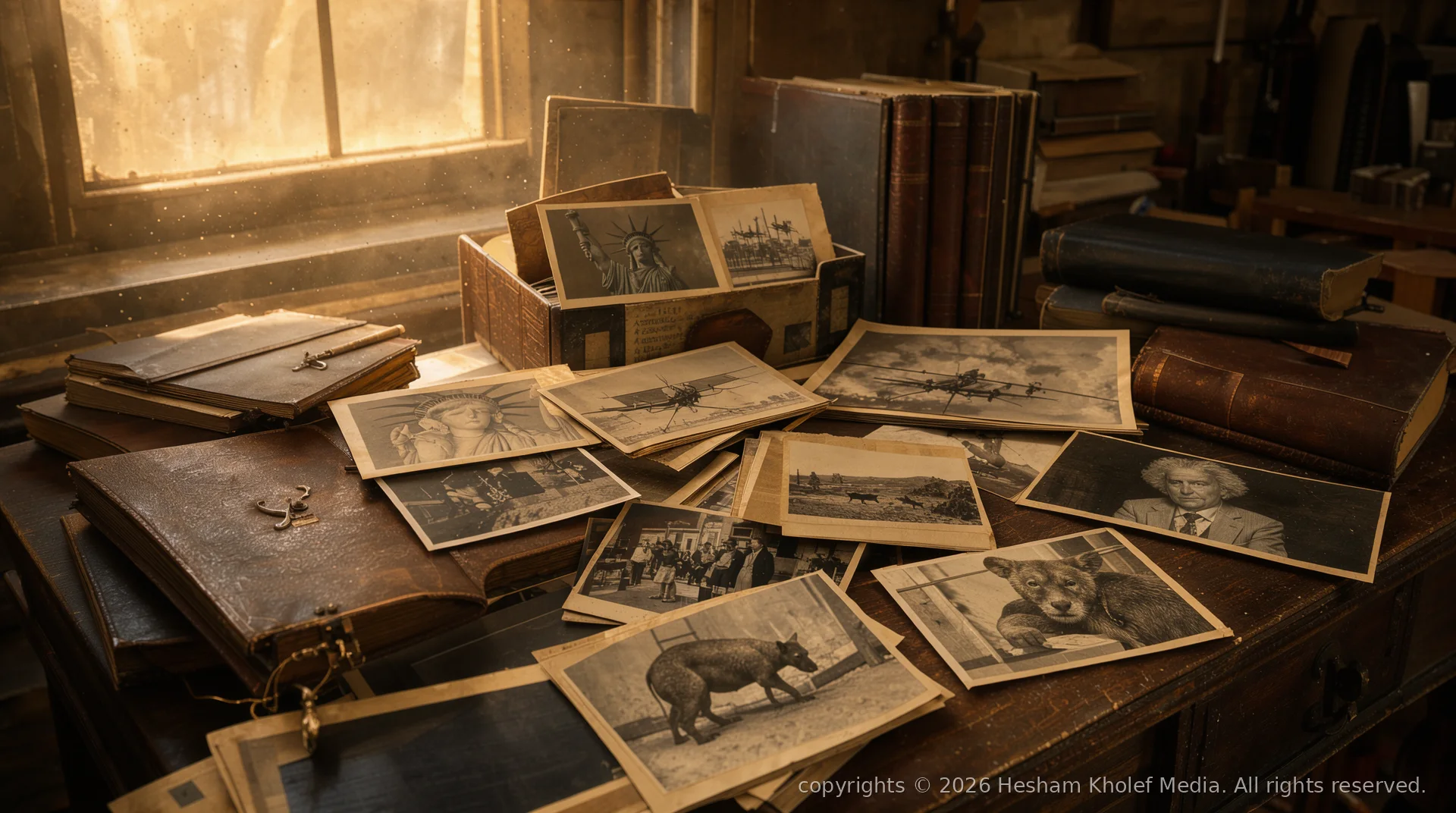
The Camera as Time Machine: Why Photographs Outlive Narratives

We inherit history through the filter of victors, editors, and decades of retelling. A photograph, however, is an unmediated witness. It does not argue; it simply exists. When we look at the only known image of the iceberg that sank the Titanic, or the candid shot of a young Bill Gates mugshot after a traffic violation, the mythos dissolves. We are left with the raw, unvarnished instant—a man, a mountain of ice, a moment that changed everything.
Monuments Unveiled: The Anatomy of Icons
We know the silhouettes: the Statue of Liberty, the Eiffel Tower, Mount Rushmore. But the photographs of their making tell a different story—one of scaffolding, sweat, and improbable engineering. A 1884 image shows Liberty’s face, massive and detached, staring blankly from a Parisian workshop courtyard before her copper skin was riveted together. Another captures the Eiffel Tower at half-height, a lattice spine rising against a skeptical Paris sky. These frames remind us that every eternal symbol began as a chaotic construction site.
Extinction in Real Time: The Last of Their Kind
Few photographs carry the weight of finality like the 1933 footage of Benjamin, the last thylacine, pacing his concrete enclosure in Hobart Zoo. His stripes ripple as he yawns—an ordinary gesture frozen into an elegy for an entire species. Similarly, the sole photograph of the passenger pigeon Martha, who died in 1914 at the Cincinnati Zoo, transforms an abstract statistic—billions reduced to one—into a face we can mourn. These images are not merely records; they are indictments.
History’s Hidden Figures: The People Behind the Events
We celebrate the astronauts, but rarely see the "Human Computers"—Katherine Johnson, Dorothy Vaughan, Mary Jackson—hunched over Friden calculators at Langley, their brilliance propelling trajectories no machine could yet manage. A 1962 photograph of the NASA control room reveals a sea of white shirts and dark ties, with a single Black woman at a console: the future, quietly arriving. These frames correct the record, restoring visibility to those whom the official narrative cropped out.
War and Peace: The Quiet Moments Between the Headlines

The iconic kiss in Times Square on V-J Day dominates memory. Less seen: the photograph of a Soviet soldier playing an abandoned piano in the ruins of the Reichstag, 1945. Or the 1914 Christmas Truce image—German and British soldiers exchanging cigarettes in no-man’s-land, the war paused for a single night by mutual exhaustion and shared humanity. These photographs do not glorify conflict; they illuminate the fragile, persistent impulse toward connection even in the darkest hours.
"A photograph is a secret about a secret. The more it tells you, the less you know."
— Hesham Kholef
Everyday Life, Elevated: The Poetry of the Mundane
A 1900 street scene in New York: horses, trolleys, a boy selling newspapers, a woman adjusting her hat—nothing "historic" by conventional measure. Yet this frame holds the DNA of modern urbanism. The same year, a photographer in rural Japan captures a family gathered around a kotatsu, their faces lit by charcoal glow. Side by side, these images reveal a world simultaneously diverging and converging. The mundane, photographed, becomes anthropology.
The most powerful historical photographs are rarely the staged portraits of leaders. They are the accidental frames—the candid, the overlooked, the "failed" exposures—that survive to contradict the official story and restore the complexity of lived experience.
Science Caught in the Act: Breakthroughs Before They Were Famous
Einstein’s tongue-out portrait is ubiquitous. Far rarer: the 1919 eclipse expedition photograph that proved general relativity, showing starlight bending around the sun’s obscured disk. Or the blurry 1953 X-ray diffraction image—Photo 51—Rosalind Franklin’s decisive evidence for the double helix, taken without her knowledge that it would be shared. These frames capture the precise instant the universe revealed a secret, before the Nobel ceremonies and textbook revisions.
Transportation’s Turning Points: From Novelty to Necessity
The Wright brothers’ first flight lasted twelve seconds and covered 120 feet. The photograph—Orville airborne, Wilbur running alongside—is grainy, almost indistinguishable from a hop. Yet it divides history into "before flight" and "after." Decades later, a 1969 image of the Boeing 747 prototype dwarfing a farmhouse in Everett, Washington, signals the democratization of the sky. Each transport photograph marks a contraction of the planet.
Disasters Frozen: Lessons Etched in Light

The Hindenburg burning, the Challenger contrail twisting unnaturally, the 1906 San Francisco earthquake’s shattered facades—these are not morbid curiosities. They are engineering autopsies. The photograph of the Tacoma Narrows Bridge oscillating in a 40-mph wind, moments before collapse, taught a generation of engineers about aeroelastic flutter. From tragedy, safer structures.
Childhood Across Centuries: The Universal and the Particular
A 1910 portrait of a newsie in St. Louis, barefoot, cigarette dangling, eyes old beyond his years. A 1947 image of Japanese children studying by candlelight in a bombed-out classroom. A 1980s snapshot of a girl in East Berlin pressing her hand against the Wall. Childhood adapts; its resilience does not. These photographs compress decades into a single truth: children endure what adults create.
The Digital Dawn: The First Pixels of Our Future
The first digital photograph (1957)—a 176×176 pixel scan of Russell Kirsch’s infant son, Walden. The first camera phone photo (1997)—Philippe Kahn’s newborn daughter, Sophie, transmitted from a jury-rigged Motorola. The first image uploaded to the web (1992)—a parody band of CERN secretaries, Les Horribles Cernettes. Each frame is a humble threshold. We now upload billions daily; the miracle has become mundane.
Why These Frames Matter Now
In an era of synthetic media, deepfakes, and algorithmic curation, the analog photograph stands as a tether. Its grain is physics, not probability. Its existence proves a photon traveled from subject to emulsion at a specific instant. The forty photographs surveyed here—and thousands more in archives worldwide—are not nostalgia. They are evidence. They remind us that history is not a settled story but a contested terrain, and every recovered image is a stake driven into the ground of truth.
The next time you encounter a historical photograph, linger. Ask what lies outside the frame. Ask who held the camera and why. Ask what the subject knew—or didn’t—about the future rushing toward them. In that pause, history stops being something you read and becomes something you witness.
Comments (0)