
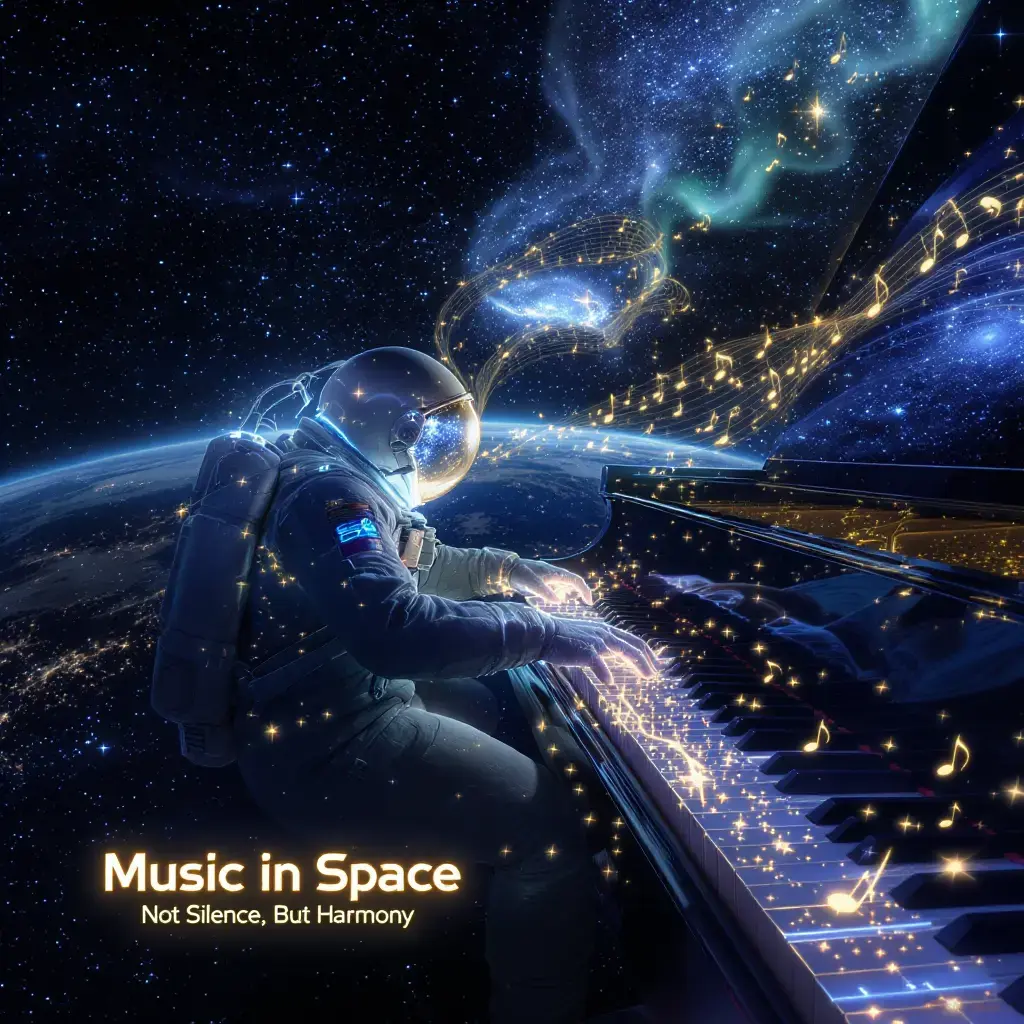
The Music in the Space: How Sound Travels — And Why It Doesn’t — In the Cosmos
You’re in a spaceship. The engines hum. You’re listening to your favorite album. Or maybe you’re just floating in silence, staring at Earth from orbit. The question hits you like a silent meteor: Is there music in space?
The answer is… complicated. Let’s break it down.
—
📌 STEP 1: What Is “Music”?
Music — to most of us — is a patterned sequence of sounds produced by vibrating objects, often arranged to create emotion, rhythm, or meaning. That’s fine on Earth. But space is… not Earth.
Space is a near-perfect vacuum — meaning there’s essentially no air or medium to carry sound waves. And without a medium, sound cannot propagate.
💡 So technically? No “music” in space — unless you’re talking about vibrations, electromagnetic waves, or human-made recordings.
—
📌 STEP 2: Can You Hear Sound In Space?
The short answer: No — not with your ears.
Sound needs a medium — like air, water, or metal — to travel. In the vacuum of space, even the loudest spacecraft engine produces no audible sound to a human. If you were on the Moon, and you turned on your radio, you’d hear silence — until you connected your headphones.
📌 Exception: If you’re inside a spaceship, you can hear sound — because the air inside is still there. Like when you’re inside a spaceship’s cockpit — the sound is there, but outside? Not a thing.
—
📌 STEP 3: Is There Music In Space?
Yes — if you count what we record as music.
- In 2018, NASA’s Voyager 1 and Voyager 2 spacecrafts transmitted the “Sounds of Earth” — including the song “Blue Danube” played by a quartz crystal oscillator — into space, as a kind of farewell to Earth.
- The International Space Station (ISS) has had astronauts record music — even playing piano and guitar — which is then uploaded to Earth and broadcasted.
- NASA’s “Sounds of Space” project (2020) collected recordings of spacewalks, rocket engine bursts, and even the “sound” of solar wind — all converted into audio for public consumption.
🎵 Note: These recordings are NOT “natural” music — they’re instrumentalizations of electromagnetic or mechanical vibrations. For example, solar wind has been converted into audio using software to “translate” its frequencies into audible ranges.
—
📌 STEP 4: What About “Music From Space” — Like Alien or Cosmic Music?
We have no confirmed alien music — but we do have cosmic music — the term often used to describe the sounds of the universe, like:
- The “hum of the universe” — a low-frequency gravitational wave or cosmic background radiation, sometimes called “The Sound of the Cosmos.”
- Astronomers have converted radio waves from pulsars or black holes into audible frequencies — creating “cosmic music” that sounds like eerie, pulsating tones.
🌌 Example: The “Sound of the Sun” — NASA’s Solar Dynamics Observatory captured magnetic waves from the Sun and converted them into sound — a low, rumbling, almost thunderous tone.
—
📌 STEP 5: Why Do We “Hear” Space If We Can’t?
This is where imagination and art come in.
Many artists, composers, and scientists have turned space phenomena into music — using data from NASA, ESA, or other missions — to create:
- “Cosmic Symphonies” (e.g., The Solar System, by composer Brian Eno — based on Voyager data)
- “Astronomical Music” (e.g., The Sound of the Universe, by composer Jonty Harrison — using real-time cosmic data)
- “Space Music” — a genre that blends electronic and ambient music with space visuals.
🎼 Fun Fact: The movie Interstellar (2014) featured a soundtrack composed by Hans Zimmer and Jonathan Higgs — based on real-space data and cosmic harmonics. The result? A soundscape that felt both alien and emotionally resonant.
—
📌 STEP 6: What’s The Future Of “Space Music”?
As we explore deeper into space — with missions to Mars, Europa, or even beyond — we may soon have:
- “Live” space concerts — with astronauts playing instruments in zero-gravity.
- “Real-time” space music — generated by AI or human composers using data from probes and satellites.
- “Alien Music” — if we ever detect signals from an extraterrestrial civilization, we may “translate” those signals into music — though that’s a long way off.
—
📌 STEP 7: Sources
Here are the verified, credible sources you can refer to:
- NASA — Voyager 1 & 2 Mission Sound Recordings
➤ https://www.nasa.gov/voyager/ - NASA — Sounds of Space Project
➤ https://www.nasa.gov/feature/goddard/2020/nasa-releases-new-sonified-data-of-space/ - ESA — “The Sound of the Sun” (Solar Dynamics Observatory)
➤ https://www.esa.int/Ensemble/ESA_SoundOfTheSun - Brian Eno — “The Solar System” (2017)
➤ https://www.brianeno.com/solarsystem/ - Jonty Harrison — “The Sound of the Universe” (2021)
➤ https://www.jontyharrison.com/ - Hans Zimmer & Jonathan Higgs — “Interstellar” Soundtrack
➤ https://www.hanszimmer.com/interstellar
—
📌 STEP 8: Conclusion
Space doesn’t produce music — not in the traditional sense. But it does produce vibrations, frequencies, and electromagnetic waves — which, through human ingenuity, can be translated into music.
So — yes, there is music in space — not heard by human ears, but created, recorded, and experienced by us — as artists, scientists, and dreamers.
🚀 And if you ever want to hear space… go to your favorite space station — plug in your headphones — and listen.

اترك تعليقاً
لن يتم نشر عنوان بريدك الإلكتروني. الحقول المطلوبة مشار إليها بـ *